Three Oaks Township in Berrien County, Michigan — The American Midwest (Great Lakes)
Three Oaks Michigan
Founded 1850 Est 1867
Photographed by Daniel Barriball, July 23, 2025
1. Three Oaks, Michigan Marker
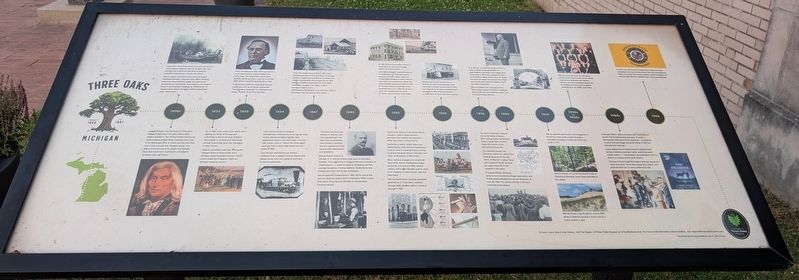
Ojibwe, Odawa, and Miami Indians have all lived in Southwest Michigan, but by the early 1800's, Michiana was primarily occupied by people who referred to themselves as "Neshnabek" (true people), and who were known in the Algonquin language as "Bodéwadmi," or "keepers of the flame." European settlers spelled their name "Potowatomi."
Leopold Pokagon was the leader of Potowatomi villages in this area in the early 1800's, when settlers flooded in. The US Government was forcing native peoples off their lands, resettling them west of the Mississippi River in forced marches that often took a severe human toll. Pokagon, though, was able to avoid removal of his people. The Pokagon Band had converted to Catholicism and adopted European-style agriculture.
this page online
Federal authorites tried later to force the Pokagon Band off those lands, but a Michigan judge thwarted removal, ruling it would violate the Pokagons' rights as Michigan property owners.
Chamberlain loaded the wood onto railroad freight cars at a set of tracks nicknamed "Chamberlain's Sidetrack" or "Chamberlain's Siding," located not far from this sign.
Chamberlain built the first permanent residence here, a double home he shared with Joseph Ames, who ran a general store and served as postmaster.
Photographed by Daniel Barriball, July 23, 2025
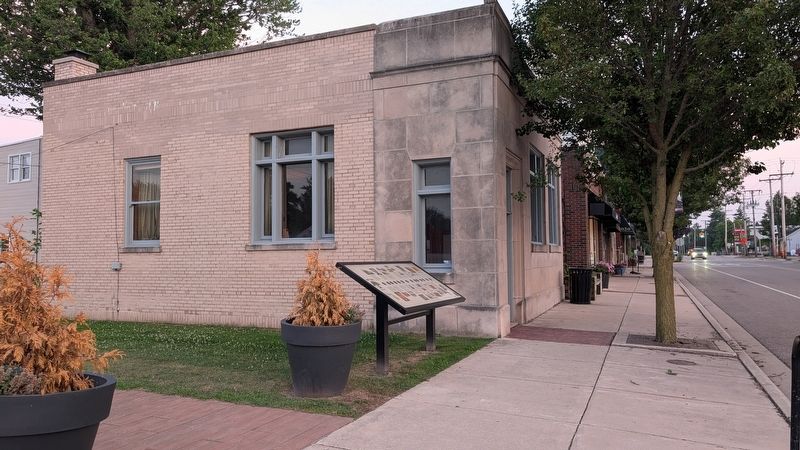
2. Three Oaks Michigan Marker in context
Buying feather dusters in Chicago, E.K. Warren noticed large piles of discarded feathers. That, legend has it, triggered Warren's invention of "Featherbone"—a material made by shredding and then weaving the spines of turkey feathers. Featherbone was cheaper and more sturdy than whalebone.
Warren patented Featherbone in 1883. By the end of that year, he opened a factory with 9 employees. Within a year, there were 75 workers on the Warren Featherbone Company payroll.
After initial struggles, business boomed. The population of Three Oaks nearly doubled during the 1880's, with new Featherbone buildings transforming the look of the now-prosperous village. the office building being constructed in 1905 in the photo above now serves as the township library. E.K. Warren became quite rich, boasting that he made 50-cents "every time the clock ticked."
Featherbone became a worldwide fashion sensation, used to shape women's garments from head to toe, and also to stiffen the collars of men's shirts.
Featherbone salons, where tailors and seamstresses could see how Featherbone could be used to sculpt garments, sprang up across the globe (below is the New York salon, on Broadway at 20th Street).
When fashions changed and corsets fell out of style, Warren Featherbone began producing rick-rack and other sewing notions, and in later decades used an early form of plastic to make shower caps and baby pants.
Warren Featherbone factories employed generations of Three Oaks residents through eight decades, before moving to Georgia in 1956.
But his greatest civic triumph was the "Three Oaks Against the World" campaign that brought the town national acclaim and the famed Dewey Cannon.
The captured cannon was offered as a prize in a nationwide fundraising drive for the war effort. At Warren's urging, Three Oaks raised $1,132.80, the best per capita effort ($1.41 per resident) in the nation.
President William McKinley came to town to extol the village's patriotism, and 10,000 people attended the cannon dedication on June 28, 1900. The cannon still sits in the park northeast of this plaque.
Photo captions: Warren Woods, 311 acres of primeval forest in Chikaming Township, three miles northwest of the village.
Warren Dunes, near Bridgman, nearly 2000 acres of lakefront duneland, draws almost a million visitors a year.
Crews applied lots of artificial snow to village streets during a relatively snowless winter, and filmed some scenes indoors—moviemakers recreated parts of Three Oaks in a warehouse just south of town.
The charm that brought filmmakers here has only grown richer since then. Three Oaks enjoys arts, culture, and entertainment rare in communities of its size.
To learn more about area history, visit The Region of Three Oaks Museum at 5 Featherbone Ave. For hours and information about exhibits, visit regionofthreeoaksmuseum.com
This plaque generously donated by Lynn & Allen Turner
Erected 2020 by The Region of Three Oaks Museum, Lynn and Allen Turner.
Topics. This historical marker is listed in these topic lists: Charity & Public Work • Indigenous Peoples and Communities • Industry & Commerce • Settlements & Settlers.
Location. 41° 48.033′ N, 86° 36.619′ W. Marker is in Three Oaks, Michigan, in Berrien County. It is in Three Oaks Township. It is on South Elm Street, on the right when traveling north. Touch for map. Marker is at or near this postal address: 7 S Elm St, Three Oaks MI 49128, United States of America. Touch for directions.

Regionally, this marker is in Southwest Michigan and specifically in one of the Lake Michigan Shore counties. It is also in the American Midwest. Globally, it is in North America, on the Great Lakes, in the Western Hemisphere, in the Western World, and in the Anglosphere. Historically, it finds itself in what was once the Viceroyalty of New France and also the Northwest Territory.
Other nearby markers. At least 8 other markers are within 5 miles of this marker, measured as the crow flies: Vickers Theatre (within shouting distance of this marker); Apple Cider Century 50th Anniversary (about 400 feet away, measured in a direct line); 22 North Elm Street (about 500 feet away); The Dewey Cannon (about 600 feet away); 1854 Site First School (about 600 feet away); Warren Woods State Park (approx. 2½ miles away); Lakeside Inn (approx. 4.6 miles away); Gordon Beach Inn (approx. 4.9 miles away). Touch for a list and map of all markers in Three Oaks.
Also see . . .
1. The Region of Three Oaks Museum. Official site (Submitted on July 28, 2025, by Daniel Barriball of Chesterton, Indiana.)
2. Timeline of a Village Unveiled in Downtown Three Oaks. Harbor Country News News article about this historical marker's dedication
"We're delighted to have cooperated in bringing some of the history out of the indoors … and onto a street where people passing by can learn a little more about history."(Submitted on July 28, 2025, by Daniel Barriball of Chesterton, Indiana.)
Credits. This page was last revised on August 11, 2025. It was originally submitted on July 27, 2025, by Daniel Barriball of Chesterton, Indiana. This page has been viewed 338 times since then and 151 times this year. Photos: 1. submitted on July 27, 2025, by Daniel Barriball of Chesterton, Indiana. 2. submitted on July 28, 2025, by Daniel Barriball of Chesterton, Indiana. • J. Makali Bruton was the editor who published this page.
