Southwest Quadrant in Alexandria, Virginia — The American South (Mid-Atlantic)
Sanctuary
A place of refuge, safety, protection
| — | City of Alexandria, est. 1749 | — |
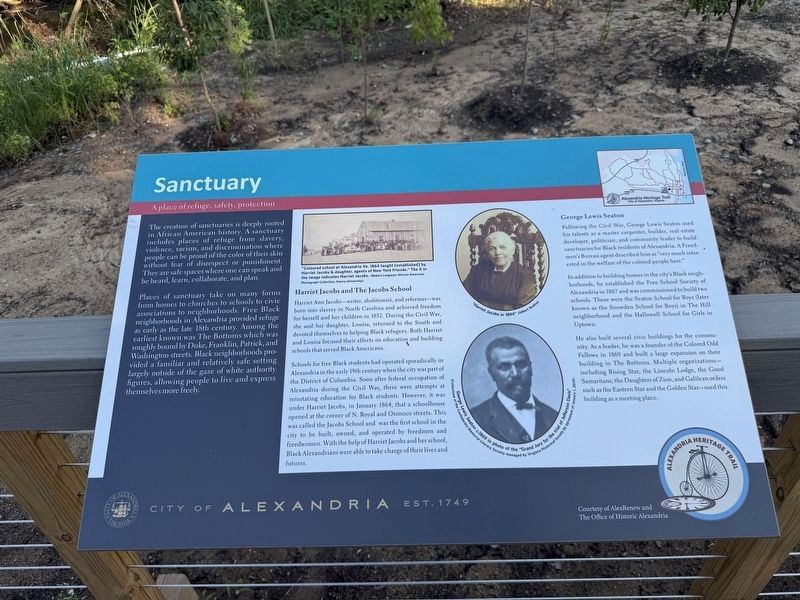
The creation of sanctuaries is deeply rooted in African American history. A sanctuary includes places of refuge from slavery, violence, racism, and discrimination where people can be proud of the color of their skin without fear of disrespect or punishment. They are safe spaces where one can speak and be heard, learn, collaborate, and plan.
Places of sanctuary take on many forms from homes to churches to schools to civic associations to neighborhoods. Free Black neighborhoods in Alexandria provided refuge as early as the late 18th century. Among the earliest earliest known was The Bottoms which was roughly bound by Duke, Franklin, Patrick, and Washington streets. Black neighborhoods provided a familiar and relatively safe setting largely outside of the gaze of white authority figures, allowing people to live and express themselves more freely.
Harriet Jacobs and The Jacobs School
Harriet Ann Jacobs—writer, abolitionist, and reformer—was born into slavery in North Carolina and achieved freedom for herself and her children in 1852. During the Civil War, she and her daughter, Louisa, returned to the South and devoted
this page online
Schools for free Black students had operated sporadically in Alexandria in the early 19th century when the city was part of the District of Columbia. Soon after federal occupation of Alexandria during the Civil War, there were attempts at reinstating education for Black students. However, it was under Harriet Jacobs, in January 1864, that a schoolhouse opened at the corner of N. Royal and Oronoco streets. This was called the Jacobs School and was the first school in the city to be built, owned, and operated by freedmen and freedwomen With the help of Harriet Jacobs and her school, Black Alexandrians were able to take charge of their lives and futures.
George Lewis Seaton
Following the Civil War, George Lewis Seaton used his talents as a master carpenter, builder, real estate developer, politician, and community leader to build sanctuaries for Black residents of Alexandria. A Freedmen's Bureau agent described him as "very much interested in the welfare of the colored people here."
In
He also built several civic buildings for the community. As a leader, he was founder of the Colored Odd Fellows in 1869 and built a large expansion on their building in The Bottoms. Multiple organizations—including Rising Star, the Lincoln Lodge, the Good Samaritans, the Daughters of Zion, and Galilean orders such as the Eastern Star and the Golden Star—used this building as a meeting place.
[Captions:]
"Coloured school at Alexandria Va. 1864 taught [established] by Harriet Jacobs & daughter, agents of New York Friends." The X in the image indicates Harriet Jacobs. (Robert Langmuir African American Photograph Collection, Emery University)
"Harriet Jacobs in 1894" (Gilbert Studios)
George Lewis Seaton c. 1869 in photo of the "Grand Jury for the trial of Jefferson Davis" (Collection of the Confederate Memorial Literary Society managed by Virginia Historical Society by agreement of January 1, 2014)
Erected 2025 by City of Alexandria, Virginia.
Topics and series. This historical marker is listed in these topic lists: African Americans • Education • Industry & Commerce • War, US Civil. In addition, it is included in the Virginia, The City of Alexandria series list. A significant historical month for this entry is January 1864.
Location. 38° 48.007′ N, 77° 3.602′ W. Marker is in Alexandria, Virginia. It is in the Southwest Quadrant. It can be reached from the intersection of Holland Lane and Eisenhower Avenue, on the right when traveling north. Touch for map. Marker is at or near this postal address: 700 Holland Ln, Alexandria VA 22314, United States of America. Touch for directions.

Regionally, this marker is in the Washington Metropolitan Area and in Northern Virginia. It is also in the American South, specifically in the Upper South, in the Mid-Atlantic, and on the Eastern Seaboard. Globally, it is in the North Atlantic Region, North America, the Western Hemisphere, the Western World, and the Anglosphere. Historically, it finds itself in what was once the territory of the Mississippian Culture, one of the original Thirteen Colonies, one of the Confederate States of America, and the Antebellum South.
Other nearby markers. At least 8 other markers are within walking distance of this marker: African American Heritage Park (within shouting distance of this marker); Freedom (about 400 feet away, measured in a direct line); Civil Rights (about 500 feet away); Alexandria National Cemetery (about 800 feet away); "Pursuers of Booth the Assassin" (about 800 feet away); In Honor of Those Who Gave the Ultimate Sacrifice (approx. 0.2 miles away); Old Presbyterian Meeting House (approx. 0.2 miles away); A National Cemetery System (approx. 0.2 miles away). Touch for a list and map of all markers in Alexandria.
Credits. This page was last revised on July 28, 2025. It was originally submitted on July 28, 2025, by Devry Becker Jones of Washington, District of Columbia. This page has been viewed 81 times since then and 16 times this year. Photos: 1, 2. submitted on July 28, 2025, by Devry Becker Jones of Washington, District of Columbia.
