Lancaster in Lancashire, England, United Kingdom — Northwestern Europe (the British Isles)
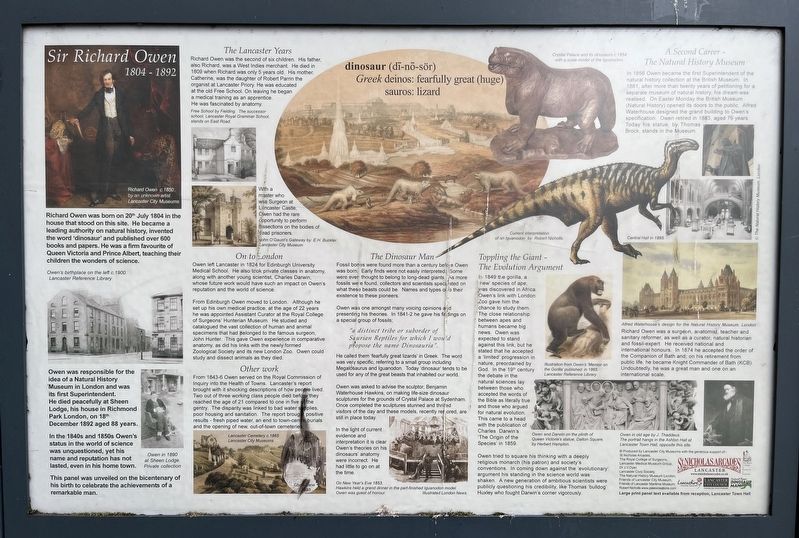
Sir Richard Owen 1804-1892
Photographed by Ray Gurganus, April 12, 2025
1. Sir Richard Owen 1804-1892 Marker
Owen was responsible for the idea of a Natural History Museum in London and was its first Superintendent. He died peacefully at Sheen Lodge, his house in Richmond Park London, on 18 December 1892 aged 88 years.
In the 1840s and 1850s Owen's status in the world of science was unquestioned, yet his name and reputation has not lasted, even in his home town.
This panel was unveiled on the bicentenary of his birth to celebrate the achievements of a remarkable man.
The Lancaster Years
Sir Richard Owen Richard Owen was the second of six children. His father, also Richard, was a West Indies merchant. He died in 1809 when Richard was only 5 years old. His mother Catherine was the daughter of Robert Parrin the organist at Lancaster Priory. He was educated at the Free School. On leaving he began a medical training as an
this page online
On to London
Owen left Lancaster in 1824 for Edinburgh University Medical School. He also took private classes in anatomy along with another young scientist, Charles Darwin, whose future work would have such an impact on Owen's reputation and the world of science.
From Edinburgh Owen moved to London. Although he set up his own medical practice at the age of 22 years he was appointed Assistant Curator at the Royal College of Surgeons' Hunterian Museum. He studied and catalogued the vast collection of human and animal specimens that had belonged to the famous surgeon John Hunter. This gave Owen experience in comparative anatomy, as did his links with the newly formed Zoological Society and its new London Zoo. Owen could study and dissect animals as they died.
Other work
From 1843-6 Owen served on the Royal Commission of Inquiry into the Health of Towns. Lancaster's report brought with shocking descriptions of how people lived. Two out of three working class people died before they reached the age of 21 compared to one in five of the gentry. The disparity was linked to bad water supplies,
From The Marker
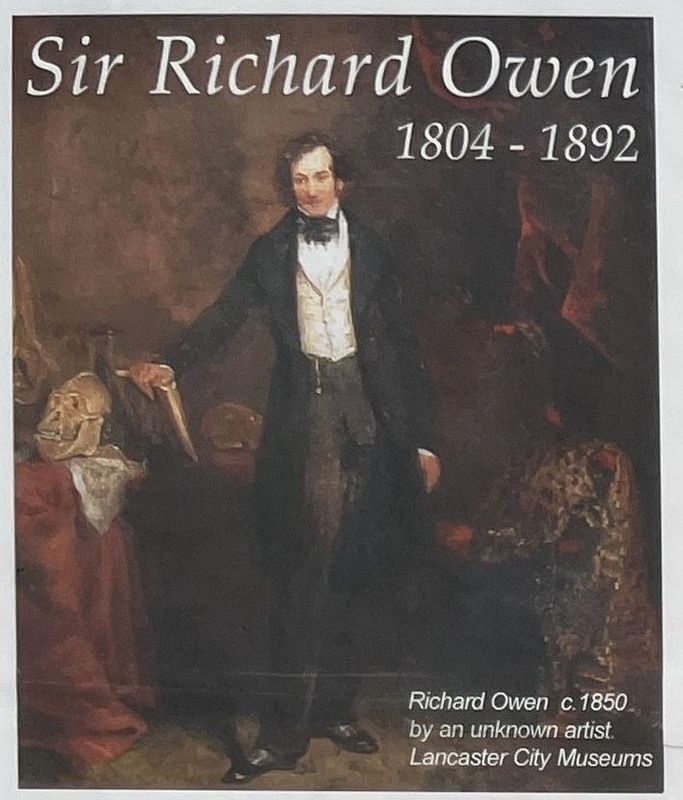
2. Sir Richard Owen by an unknown artist, Lancaster City Museums
The Dinosaur Man
Fossil bones were found more than a century before Owen was born. Early finds were not easily interpreted. Some were even thought to belong to long-dead giants. As more fossils were found, collectors and scientists speculated on what these beasts could be. Names and types owe their existence to these pioneers.
Owen was one amongst many voicing opinions and presenting his theories. In 1845-2 he gave his findings on a special group of fossils;
"a distinct tribe or suborder of Saurian Reptiles for which I would propose the name Dinosauria."
He called them 'fearfully great lizards' in Greek. The word was very specific, referring to a small group including Megalosaurus and Iguanodon. Today 'dinosaur' tends to be used for any of the great beasts that inhabited our world.
Owen was to asked to advise the sculptor, Benjamin Waterhouse Hawkins, on making life-size dinosaur sculptures for the grounds of Crystal Palace at Sydenham. Once completed the
From The Marker
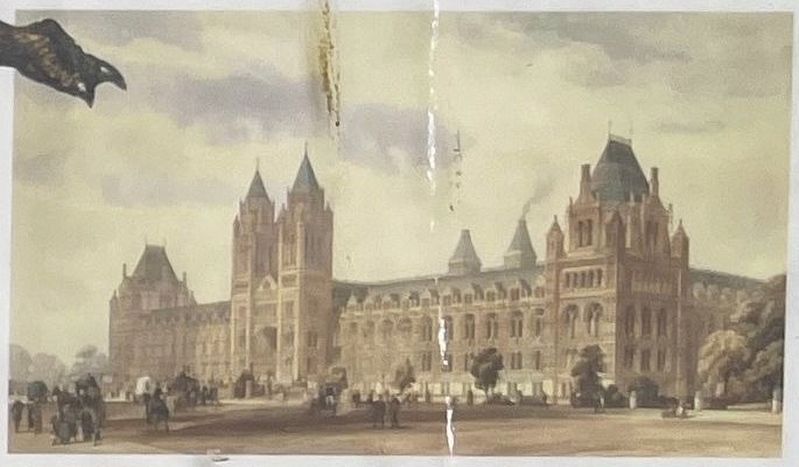
3. Alfred Waterhouse's design for the Natural History Museum, London
In the light of current evidence and interpretation it is clear Owen's theories on his dinosaurs' anatomy were incorrect. He had little to go on at the time.
Toppling the Giant - The Evolution Argument
In 1849, the gorilla, a 'new' species of ape, was discovered in Africa. Owen's link with London Zoo gave him the chance to study them. The close relationship between apes and humans became big news. Owen was expected to stand against this link, but he stated that he accepted a limited progression nature, preordained by God. In the 19th century the debate in the natural sciences lay between those who accepted the words of the Bible as literally true and those who argued for natural evolution. This came to a head with the publication of Charles Darwin's 'The Origin of the Species' in 1859.
Owen tried to square his thinking with a deeply religious monarch (his patron) and society's conventions. In coming down against the 'evolutionary' argument his standing in the science world was shaken. A new generation of ambitious scientists were publicly questioning his credibility, like Thomas 'bulldog' Huxley who fought Darwin's corner vigorously.
A Second Career -The Natural History Museum
In 1856 Owen became the first Superintendent of the natural history collection at the British Museum. In 1881, after more than twenty years of petitioning for a separate museum of natural history, his dream was realised. On Easter Monday the British Museum (Natural History) opened its doors to the public. Alfred Waterhouse designed the grand building to Owen's specification. Owen retired in 1883, aged 79 years. Today his statue, by Thomas Brock, stands in the Museum.
Richard Owen was a surgeon, anatomist, teacher and sanitary reformer, as well as a curator, natural historian and fossil-expert. He received national and international honours. In 1874 he accepted the order of the Companion of Bath and, on his retirement from public life, he became Knight Commander of Bath (KCB). Undoubtedly, he was a great man and one on an international scale.
Topics. This historical marker is listed in these topic lists: Paleontology • Science & Medicine. A significant historical date for this entry is July 20, 1804.
Location. 54° 2.842′ N, 2° 47.902′ W. Marker is in Lancaster, England, in Lancashire. It is at the intersection of Brock Street and Thurnham Street, on the right when traveling east on Brock Street. Touch for map. Marker is at or near this postal address: 23b Brock Street, Lancaster, England LA1 1UU, United Kingdom. Touch for directions.

Regionally, this marker is in North West England. Globally, it is on the Atlantic Ocean, in the North Atlantic Region, in Europe, in Atlantic Europe, on one of the British Isles, in the Western World, and in the Anglosphere. Historically, it finds itself in what was once the Roman Empire.
Other nearby markers. At least 8 other markers are within walking distance of this marker: Sir William Turner (about 180 meters away, measured in a direct line); Hidden Horseshoe (about 180 meters away); Gillows (1730-1897) (approx. 0.3 kilometers away); Charles Dickens (approx. 0.4 kilometers away); Window to your soul (1750-1982) (approx. 0.4 kilometers away); Fruits of the mind (1887 - ) (approx. 0.4 kilometers away); Lancaster Castle (approx. half a kilometer away); Elizabeth Fry (approx. half a kilometer away). Touch for a list and map of all markers in Lancaster.
Credits. This page was last revised on August 13, 2025. It was originally submitted on July 29, 2025, by Ray Gurganus of Washington, District of Columbia. This page has been viewed 210 times since then and 58 times this year. Photos: 1, 2, 3. submitted on July 29, 2025, by Ray Gurganus of Washington, District of Columbia. • Andrew Ruppenstein was the editor who published this page.
