Near Fairburn in Custer County, South Dakota — The American Midwest (Upper Plains)
Bison are Making a Comeback

Photographed by Daniel Barriball, June 12, 2025
1. Bison are Making a Comeback Marker
Once revered as the symbol of the American West, the bison have come back from the brink of extinction. Currently, there are over 350,000 bison in public and private herds across North America.
Organizations like the National Buffalo Foundation are key in the continued preservation of the species. They inform the public about the importance of bison through partnerships between producers and consumers. This relationship not only celebrates the heritage of the species, but it creates a strong future for the bison industry.
Bison is North America's Original Red Meat
Bison meat is perhaps the most common product marketed by the bison industry. Compared to other meat sources, bison is low in fat and contains more protein and nutrients. With fewer calories, it is a healthy alternative. Furthermore, bison meat is dense, which tends to satisfy more while eating less.
Photo captions: The United States consumes around one million pounds of bison meat each month. For many years, diners and upscale restaurants from coast to coast have offered "buffalo" burgers and steaks as main entrées.
Bison and beef have a similar taste, but
this page online
Park Herds Attract Attention and Tourism
Visitors from across the country and around the world flock to western parks in order to witness bison in their natural habitat. Places like Yellowstone National Park (Wyoming), National Bison Range (Montana), Wind Cave National Park (South Dakota), and Custer State Park serve the local visitor industry by providing bison viewing areas. This type of tourism attraction is another part of economic growth.
Photo captions: With a backdrop of natural features and rich cultural history, bison add to the scenery in many parks across the country. Their presence blends into the surroundings and complements the beauty of the landscape.
Some public parks and refuges, like Custer State Park, attract millions of visitors each year to witness bison along scenic byways.
Hollywood Even Protects the Species
Past and present movies have captured bison on screen and provoked the audience to value the species. The films often portray America's frontier in the late 1800s. From Plains Indians
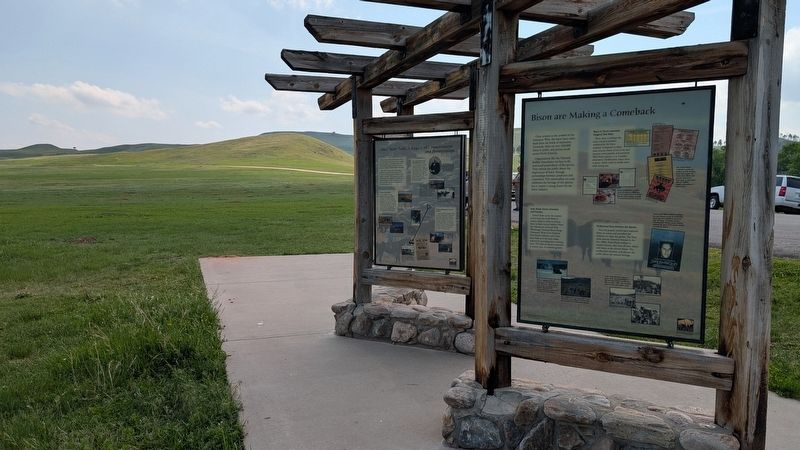
Photographed by Daniel Barriball, June 12, 2025
2. Bison are Making a Comeback Marker in context
This marker is the front right panel.
Photo captions: Dances with Wolves (1990) is perhaps the most famous movie for presenting bison and their kinship to America's past. Winning 7 Academy Awards, including Best Picture, Kevin Costner captured the story of the species during our nation's infancy.
Custer State Park has served as a movie set for several productions. The Last Hunt (1955) and How the West was Won (1961) used the park's bison herd for a few staged scenes.
Erected by Custer State Park.
Topics. This historical marker is listed in these topic lists: Animals • Entertainment • Industry & Commerce • Parks & Recreational Areas. A significant historical year for this entry is 1955.
Location. 43° 38.454′ N, 103° 22.05′ W. Marker is near Fairburn, South Dakota, in Custer County. It is on Csp Road 1, on the left when traveling west. This marker is located along the Wildlife Loop Road within Custer State Park. Touch for map. Marker is at or near this postal address: 13442 Csp Road 1, Custer SD 57730, United States of America. Touch for directions.

Regionally, this marker is in West River and in Greater Rapid City. It is also in the American Black Hills, in the Lewis & Clark Corridor, on the prairies, and on the Northern Plains. Globally, it is in North America, the Western Hemisphere, the Western World, and the Anglosphere. Historically, it finds itself in what was once Rupert’s Land and also the Louisiana Purchase.
Other nearby markers. At least 8 other markers are within 8 miles of this marker, measured as the crow flies: Bison: Symbol of the American West (here, next to this marker); Custer State Park: A Legacy of Conservation and Preservation (here, next to this marker); The Buffalo: More Than an Animal-A Way of Life (here, next to this marker); Market Hunting was a Gruesome Business (here, next to this marker); America's First Environmental Success Story (here, next to this marker); The Buffalo Corrals (approx. 1.2 miles away); Life in a Prairie Dog Town (approx. 7.6 miles away); Early Game Preserve (approx. 7.6 miles away). Touch for a list and map of all markers in Fairburn.
Credits. This page was last revised on July 30, 2025. It was originally submitted on July 29, 2025, by Daniel Barriball of Chesterton, Indiana. This page has been viewed 105 times since then and 31 times this year. Photos: 1, 2. submitted on July 29, 2025, by Daniel Barriball of Chesterton, Indiana. • Andrew Ruppenstein was the editor who published this page.
