Windsor in Essex County, Ontario — Central Canada (North America)
Indigenous Movement of People

Photographed by Bill Coughlin, July 9, 2025
1. Indigenous Movement of People Marker
5:1 | Introduction – The Great Lakes Basin
The Great Lakes Basin is the home to the largest body of fresh water on earth. Connected by a capillary of rivers and lakes they form a network of transportation systems. The Windsor region is a focal point of the Great Lakes. The surrounding waters support a vast array of economic, historical, cultural, and natural resources. The panels in this series bring together only a few of the many stories. The stories of the lakes are as interconnect[ed] as the rivers, locks and channels, bringing together the many people who live in its watershed. The region served as the heart and soul for the first population and held great importance then as well as today. The water provided a strong transportation system, people traveled from across the continent on pathways and water routes, travelling for days, months and years on land and on the water. The Great Lakes and its people, the way of life – past and present, are integral to the ecology, climate, culture and economy of North America.
5:2 | The Springwell Mounds
Some of the largest human-made structures on the planet are the earthworks structures
this page online
5:3 | The Serpent Mound in Ohio
Many of the early cities and towns are now gone, either looted for the valuable artifacts or ploughed-over for agricultural use. Some remain standing. The Serpent Mound in Ohio is one/quarter of a mile long, in the shape of a serpent, with the head of a serpent pointing to the summer solstice.
5:4 | Cahokia Mounds
Cahokia Mounds were first inhabited about 700 AD until 1150 AD. The Cahokia Mounds are now an Illinois state park along the Mississippi river. By volume, the mounds found at Cahokia are four times the size of the Egyptian pyramids.
5:5 | Nindoodem
Nidoodem,

Photographed by Bill Coughlin, July 9, 2025
2. Indigenous Movement of People Marker
5:6 | Wawiiahtanong
Material culture found in the Olde Sandwich district dates back to 10,000 years. The many thousands of items point to a long period of human habitation. The history of the region, up to the present, was and is a hub of activity and a central gathering place for the first people of the area, Olde Sandwich has several significant cultural sites within Wawiiahtanong, revealing a resilient past and present.
Topics. This historical marker is listed in
Photographed by Bill Coughlin, July 9, 2024
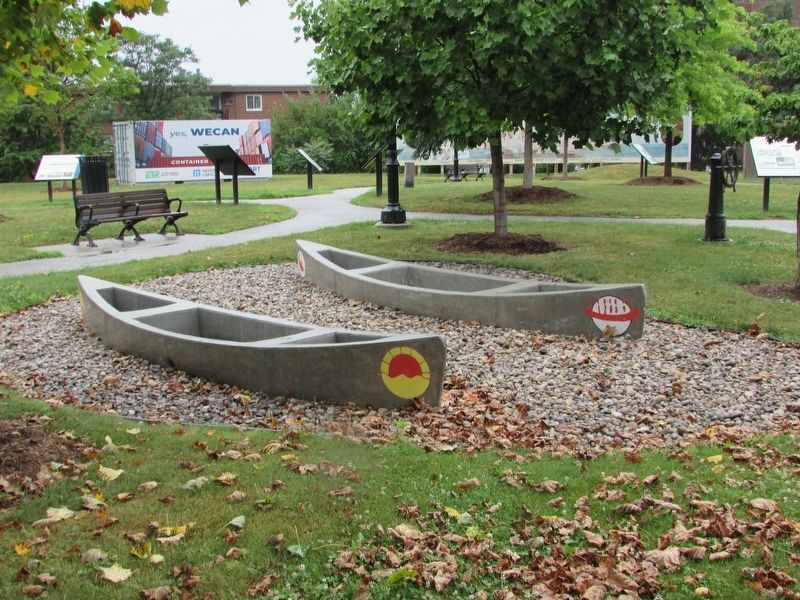
3. Indigenous Canoes
Nidoodem, or Clan images, mentioned on the marker can be seen painted on these canoes.
Location. 42° 18.151′ N, 83° 4.547′ W. Marker is in Windsor, Ontario, in Essex County. It is on Sandwich Street north of Mill Street, on the right when traveling south. Touch for map. Marker is in this post office area: Windsor ON N9C 1B2, Canada. Touch for directions.

Regionally, this marker is in the Southwest Ontario Area and in Southwestern Ontario. It is also in Central Canada. Globally, it is in North America, on the Great Lakes, in the Western Hemisphere, in the Western World, and in the Anglosphere. Historically, it finds itself in what was once a British colony, the Viceroyalty of New France, the Haudenosaunee (Iroquois) Confederacy, and Rupert’s Land.
Other nearby markers. At least 8 other markers are within walking distance of this marker: Sandwich and the Underground Railroad (a few steps from this marker); Fur Trade & European Settlement (a few steps from this marker); The Story of the Anchor (The James Norris) (a few steps from this marker); The Mansion on the Detroit River Frontier (a few steps from this marker); The Founding of Sandwich (a few steps from this marker); Movement of Indigenous Trade (within shouting distance of this marker); Battle of Lake Erie (within shouting distance of this marker); The Battle of Windsor (within shouting distance of this marker). Touch for a list and map of all markers in Windsor.
More about this marker. Several pictures appear on the marker. These include The Great Mound at River Rouge; the great Serpent Mound; Cahokia Mounds; a projectile point and other artifacts; and various clan images.
Credits. This page was last revised on December 21, 2025. It was originally submitted on July 30, 2025, by Bill Coughlin of Woodland Park, New Jersey. This page has been viewed 119 times since then and 30 times this year. Photos: 1, 2, 3. submitted on July 30, 2025, by Bill Coughlin of Woodland Park, New Jersey.
