Quanah Parker Trail
Texas Plains Trail Region
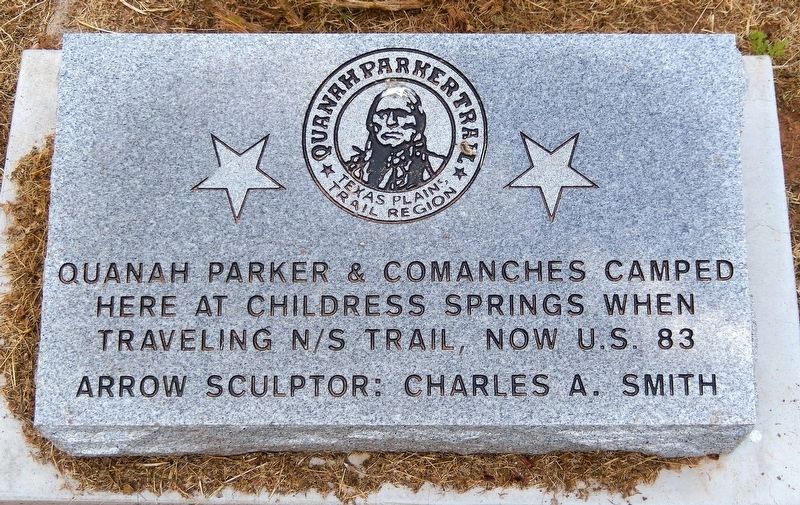
Quanah Parker & Comanches camped here at Childress Springs when traveling N/S Trail, now U.S. 83
Arrow sculptor: Charles A. Smith
Erected 2014. (Marker Number 33.)
Topics. This historical marker is listed in this topic list: Indigenous Peoples and Communities.
Location. 34° 25.856′ N, 100° 12.178′ W. Marker is in Childress, Texas, in Childress County. It can be reached from Commerce Street Northwest north of Avenue I Northwest. The marker and arrow are located between the Fair Park Auditorium and Park Lake in Fair Park. Touch for map. Marker is at or near this postal address: 100 Fair Park Drive, Childress TX 79201, United States of America. Touch for directions.

Regionally, this marker is on the Texas Panhandle. It is also on the American Great Plains and specifically on the Southern Plains. Globally, it is in North America, a Gulf of Mexico state, the Western Hemisphere, the Western World, and the Anglosphere. Historically, it finds itself in what was once New Spain, the Comanchería, the Dust Bowl, the Republic of Texas, and one of the Confederate
this page online
Other nearby markers. At least 8 other markers are within walking distance of this marker: Goodnight Trail (within shouting distance of this marker); Childress Cemetery (approx. ¼ mile away); Colonel Wm. Edgar Hughes of the Mill Iron (approx. 0.3 miles away); Childress County (approx. 0.4 miles away); Frank Collinson (approx. half a mile away); Childress Post Office Building (approx. 0.6 miles away); Palace Theater (approx. 0.6 miles away); Old Railroad Y.M.C.A. (approx. 0.8 miles away). Touch for a list and map of all markers in Childress.
Related markers. Click here for a list of markers that are related to this marker.
Also see . . .
1. Quanah Parker (Wikipedia).
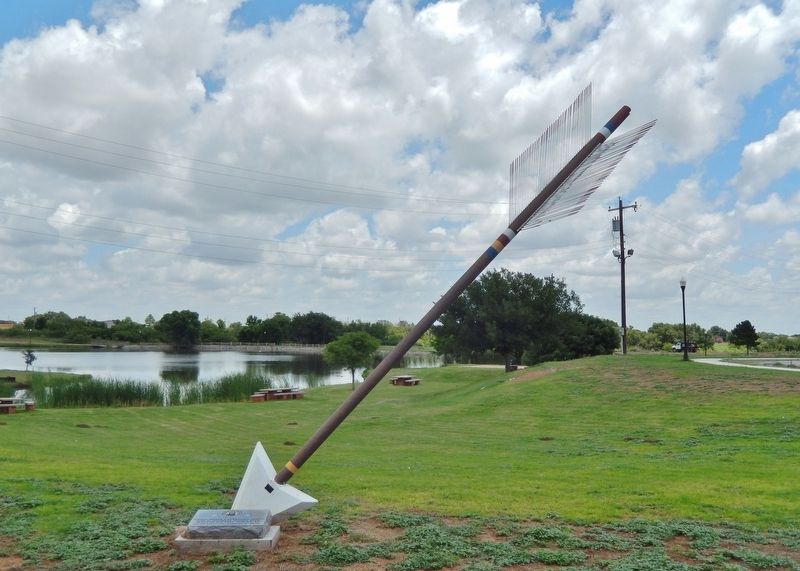
Excerpt: Quanah Parker (c. 1845 – February 23, 1911) was a war leader of the Kwahadi ("Antelope") band of the Comanche Nation. Quanah Parker was never elected chief by his people but was appointed by the federal government as principal chief of the entire Comanche Nation. He became a primary emissary of southwest indigenous Americans to the United States legislature. After his death in 1911, the leadership title of Chief was(Submitted on July 31, 2025, by Cosmos Mariner of Cape Canaveral, Florida.)replaced with chairman; Quanah Parker is thereby described as the "Last Chief of the Comanche".Photographed by Cosmos Mariner, July 6, 20252. Quanah Parker Trail Marker and ArrowThis view is looking northeast through Fair Park. Park Lake is in the left background.The Quanah Parker Trail, a public art project begun in 2010 by the Texas Plains Trail Region, commemorates sites of Comanche history in the Plains and Panhandle of Texas, the central region of Comancheria.
2. Exploring the Quanah Parker Trail (Texas Historical Commission).
Excerpt: Dozens of arrows, 22 feet tall, pierce the landscape of the Panhandle Plains. They commemorate Quanah Parker, last chief of the Comanche (Nʉmʉnʉʉ), and the territory called Comanchería where his people lived. Parker was the son of a Quahada Comanche man and a white woman, a heritage that made a lasting impact on his life.(Submitted on July 31, 2025, by Cosmos Mariner of Cape Canaveral, Florida.)For years under Quanah Parker’s leadership, in the 1860s and 1870s, the Quahada Comanche held their territory against increasing force. But after unrelenting pressure from the US Army, they were removed to the Kiowa-Comanche reservation in Oklahoma in the mid-1870s.
In 2011, residents living in the former Comanchería established the
Quanah Parker Trail to interpret the Indigenous history of the region in the days before and during colonial settlement. The enormous arrows that mark the trail sites were made by regional sculptor Charles Smith (1942-2018), who lived near Lubbock.Photographed by Allen Lowrey, July 12, 20203. Quanah Parker Trail Marker

3. Quanah Parker Trail — Childress, Texas (quanahparkertrail.com).
Excerpt: A Quanah Parker Trail arrow went into place July 19, 2014 in Childress near the entrance to Fair Park, close to a lake that has always been an important geographical feature.(Submitted on July 31, 2025, by Cosmos Mariner of Cape Canaveral, Florida.)Springs across the area once provided water for inhabitants of the region — from times when Indians practiced agriculture until the era of the nomadic buffalo-hunting Comanche, then the cattlemen and lastly settlers who put their plows to the soil. Among the ranchers was Charles Goodnight, friend of Quanah Parker.
Credits. This page was last revised on August 15, 2025. It was originally submitted on July 31, 2025, by Cosmos Mariner of Cape Canaveral, Florida. This page has been viewed 281 times since then and 93 times this year. Last updated on August 1, 2025, by Allen Lowrey of Amarillo, Texas. Photos: 1, 2. submitted on July 31, 2025, by Cosmos Mariner of Cape Canaveral, Florida. 3. submitted on August 1, 2025, by Allen Lowrey of Amarillo, Texas. • James Hulse was the editor who published this page.
