Fulton in Oswego County, New York — The American Northeast (Mid-Atlantic)
Fulton’s Industries Along the River
| — | Towpath Trail | — |
Photographed by Steve Stoessel, July 23, 2025
1. Fulton’s Industries Along the River Marker
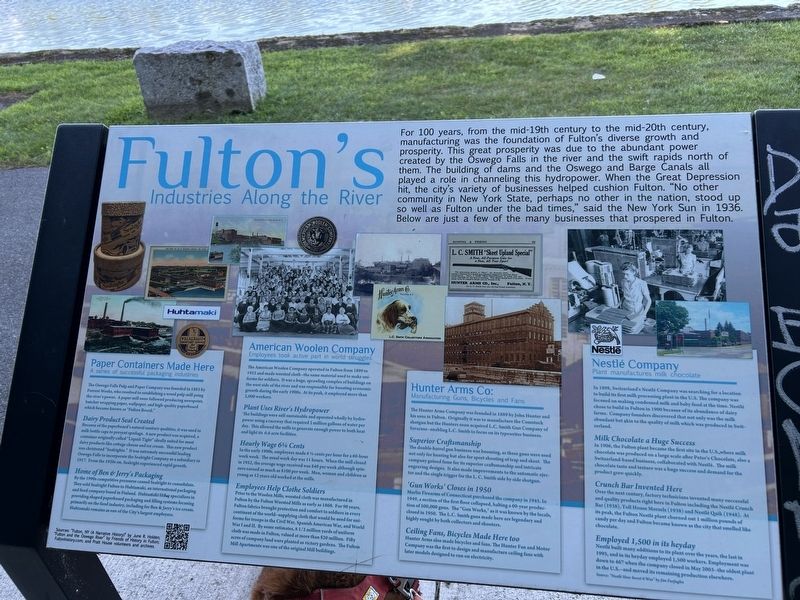
For 100 years, from the mid-19th century to the mid-20th century, manufacturing was the foundation of Fulton's diverse growth and prosperity. This great prosperity was due to the abundant power created by the Oswego Falls in the river and the swift rapids north of them. The building of dams and the Oswego and Barge Canals all played a role in channeling this hydropower. When the Great Depression hit, the city's variety of businesses helped cushion Fulton. "No other community in New York State, perhaps no other in the nation, stood up so well as Fulton under the bad times, " said the New York Sun in 1936. Below are just a few of the many businesses that prospered in Fulton.
Paper Containers Made Here
A series of successful packaging industries.
The Oswego Falls Pulp and Paper Company was founded in 1883 by Forrest Weeks, who resolved to establishing a wood pulp mill using the river's power. A paper mill soon followed producing newsprint, butcher wrapping paper, wallpaper, and high-quality paperboard which became known as "Fulton Board."
Dairy Product Seal Created
Because of the paperboard's natural sanitary qualities,
this page online
Home of Ben & Jerry's Packaging
By the 1990s competitive pressures caused Sealright to consolidate. They sold Sealright Fulton to Huhtamaki, an international packaging and food company based in Finland. Hubtamaki foday specializes in providing shaped paperboard packaging and filling systems focusing primarily on the food industry, including for Ben & Jerry's ice cream. Huhtamaki remains as one of the City's largest employers.
American Woolen Company
Employees took active part in world struggles.
The American Woolen Company operated in Fulton from 1899 to 1952 and made worsted cloth - the same material used to make uniforms for soldiers. It was a huge, sprawling complex of buildings on the west side of the river and was
Photographed by Steve Stoessel, July 23, 2025
2. Fulton’s Industries Along the River Marker
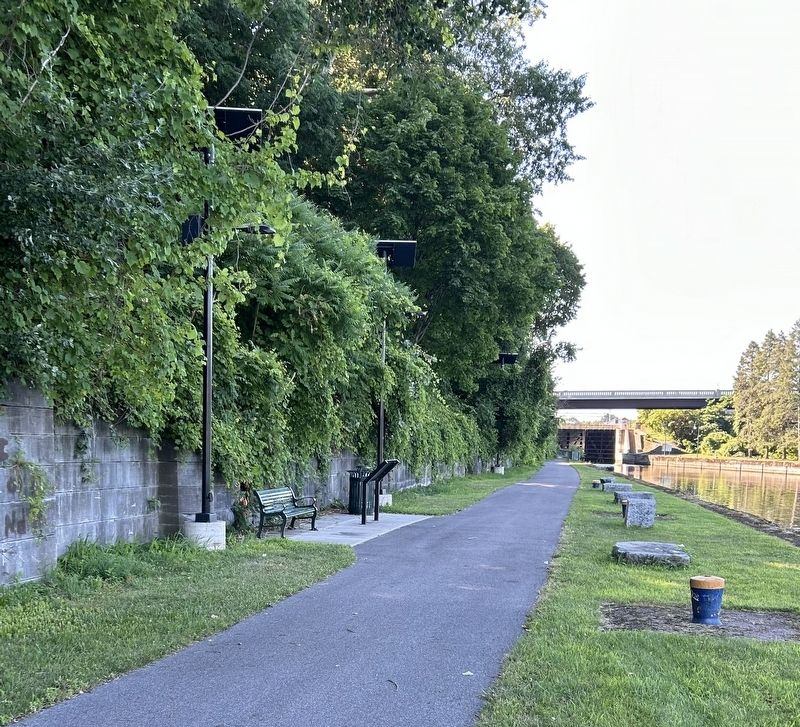
The steep embankment prevents direct access from First Street.
Plant Uses River's Hydropower
The buildings were self-sustainable and operated wholly by hydropower using a raceway that required 2 million gallons of water per day. This allowed the mills to generate enough power to both heat and light its 6.6 acre facilities.
Hourly Wage 6¼ Cents
In the early 1900s, employees made 6¼ cents per hour for a 60-hour work week. The usual work day was 11 hours. When the mill closed in 1952, the average wage received was $40 per week although spinners earned as much as $100 per week. Men, women and children as young as 12 years old worked at the mills.
Employees Help Clothe Soldiers
Prior to the Woolen Mills, worsted cloth was manufactured in Fulton by the Fulton Worsted Mills as early as 1860. For 90 years, Fulton fabrics brought protection and comfort to soldiers in every continent of the world - supplying cloth that would be used for uniforms for troops in the Civil War, Spanish American War, and World War I and II. By some estimates, 8 1/2 million yards of uniform cloth was made in Fulton, valued at more than $20 million. Fifty acres of company land were planted as victory gardens. The Fulton Mill Apartments was one of the original Mill buildings.
Hunter Arms Co:
Manufacturing Guns, Bicycles and Fans
The Hunter Arms Company was founded in 1889 by John Hunter and his sons in Fulton. Originally it was to manufacture the Comstock shotgun but the Hunters soon acquired L.C. Smith Gun Company of Syracuse - enabling L.C. Smith to focus on its typewriter business.
Superior Craftsmanship
The double-barrel gun business was booming, as these guns were used not only for hunting but also for sport shooting of trap and skeet. The company gained fame for its superior craftsmanship and intricate engraving designs. It also made improvements to the automatic ejector and the single trigger for the L. C. Smith side by side shotgun.
'Gun Works' Closes in 1950
Marlin Firearms of Connecticut purchased the company in 1945. In 1949, a section of the first floor collapsed, halting a 60-year production of 500,000 guns. The "Gun Works," as it was known by the locals, closed in 1950, The L.C. Smith guns made here are legendary and highly sought by both collectors and shooters.
Ceiling Fans, Bicycles Made Here too
Hunter Arms also made bicycles and fans. The Hunter Fan and Motor Company was the first to design and manufacture ceiling fans with later models designed to run on electricity.
Nestlé Company
Plant manufactures milk chocolate
In 1898, Switzerland's Nestlé Company was searching for a location to build its first milk processing plant in the U.S. The company was focused on making condensed milk and baby food at the time. Nestlé chose to build in Fulton in 1900 because of its abundance of dairy farms. Company founders discovered that not only was the milk abundant but akin to the quality of milk which was produced in Switzerland.
Milk Chocolate a Huge Success
In 1906, the Fulton plant became the first site in the U.S.,where milk chocolate was produced on a large scale after Peter's Chocolate, also a Switzerland-based business, collaborated with Nestle. The milk chocolate taste and texture was a huge success and demand for the product grew quickly.
Crunch Bar Invented Here
Over the next century, factory technicians invented many successful and quality products right here in Fulton including the Nestle Crunch Bar (1938), Toll House Morsels (1938) and Nestlé Quik (1948), At its peak, the Fulton Nestlé plant churned out 1 million pounds of candy per day and Fulton became known as the city that smelled like chocolate.
Employed 1,500 in its heyday
Nestlé built many additions to its plant over the years, the last in 1995, and in its heyday employed 1,500 workers. Employment was down to 467 when the company closed in May 2003 - the oldest plant in the U.S, - and moved its remaining production elsewhere. Source: "Nestlé How Sweet it Was" by Jim Farfaglia
Sources: “Fulton, NY (A Narrative History) by June Holden; “Fulton and the Oswego River” by Friends of History in Fulton; Fultonhidtory.com and Pratt House volunteers and archives.
Topics. This historical marker is listed in these topic lists: Industry & Commerce • Waterways & Vessels.
Location. 43° 19.142′ N, 76° 24.956′ W. Marker is in Fulton, New York, in Oswego County. It can be reached from Towpath Trail, on the left when traveling south. Marker is on a bicycle path beside the Oswego River, 0.25 miles south of the trailhead at South First Street and Rochester Street. Touch for map. Marker is in this post office area: Fulton NY 13069, United States of America. Touch for directions.

Regionally, this marker is in Upstate New York, specifically in Central New York, and in the Syracuse Metropolitan Area. It is also in the American Northeast and in the Mid-Atlantic. Globally, it is in North America, on the Great Lakes, in the Western Hemisphere, in the Western World, and in the Anglosphere. Historically, it finds itself in what was once New Netherland and also one of the original Thirteen Colonies.
Other nearby markers. At least 8 other markers are within walking distance of this marker: John Wells Pratt House (within shouting distance of this marker); Fulton Public Library (within shouting distance of this marker); In Memory (about 600 feet away, measured in a direct line); Oswego Canal (about 700 feet away); The Erie Canalway National Heritage Corridor (approx. 0.2 miles away); Msgt. Gregory John Harris USMC (approx. 0.6 miles away); Civil War (approx. 0.6 miles away); War of 1812 (approx. 0.6 miles away). Touch for a list and map of all markers in Fulton.
Credits. This page was last revised on August 3, 2025. It was originally submitted on August 3, 2025, by Steve Stoessel of Niskayuna, New York. This page has been viewed 558 times since then and 272 times this year. Photos: 1, 2. submitted on August 3, 2025, by Steve Stoessel of Niskayuna, New York.
