Cohoes in Albany County, New York — The American Northeast (Mid-Atlantic)
Power Canal Park

Photographed by Steve Stoessel, August 3, 2025
1. Power Canal Park Marker
In 1834, the Cohoes Hydraulic Company built a dam above the Cohoes Falls, harnessing the abundant flow of the Mohawk River for industrial use. The Cohoes Company gradually developed a series of canals that provided low-cost waterpower to local textile manufactories, thrusting Cohoes into the forefront of the American Industrial Revolution. Cohoes Company Canal Park (where you are standing now) is the last unfilled section of its original power canal system. This portion of the power canal was originally a section of "Clinton's Ditch."
Powering an Industry
The Harmony Mills was the largest and most complete cotton manufacturing establishment in the United States from the late 1860s through the 1880s. It was the largest American producer of cotton fabrics for printed calicos and fine cotton muslins, which were spun and woven from raw cotton right in the mills. Inside Mill #3, built in 1866-1872, are some of the largest vertical turbines in the United States.
These Boyden turbines converted the energy of flowing water to mechanical power to turn a system of belts that ran various machines in the mill, Two of the turbines
this page online
Power from the main axle, turned by water flowing through the turbines, was transmitted to driveshafts on each floor by a system of leather belts.
Today.
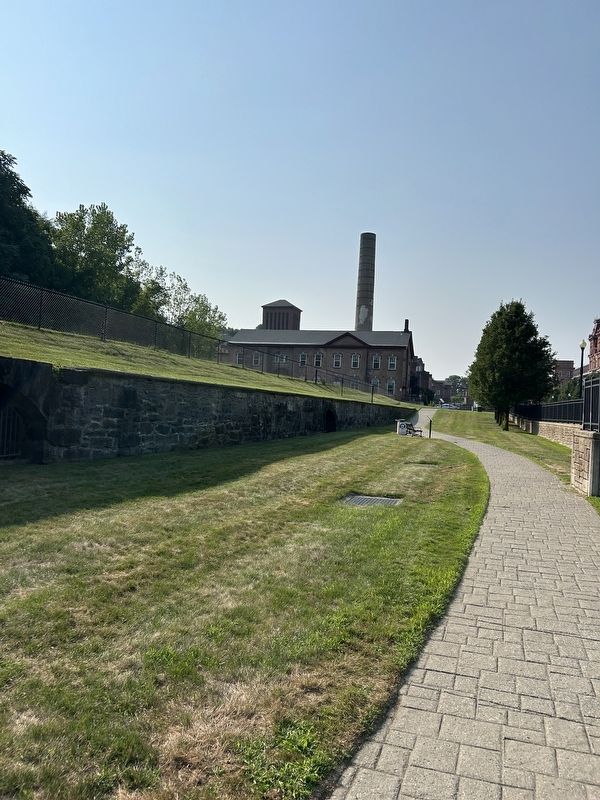
You are standing inside the former power canal, which can be seen in the image to the left.
[ Small Photo Caption: ] One of the Boyden turbines in Harmony Mill #3.
[ Illustration Caption: ] A cross-section of Harmony Mill #3, showing the system of turbines. shafts and belts that drove the machinery in the mill.
Topics. This historical marker is listed in these topic lists: Industry & Commerce • Waterways & Vessels. A significant historical year for this entry is 1834.
Location. 42° 46.766′ N, 73° 42.198′ W. Marker is in Cohoes, New

Photographed by Steve Stoessel, August 3, 2025
2. Power Canal Park Marker
Looking north along the power canal towards the original mill.

Regionally, this marker is in Upstate New York, in the Capital District, and in the Albany Metropolitan Area. It is also in the American Northeast and in the Mid-Atlantic. Globally, it is in North America, the Western Hemisphere, the Western World, and the Anglosphere. Historically, it finds itself in what was once New Netherland and also one of the original Thirteen Colonies.
Other nearby markers. At least 8 other markers are within walking distance of this marker: The Erie Canal (here, next to this marker); Developing an Industrial Empire (within shouting distance of this marker); The Harmony Mills Historic District (within shouting distance of this marker); The Harmony Mills (about 300 feet away, measured in a direct line); The Cohoes Mastodont (about 400 feet away); A Company Town (about 400 feet away); Rise of the Harmony Company (approx. 0.2 miles away); Capturing the Power of Water (approx.
Photographed by Steve Stoessel, August 3, 2025
3. Power Canal
Also see . . .
1. Textile Industry in Cohoes. (Submitted on August 3, 2025, by Steve Stoessel of Niskayuna, New York.)
2. Harmony Mills (Wikipedia). (Submitted on August 3, 2025, by Steve Stoessel of Niskayuna, New York.)
Credits. This page was last revised on August 3, 2025. It was originally submitted on August 3, 2025, by Steve Stoessel of Niskayuna, New York. This page has been viewed 146 times since then and 42 times this year. Photos: 1, 2, 3. submitted on August 3, 2025, by Steve Stoessel of Niskayuna, New York.
