Decatur in Morgan County, Alabama — The American South (East South Central)
Doublehead
Photographed by Darren Jefferson Clay, July 26, 2025
1. Doublehead Marker
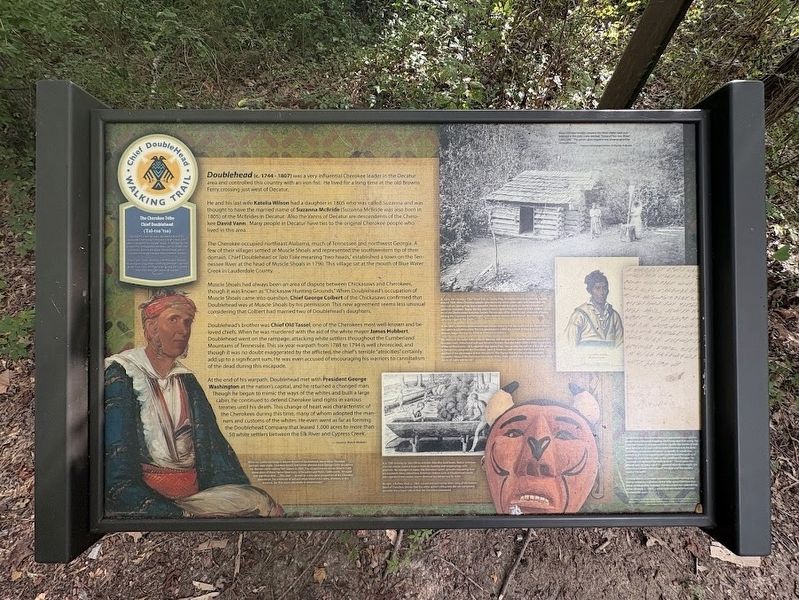
He and his last wife Katelia Wilson had a daughter in 1805 who was called Suzanna and was thought to have the married name of Suzanna McBride (Suzanna McBride was also born in 1805) of the McBrides in Decatur. Also the Vanns of Decatur are descendents of the Cherokee David Vann. Many people in Decatur have ties to the original Cherokee people who lived in this area.
The Cherokee occupied northeast Alabama, much of Tennessee and northwest Georgia. A few of their villages settled at Muscle Shoals and represented the southwestern tip of their domain. Chief Doublehead or Talo Tiske meaning "two heads," established a town on the Tennessee River at the head of Muscle Shoals in 1790. This village sat at the mouth of Blue Water Creek in Lauderdale County.
Muscle Shoals had always been an area of dispute between Chickasaws and Cherokees, though it was known as "Chickasaw Hunting Grounds." When Doublehead's occupation
this page online
Doublehead's brother was Chief Old Tassel, one of the Cherokees most well-known and beloved chiefs. When he was murdered with the aid of the white mayor James Hubbert, Doublehead went on the rampage, attacking white settlers throughout the Cumberland Mountains of Tennessee. This six-year warpath from 1788 to 1794 is well chronicled, and though it was no doubt exaggerated by the afflicted, the chief's terrible "atrocities" certainly add up to a significant sum. He was even accused of encouraging his warriors to cannibalism of the dead during this escapade.
At the end of his warpath, Doublehead met with President George Washington at the nation's capital, and he returned a changed man. Though he began to mimic the ways of the whites and built a large cabin, he continued to defend Cherokee land rights in various treaties until his death. This change of heart was characteristic of the Cherokees
Photographed by Darren Jefferson Clay, July 26, 2025
2. Doublehead Marker
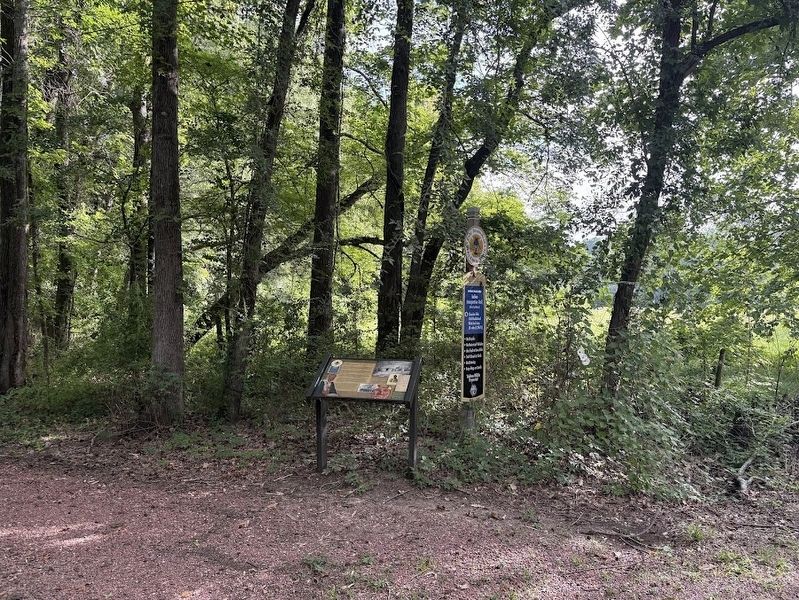
The Cherokee Tribe Chief Doublehead (Tal-tsu'tsa) During his warring years, Doublehead and his renegade Cherokees, Chickasaws and Creeks cultivated a bloodthirsty savage image. Scalp-taking was uncommon among the Cherokee, yet he made it his signature. Even more grisly, Doublehead and his warriors would cannibalize their enemies bodies.
Years later, when meeting with President George Washington, a reporter asked Doublehead's opinion of the white race. Without even giving the matter moment's thought, the chief replied: "Too salty."
Image captions:
(Bottom Left): While no confirmed image is known to exist of Doublehead, many other Cherokee portraits were made. Cherokee Band Chief Có-lee allowed artist George Catlin to capture his likeness while visiting Fort Gibson in 1834. The oil painting on canvas depicts traditional dress of these Native Americans. In his Letters and Notes, Catlin wrote, "An aged and dignified chief.... This man as well as a very great proportion of the Cherokee population, has a mixture of red and white blood in his veins, of which, in this instance, the first seems decidedly to predominate."
Compiled by Paul Floyd and McWhorter Communications (McWhorterOnline.com) with special thanks to Buich Wa
(Bottom Center): In a 1590 drawing by John White entitled, How they build boats, Native American men are shown making dugout boats by burning and scraping logs with seashells. No strangers to water, the Cherokees spent centuries mastering their environment. Many industrious American Indians such as Doublehead would.. later operate ferries across waters deemed too dangerous for most.
At right, a Buffalo Mask (c. 1965) carved and painted by Allen Long of the Eastern Band of Cherokee, proves that the white settler's influences did not completely overtake the unique culture that the Cherokees possessed.
(Top) At right, the Cherokee Chief Tooan Tuh, or Spring Frog, let Charles Bird King paint his portrait around 1838. Many Cherokee people adapted to the white settler ways and integrated into their culture. Spring Frog was a naturalist, having served as a guide to the renowned bird authority Audubon. Today, the log cabin in which Spring Frog was born is in the wildlife sanctuary of the Chattanooga Audubon Society. He was one of the most fervent advocates of peace among the Cherokees but he fought under Andrew Jackson in the War of 1812 and in the campaign against the Creeks.
In the 1830's, however, tensions between settlers moving into the south and the Native Americans grew to a boiling point. The U.S. government, under the control of President Andrew Jackson, began forcing the removal of American Indians.
The History of the Indian Tribes of North America, with Biographical Sketches and Anecdotes of the Principal Chiefs, Embellished with one Hundred Portraits, from the Indian Gallery in the Department of War, at Washington, 1872, reported that Spring Frog "was among the earliest of the emigrants to the country assigned the Cherokees, west of Arkansas, and we hope that he lived to be satisfied of the advantages of that movement. The change has thus far proved eminently successful. Many of the Cherokees have large farms, under a good state of cultivation, and large droves of cattle and horses."
Spring Frog was also prominent as a sportsman, especially for his skill in hunting and trapping. McKenney and Hall wrote, "He knew the habits of animals and their signals; the voices of birds were familiar to his ear; and he could sit for hours in the lone wilderness, an interested listener to sounds, in which one unused to the forest could detect nothing but the rustling of leaves, the rush of the winds, or the creaking of boughs. His practiced eye detected the footmarks of animals upon the ground, and his quick ear distinguished, even in the night, the difference between the tramp of the deer and the stealthy tread of the wolf."
Pictured above, a Cherokee Sacred Formulae for Hunting and Fishing written by a shaman of the tribe using Cherokee characters developed by Sequoya. The document was collected by James Mooney (c. 1887), a white man who lived among the Cherokee for years.
-The History of the Indian Tribes of North America, with Biographical Sketches and Anecdotes of the Principal Chiefs, Embellished with one Hundred Portraits from the Indian Gallery in the Department of War, at Washington 1872
Topics. This historical marker is listed in this topic list: Indigenous Peoples and Communities.
Location. 34° 34.439′ N, 86° 55.78′ W. Marker is in Decatur, Alabama, in Morgan County. It is on Point Mallard Circle, on the left when traveling east. Touch for map. Marker is at or near this postal address: 2900 Point Mallard Cir, Decatur AL 35601, United States of America. Touch for directions.

Regionally, this marker is in North Alabama. It is also in the American South, specifically in the Deep South, in Appalachia, and specifically in Southern Appalachia. Globally, it is in North America, a Gulf of Mexico state, the Western Hemisphere, the Western World, and the Anglosphere. Historically, it finds itself in what was once the original Cherokee Nation, the territory of the Mississippian Culture, one of the Confederate States of America, and the Antebellum South.
Other nearby markers. At least 8 other markers are within 4 miles of this marker, measured as the crow flies: Black Fox (a few steps from this marker); Our History (approx. 1.7 miles away); Albany (approx. 2.9 miles away); The Land of the Indians (approx. 3.1 miles away); Recreation and Refreshment (approx. 3.2 miles away); Health and Civic Welfare (approx. 3.2 miles away); Carolyn Cortner Smith (approx. 3.2 miles away); Beauty and Hope (approx. 3.3 miles away). Touch for a list and map of all markers in Decatur.
Credits. This page was last revised on August 7, 2025. It was originally submitted on August 4, 2025, by Darren Jefferson Clay of Duluth, Georgia. This page has been viewed 209 times since then and 85 times this year. Photos: 1, 2. submitted on August 4, 2025, by Darren Jefferson Clay of Duluth, Georgia. • James Hulse was the editor who published this page.
