Decatur in Morgan County, Alabama — The American South (East South Central)
Black Fox
Photographed by Darren Jefferson Clay, July 26, 2025
1. Black Fox Marker
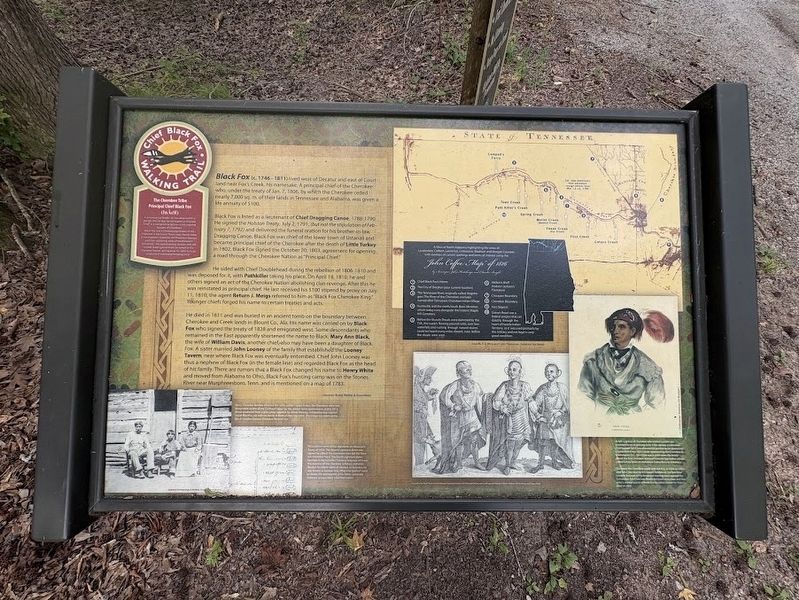
Black Fox is listed as a lieutenant of Chief Dragging Canoe, 1788-1790. He signed the Holston Treaty, July 2, 1791, (but not the stipulation of February 7, 1792) and delivered the funeral oration for his brother-in-law Dragging Canoe. Black Fox was chief of the lower town of Ustanali and became principal chief of the Cherokee after the death of Little Turkey in 1802. Black Fox signed the October 20, 1803, agreement for opening a road through the Cherokee Nation as "Principal Chief."
He sided with Chief Doublehead during the rebellion of 1806-1810 and was deposed for it, with Pathkiller taking his place. On April 18, 1810, he and others signed an act of the Cherokee Nation abolishing clan revenge. After this he was reinstated as principal chief. He last received his $100 stipend by proxy on July 11, 1810; the agent Return J. Meigs
this page online
He died in 1811 and was buried in an ancient tomb on the boundary between Cherokee and Creek lands in Blount Co., Ala. His name was carried on by Black Fox who signed the treaty of 1828 and emigrated west. Some descendants who remained in the East apparently shortened the name to Black. Mary Ann Black, the wife of William Davis, another chief, also may have been a daughter of Black Fox. A sister married John Looney of the family that established the Looney Tavern, near where Black Fox was eventually entombed. Chief John Looney was thus a nephew of Black Fox (in the female line) and regarded Black Fox as the head of his family. There are rumors that a Black Fox changed his name to Henry White and moved from Alabama to Ohio. Black Fox's hunting camp was on the Stones River near Murphreesboro, Tenn, and is mentioned on a map of 1783. - (Sources: Butch Walker & RootsWeb)
The Cherokee Tribe Principal Chief Black Fox (InAcli)
A controversial leader, he was deposed for a period, only to later be reinstated as Principal Chief, in
Photographed by Darren Jefferson Clay, July 26, 2025
2. Black Fox Marker
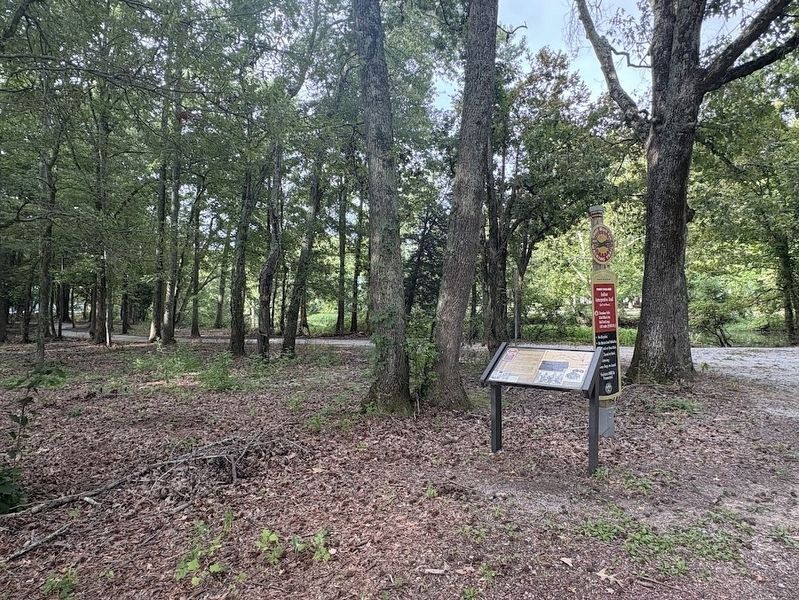
Black Fox was a Chickamauga leader of the Cherokee in the Lower Towns area (found today in northeastern Alabama, northwestern Georgia, and their adjoining areas of southeastern Tennessee). He signed several treaties with the United States government on behalf of the Cherokee Nation, giving away its rights to huge amounts of traditional foraging areas.
Image captions:
(Bottom left, top): Many Cherokee families adopted the white settler's ways, in fact, the Cherokees were later designated as one of the "Civilized Tribes" by the United States government. In this 1912 photo produced from a glass plate negative by James Mooney, a Cherokee man named Josiah Blackfox sits with his family in front of their log cabin. The image was taken at the North Carolina Eastern Cherokee Reservation.
(Bottom left, bottom): Pictured are some of the signatures on Sequoya's Treaty of 1828. The second signature down was signed by a Black Fox namesake who led the Western Cherokee Band. The fourth signature down belongs to the notable Cherokee Sequoya who was the inventor of the Cherokee syllabary alphabet. Besides his native name of Sikwayi, or Sequoya, he was known as George Gist, otherwise spelled Guest or Guess, the patronymic of his father, generally believed to have been a German trader.
A View of North Alabama highlighting the areas of Lauderdale, Colbert, Lawrence, Limestone, Madison and Morgan Counties with overlays of current spellings and items of interest using the "John Coffee Map" of 1816 by Surveyors John Hutchings and Charles Bright
1 Chief Black Fox's Home
2 The City of Decatur (your current location)
3 The Tennessee River, originally called Hogohe-gee (The River of the Cherokee) and later named after Tannassee Cherokee Indian Village
4 Huntsville and the north/south Basis Meridian which today runs alongside the historic Maple Hill Cemetery
5 Before the Muscle Shoals were dammed by the TVA, the waters flowing around rocks, over low waterfalls and rushing through natural sluices could be heard many miles distant, even before the shoals were seen.
6 Melton's Bluff Andrew Jackson's Plantation 7 Chicasaw Boundary
8 Cherokee Boundary
9 Fort Deposit
10 Gaine's Road was a federal project that ran directly through the heart of hostile Indian Territory, so it was used primarily by the military and not kept in very good condition.
-(sources: P.D. Wirey and Curtis Thomasson, Andalusia Star news)
(Bottom right): At left, a group of Cherokee who visited London are portrayed in an engraving from 1762. Above, a Cherokee Chief named Tah-Chee allowed his portrait to be painted by Charles Bird King (1837) while representing the Cherokee in Washington, D.C. Tah-Chee was a child when his family joined the first Cherokee removal from the big Indian village called Turkey Town, on Alabama's Coosa River to Arkansas.
The treaty the Cherokee made with the U.S. in 1828 so infuriated Tah-Chee that he led several families to the Red River country. Because of his fierce and warring ways against the Comanche, Tah-Chee was finally declared an outlaw and the army's wanted poster offered five hundred dollars for him dead or alive.
Topics. This historical marker is listed in this topic list: Indigenous Peoples and Communities.
Location. 34° 34.432′ N, 86° 55.774′ W. Marker is in Decatur, Alabama, in Morgan County. It is on Point Mallard Circle, on the right when traveling east. Touch for map. Marker is at or near this postal address: 2900 Point Mallard Cir, Decatur AL 35601, United States of America. Touch for directions.

Regionally, this marker is in North Alabama. It is also in the American South, specifically in the Deep South, in Appalachia, and specifically in Southern Appalachia. Globally, it is in North America, a Gulf of Mexico state, the Western Hemisphere, the Western World, and the Anglosphere. Historically, it finds itself in what was once the original Cherokee Nation, the territory of the Mississippian Culture, one of the Confederate States of America, and the Antebellum South.
Other nearby markers. At least 8 other markers are within 4 miles of this marker, measured as the crow flies: Doublehead (a few steps from this marker); Our History (approx. 1.7 miles away); Albany (approx. 3 miles away); The Land of the Indians (approx. 3.2 miles away); Recreation and Refreshment (approx. 3.2 miles away); Health and Civic Welfare (approx. 3.2 miles away); Carolyn Cortner Smith (approx. 3.2 miles away); Beauty and Hope (approx. 3.3 miles away). Touch for a list and map of all markers in Decatur.
Credits. This page was last revised on August 7, 2025. It was originally submitted on August 4, 2025, by Darren Jefferson Clay of Duluth, Georgia. This page has been viewed 236 times since then and 49 times this year. Photos: 1, 2. submitted on August 4, 2025, by Darren Jefferson Clay of Duluth, Georgia. • James Hulse was the editor who published this page.
