Midtown - Downtown in Columbia in Richland County, South Carolina — The American South (South Atlantic)
Ebenezer Lutheran Church
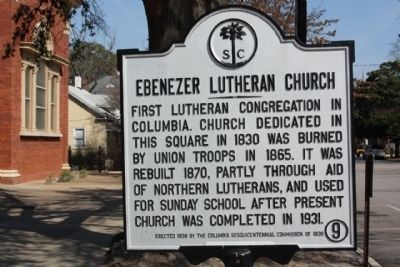
Photographed by Mike Stroud, 2010
1. Ebenezer Lutheran Church Marker
Erected 1938 by The Columbia Sesquicentennial Commission of 1936. (Marker Number 40-9.)
Topics. This historical marker is listed in these topic lists: Religion & Religious Structures • War, US Civil. A significant historical year for this entry is 1830.
Location. 34° 0.686′ N, 81° 2.131′ W. Marker is in Columbia, South Carolina, in Richland County. It is in Midtown - Downtown. It is on Richland Street, on the right when traveling north. Located between Marion Street and North Sumter Street. Touch for map. Marker is in this post office area: Columbia SC 29201, United States of America. Touch for directions.

Regionally, this marker is in the Midlands. It is also in the American South and specifically in the Deep South. Globally, it is in North America, the Western Hemisphere, the Western World, and the Anglosphere. Historically, it finds itself in what was
this page online
Other nearby markers. At least 8 other markers are within walking distance of this marker: The Family's First Home (about 400 feet away, measured in a direct line); Food for Thought (about 400 feet away); Prosperity and Property Ownership (about 400 feet away); The Mann-Simons Site (about 400 feet away); Making History One Generation at a Time (about 400 feet away); a different marker also named Mann-Simons Site (about 400 feet away); Time to Collect the Rent (about 400 feet away); Agnes Jackson's Home (about 400 feet away). Touch for a list and map of all markers in Columbia.
Another marker is no longer nearby. Mann-Simons Cottage (was about 400 feet away but has been replaced with another marker now near it).
Regarding Ebenezer Lutheran Church. Located on the site of the first Lutheran church in Columbia, Ebenezer Lutheran Chapel was constructed in 1870 and extensively renovated in 1900. It was designed by Columbia architect Gustav Theodore Berg and remodeled
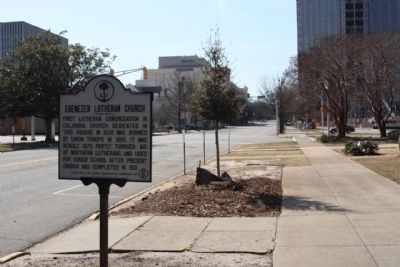
Photographed by Mike Stroud, February 21, 2010
2. Ebenezer Lutheran Church Marker seen along Richland Street
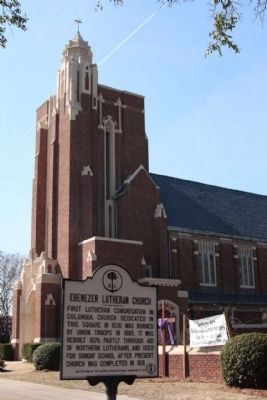
Photographed by Mike Stroud, February 21, 2010
3. Ebenezer Lutheran Church and Marker
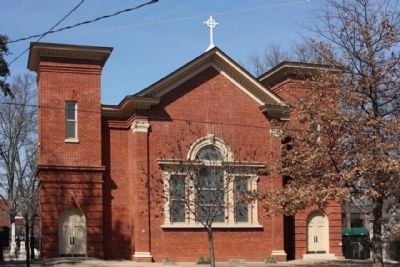
Photographed by Mike Stroud, February 21, 2010
4. Ebenezer Lutheran Church Chapel
National Register of Historic Places:
Ebenezer Lutheran Chapel ** (added 1979 - Building - #79003365) Historic Significance: Event, Architecture/Engineering •
Architect, builder, or engineer: Wilson & Edwards, Berg,Gustav Theodore •
Architectural Style: No Style Listed •
Area of Significance: Religion, Architecture •
Period of Significance: 1800-1824, 1850-1874, 1900-1924 •
Owner: Private •
Historic Function: Religion •
Historic Sub-function: Cemetery, Cemetery, Religious Structure •
Current Function: Funerary, Social •
Current Sub-function: Cemetery, Civic •
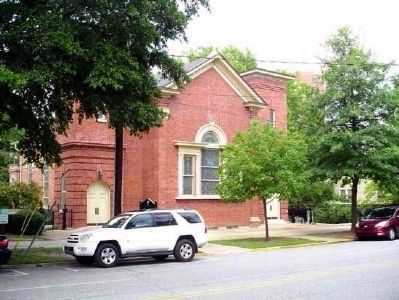
S.C. Dept. of Archives and History, circa September 21, 2006
5. Ebenezer Lutheran Chapel
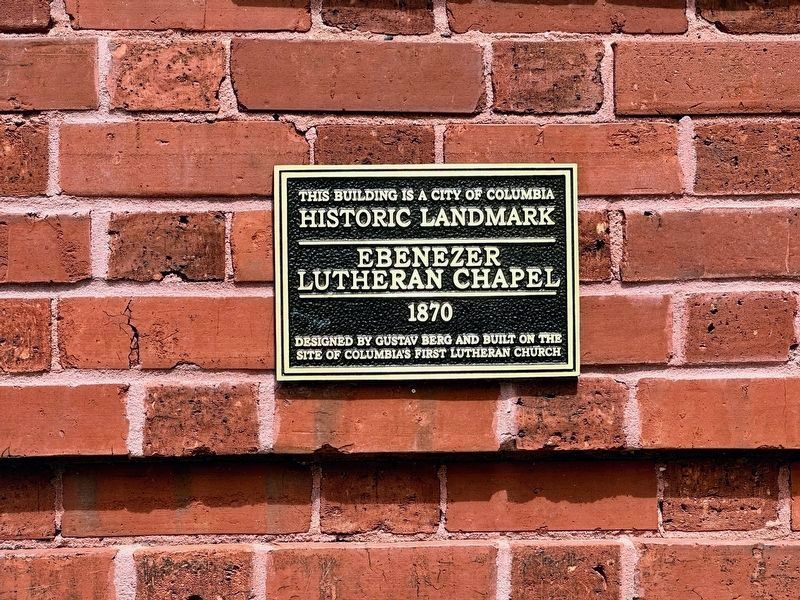
Photographed by J.T. Lambrou, August 31, 2023
6. Ebenezer Lutheran Church Marker
Credits. This page was last revised on January 12, 2024. It was originally submitted on March 1, 2010, by Mike Stroud of Bluffton, South Carolina. This page has been viewed 1,615 times since then and 43 times this year. Photos: 1, 2, 3, 4, 5. submitted on March 3, 2010, by Mike Stroud of Bluffton, South Carolina. 6. submitted on January 12, 2024, by J.T. Lambrou of New Boston, Michigan. • Craig Swain was the editor who published this page.
