Balboa Park in San Diego in San Diego County, California — The American West (Pacific Coastal)
Balboa Park
| — | National Historic Landmark | — |
Photographed by Douglass Halvorsen, July 7, 2025
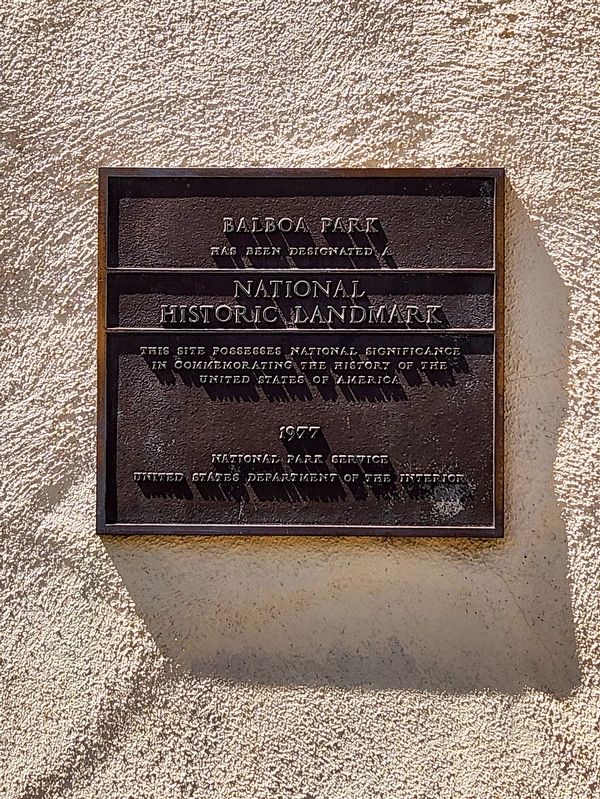
1. Balboa Park Marker
Has Been Designated a
National Historic Landmark
This Site Possesses National Significance
in Commemorating the History of the
United States of America
Erected 1977 by National Park Service - United States Department of the Interior.
Topics and series. This historical marker is listed in these topic lists: Architecture • Parks & Recreational Areas. In addition, it is included in the National Historic Landmarks, and the National Register of Historic Places (NRHP) series lists.
Location. 32° 43.892′ N, 117° 9.003′ W. Marker is in San Diego, California, in San Diego County. It is in Balboa Park. It is on El Prado east of Sixth Avenue, on the left when traveling east. Touch for map. Marker is at or near this postal address: 1540 El Prado, San Diego CA 92101, United States of America. Touch for directions.

Regionally, this marker is in the Peninsular Ranges. It is also in the American Borderlands and on the Pacific Coast. Globally, it is in North America, on the Ring of Fire, on the Pacific Rim, in the Western Hemisphere, in the Western
this page online
Other nearby markers. At least 8 other markers are within walking distance of this marker: House of Hospitality (within shouting distance of this marker); House of Charm (about 300 feet away, measured in a direct line); Laguna de Las Flores (about 300 feet away); The Botanical Building (about 400 feet away); The History of the Japanese Friendship Garden (about 400 feet away); Casa del Prado (about 500 feet away); Alcazar Garden (about 500 feet away); The Old Globe (about 600 feet away). Touch for a list and map of all markers in San Diego.
Also see . . .
1. Balboa Park National Register of Historic Places Nomination Form. A comprehensive background on Balboa Park and the history of its buildings and structures that make up the National Historic Landmark District.
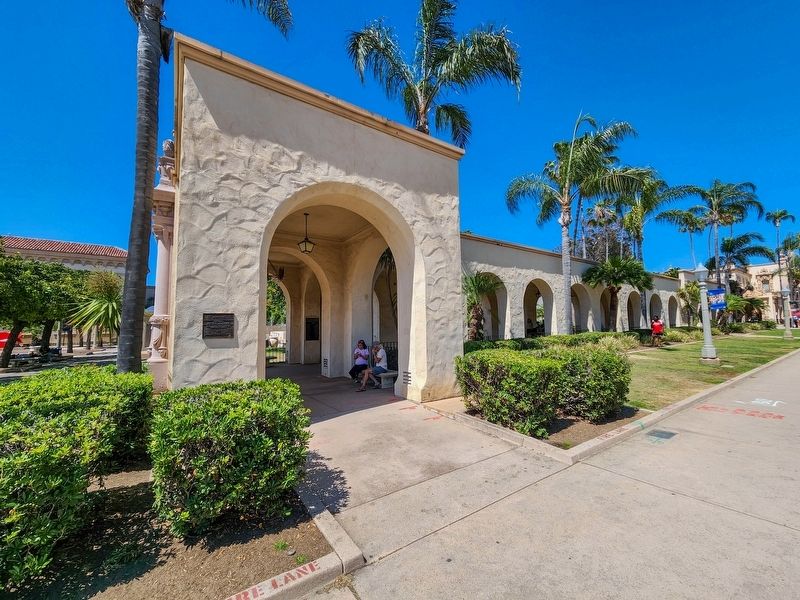
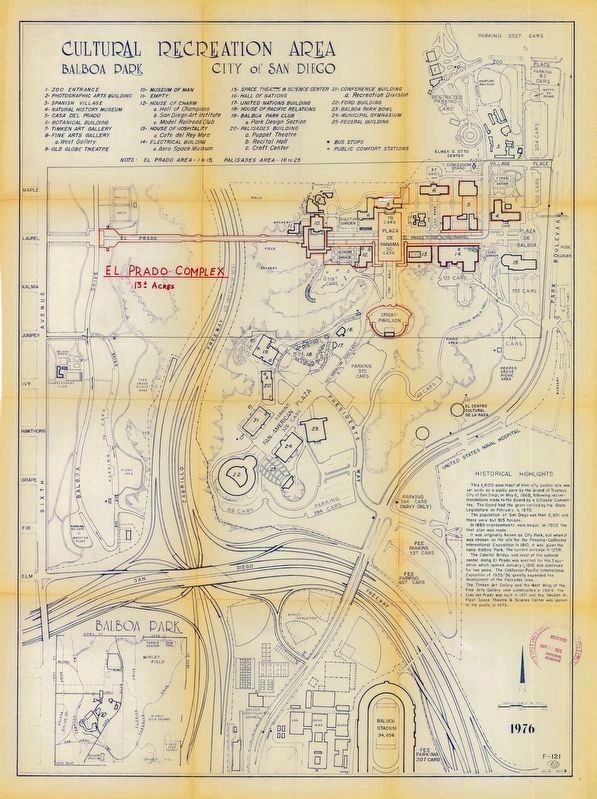
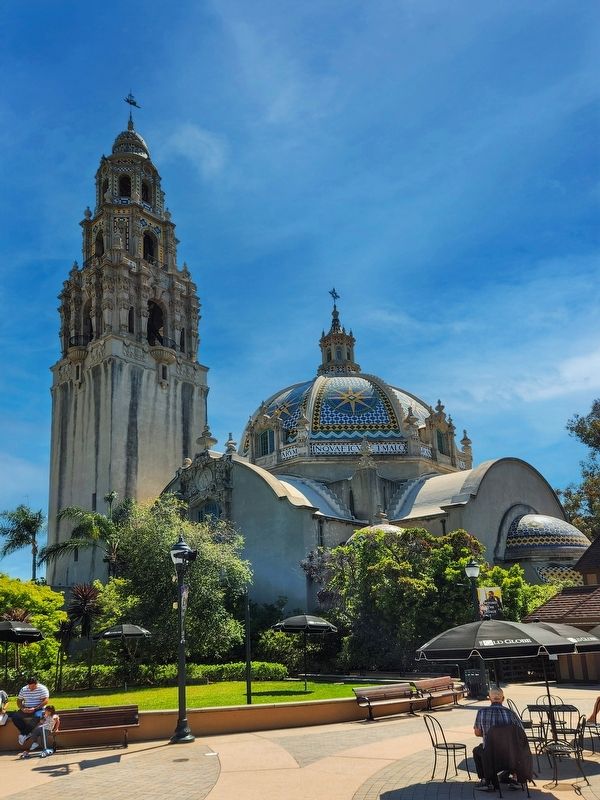
In 1902, the major turning point, George W. Marston commissioned Samuel Parsons Jr., New York landscape architect, to prepare a master plan for the park. Much of the basic road, path and tree development we see today is the result of the(Submitted on August 5, 2025, by Douglass Halvorsen of Klamath Falls, Oregon.)implementation of this plan. By 1909, the idea of an exposition was formulated to celebrate the opening of the Panama Canal, scheduled for completion in 1915. Civic leaders, led by G. Aubrey Davidson, (president of the Chamber of Commerce), rallied around the tremendously ambitious project and hired Bertram Grosvenor Goodhue from New York as the architect. Originally envisioned by the Director General (Col. D. C. Collier) as a miniature Mission-style city it is interesting speculation to wonder what role Irving Gill played in the early planning. Certainly unmistakably Gill motifs occur frequently in the arcades (with their pure circular arches), the administration building, the Cabrillo bridge, the botanical building and lily pond. In any event it is known that he acted as a consultant, but soon moved to Los Angeles, establishing a second office. Goodhue brought to San Diego the flamboyant, exciting Spanish-Colonial with the churrigueresque, the renaissance of the baroque and rococo styles, which turned the public taste away from the pure Mission simplicity. The Exposition plan was drawn, featuring the present well integrated classicalPhotographed by Douglass Halvorsen, July 7, 20252. Balboa Park MarkerView of NHL marker mounted on the East Arcade, which was restored in 1992 to commemmorate the 75th anniversary of the 1915 Panama California Exposition.scheme of landscaped buildings. The lath and plaster buildings were only to last a few years and were to be replaced later with permanent structures and landscaped gardens. The Exposition opened on 1 January 1915 and formally closed at the end of 1916, paying all its expenses and resulting in accomplishments that were far reaching for San Diego and its future role. Many new residents were attracted and, impressed by what they saw, stayed. Balboa Park emerged as the center of the city’s social, cultural and recreational life. The San Diego Zoo was established (1922) using the few animals that had been exhibited. Art and cultural exhibits were utilized and formed the beginning of the Fine Arts Society, the Museum of Man and the Natural History Museum. Morley Field developed after John Nolan's plan in 1927 and many WPA projects were instituted in the 1930's. By 1935, the city was ready for another fair and the California-Pacific International Exposition was planned, with Richard S. Requa as architect. Requa, trained in Gill's office, had developed his own architectural vocabulary, solidified by his world travels and is responsible forPhotographed by Douglass Halvorsen3. Balboa Park National Historic Landmark 'El Prado Complex' mapThis map is part of the National Register of Historic Places Nomination Form that was submitted to designate Balboa Park as a National Historic Landmark. The map includes buildings and structures that comprise the California Quadrant and the El Prado Complex, and were erected for the 1915 Panama-California Exposition.the buildings in the Palisades area, the Spanish Village, Old Globe Theater, Alcazar Garden and the Cafe Del Rey Moro patio and gardens. Used by the military throughout the war, with little additional development, the park suffered its next greatest encroachment by freeway projects, Cabrillo Freeway in the 1940s and interstate 5, in the 1960s. Balboa Park, now 102 years old, has indeed weathered many storms and has been the focus of much of San Diego's development. Along with the harbor. Mission Bay and, once, Mission Valley (now tragically destroyed) it is still one of San Diego's greatest assets.Photographed by Douglass Halvorsen, July 7, 20254. The California Building (Museum of Man)The California Building was erected for the 1915 Panama-California Exposition and is easily the most prominent/visible of all buildings that make up the National Historic Landmark District.
2. About Balboa Park.
Balboa Park is steeped in history. A true labor of love to the City’s leaders of the era, there was great effort to shape this rolling plot of land into the masterpiece it is today.(Submitted on August 5, 2025, by Douglass Halvorsen of Klamath Falls, Oregon.)
Additional commentary.
1. Official and Unofficial National Historic Landmark District buildings/structures
There is considerable confusion about which part of
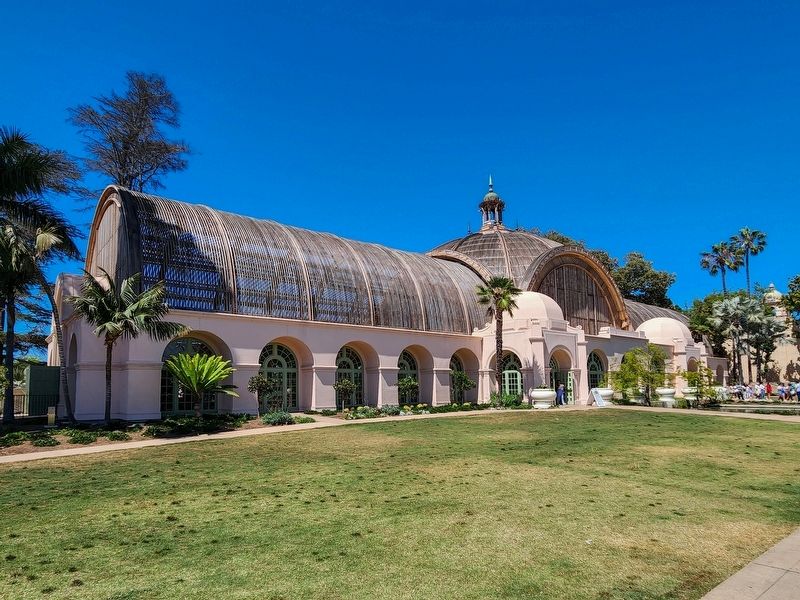
Photographed by Douglass Halvorsen, July 7, 2025
5. The Botanical Building
One of the buildings erected in 1915 for the Panama-California Exposition as part of the El Prado Complex within the National Historic Landmark District.
Officially, the National Park Service, as part of the Department of the Interior, contains three National Register of Historic Places Nomination/Inventory Forms that focus on two specific 'core groups' of buildings and structures, most of which were erected as part of the 1915 Panama-California Exposition: The California Quadrangle; and the El Prado Complex. The California Quadrangle is comprised of the following buildings and structures:
- The Administrative Building, 1915
- Structure walls of the Quadrangle connecting the California and Fine Arts Buildings, 1915
- Fine Arts Building, 1915 [currently the St. Francis Chapel]
- California Building, 1915 [currently home to the Museum of Man]
The El Prado Complex is comprised of the following buildings and structures:
- The Cabrillo Bridge (with approaches and guardhouses), 1915
- The House of Charm, 1915 [The building has had several names through the years: Mining Building (on plans during construction), Indian Arts Building (1915), Russia and Brazil Building (1916), and House of Charm (1935 to present)]
- The House
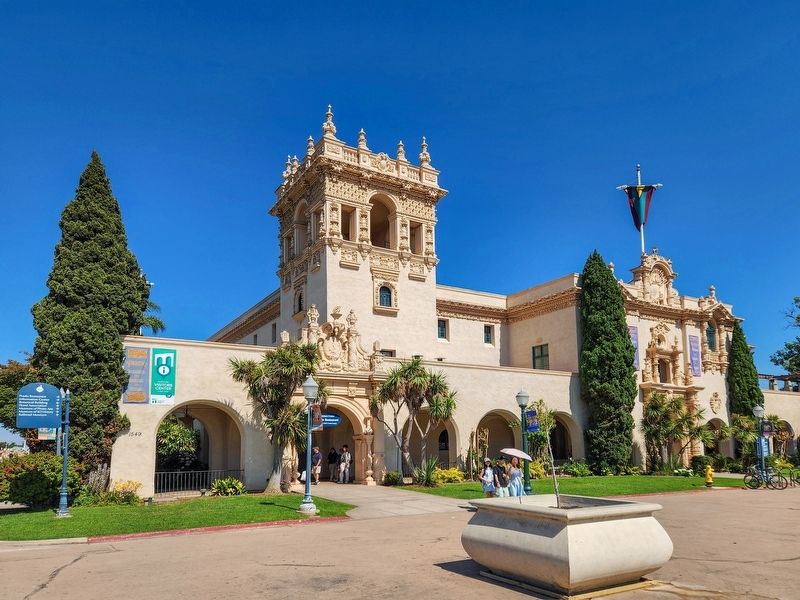
Photographed by Douglass Halvorsen, July 7, 2025
6. The House of Hospitality
The House of Hospitality, 1915 (originally called the Foreign Arts Building in 1915 for the Panama-California Exposition), and part of the El Prado Complex within the National Historic Landmark District.
- The Electrical Building [originally called the Commerce and Industries Building in 1915; renamed as the Canadian Building in 1916; renamed as the Palace of Better Housing for the 1935 California Pacific International Exposition; currently known as the San Diego Model Railroad Museum)
- The Botanical Building, 1915
- The Organ Pavilion, 1915
- The Alcazar Gardens, 1915 [originally known in 1915 as Los Jardines de Montezuma (Montezuma's Gardens)]
- The Plaza de Panama, 1915 [the plaza was called the Plaza del Pacifico during the 1935 California Pacific International Exposition
- The El Prado Arcade, 1915 [east and west sections have been demolished or reconstructed over the years]
- The Fine Arts Gallery, 1925 [West Wing erected in 1966, East Wing erected in 1975; the building occupies the site of the Sacramento Valley Building from the 1915 Panama-California Exposition]
- The Casa del Prado, 1968 [is a 90% reconstruction of the original building that was built for the 1915 Panama-California Exposition. At that time, it was known as the Varied Industries Building. In 1935, during the California Pacific International Exposition, the building was called the Food and Beverage Building]
- The Natural History Museum, 1933 [the site of the Natural History Museum was originally occupied by the Southern California Counties Building from the 1915 Panama-California Exposition. After the fair, the old building was renamed the Civic Auditorium. In December of 1925, the Civic Auditorium burned down. The site was marked for the new Natural History Museum which opened in January of 1933. In 1935, the building was called the Palace of Natural History during the California Pacific International Exposition]
There are additional buildings within the National Historic Landmark District that were NOT nominated in the National Register of Historic Places due to their recent age and architecture. They include the Timken Museum of Art and the Fleet Space/Science Center.
Unofficially, some buildings and structures were designated as part of the National Historic Landmark District and are located in the Palisades Park/Plaza area to the southwest of the Quadrangle and El Prado Complex. They were erected for the 1935 California Pacific International Exposition. The most prominent of the group is the former Ford Building, now known as the San Diego Air & Space Museum. Note To Editor only visible by Contributor and editor
— Submitted August 6, 2025, by Douglass Halvorsen of Klamath Falls, Oregon.
Credits. This page was last revised on September 5, 2025. It was originally submitted on August 5, 2025, by Douglass Halvorsen of Klamath Falls, Oregon. This page has been viewed 178 times since then and 78 times this year. Photos: 1, 2, 3, 4. submitted on August 5, 2025, by Douglass Halvorsen of Klamath Falls, Oregon. 5, 6. submitted on August 7, 2025, by Douglass Halvorsen of Klamath Falls, Oregon. • Devry Becker Jones was the editor who published this page.
