Fairgrounds in Columbus in Franklin County, Ohio — The American Midwest (Great Lakes)
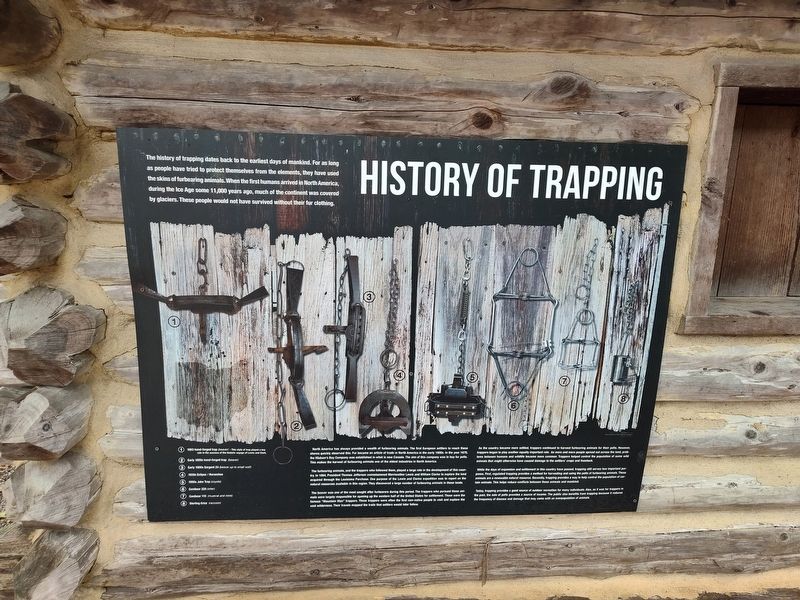
History Of Trapping
Photographed by Craig Doda, July 27, 2025
1. History Of Trapping Marker
1) 1803 hand-forged trap (beaver) - This style of trap played a key role in the success of the historic voyage of Lewis and Clark.
2) Early 1800s hand-forged trap (beaver)
3) Early 1900s Sargent 24 (beaver up to small wolf)
4) 1930s Eclipse/Horseshoe
6 1990s Jake Trap (coyote)
6) Conibear 220 (otter)
7) Conibear 110 (muskrat and mink)
8) Sterling Grizz (raccoon)
North America has always provided a wealth of furbearing animals. The first European settlers to reach these shores quickly observed this. Fur became an article of trade in North America in the early 1600s. In the year 1670 the Hudson's Bay Company was established in what is now Canada. The aim of this company was to buy fur pelts. This makes the harvest of furbearing
this page online
The furbearing animals, and the trappers who followed them, played a large role in the development of this country. In 1804, President Thomas Jefferson commissioned Merriwether Lewis and William Clarke to explore the land acquired through the Louisiana Purchase. One purpose of the Lewis and Clarke expedition was to report on the natural resources available in this region. They discovered a large number of furbearing animals in these lands.
The beaver was one of the most sought after furbearers during this period. The trappers who pursued these animals were largely responsible for opening up the western half of the United States for settlement. These were the famous "Mountain Man" trappers. These trappers were often the first non-native people to visit and explore the vast wilderness. Their travels mapped the trails that settlers would later follow.
As the country became more settled, trappers continued to harvest furbearing animals for their pelts. However trappers began to play another equally important role. As more and more people spread out across the land, problems between
Photographed by Craig Doda, July 27, 2025
2. History Of Trapping Marker
While the days of expansion settlement in this country have passed, trapping still serves two important purposes. First, regulated trapping provides a method for harvesting and using the pelts of furbearing animals. These animals are a renewable natural resource. Secondly, trapping provides a way to help control the population of certain animals. This helps reduce conflicts between these animals and mankind.
Today, trapping provides a good source of outdoor recreation for many individuals. Also, as it was for trappers in the past, the sale of pelts provides a source of income. The public also benefits from trapping because it reduces the frequency of disease and damage that may come with an overpopulation of animals.
Topics. This historical marker is listed in these topic lists: Animals • Exploration • Indigenous Peoples and Communities • Industry & Commerce. A significant historical year for this entry is 1803.
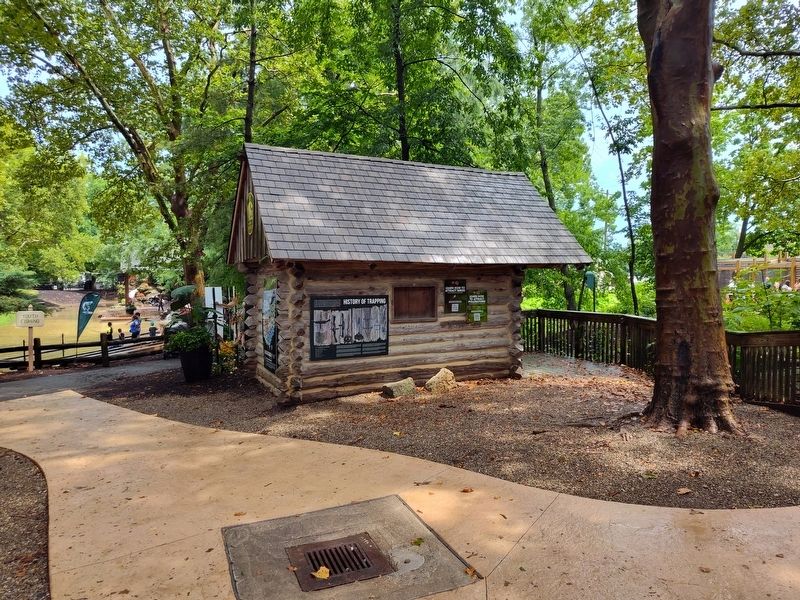
Location. 39° 59.667′ N, 82° 59.345′ W. Marker is in Columbus, Ohio, in Franklin County. It is in Fairgrounds. It is at the intersection of East 11th Avenue and Essex Avenue, on the right when traveling north on East 11th Avenue. The marker is located in natural resources park. Touch for map. Marker is at or near this postal address: 632 E 11th Avenue, Columbus OH 43211, United States of America. Touch for directions.

Regionally, this marker is in the Scioto Valley. It is also in the American Midwest and in the Corn Belt. Globally, it is in North America, the Western Hemisphere, the Western World, and the Anglosphere. Historically, it finds itself in what was once the Haudenosaunee (Iroquois) Confederacy, the territory of the Mississippian Culture, and the Northwest Territory.
Other nearby markers. At least 8 other markers are within walking distance of this marker: Apple Tree (within shouting distance of this marker); Ohio Buckeye (within shouting distance of this marker); Grindstones (within shouting distance of this marker); Serpent Mound Impact Structure (about 300 feet away, measured in a direct line); Flint: Ohio's State Gemstone (about 300 feet away); Beneath Your Feet (about 300 feet away); Geological Cross Section of Ohio (about 300 feet away); Ohio Department of Natural Resources 75th Anniversary (about 300 feet away). Touch for a list and map of all markers in Columbus.
Credits. This page was last revised on August 19, 2025. It was originally submitted on August 6, 2025, by Craig Doda of Napoleon, Ohio. This page has been viewed 124 times since then and 44 times this year. Photos: 1, 2. submitted on August 6, 2025, by Craig Doda of Napoleon, Ohio. • Andrew Ruppenstein was the editor who published this page.
