Punta Gorda in Charlotte County, Florida — The American South (South Atlantic)
Juan Ponce de Leon - Discoverer of Florida

Photographed by Brandon D Cross, July 28, 2025
1. Juan Ponce de Leon - Discoverer of Florida Marker
In 1493 Ponce de Leon accompanied Christopher Columbus on his second voyage to America, landing, in Hispaniola (present day Haiti and Dominican Republic). Ponce de Leon later served as a military commander and governor in Hispaniola from 1502 to 1508. He was awarded a land grant and Indian labor, which provided the produce and livestock to Spanish ships before their long voyage back to Spain. It was here that Juan greatly increased his wealth and prestige.
Ponce de Leon led an expedition to Puerto Rico in 1506 where he discovered gold. He was appointed governor of Puerto Rico from 1509-1511.
In early 1512, he was commissioned to explore for treasure and new territories for Spain. In the spring of 1513, Ponce de Leon set off for the Islands of Benimy with three ships, the Santa Maria de la Consolacion, the Santiago, and the San Cristobal.
this page online
He sailed around La Florida and in May 1513 was the first European to enter Bahia de Carlos (present day Charlotte Harbor) and anchored off Matanca Island (Pine Island). He did not find any gold during the three weeks he spent here, but did encounter unfriendly Calusa Indians. On June 15, 1513 they sailed away, after several Clashes with the Indians.
In 1521, Conquistador Ponce de Leon returned to Charlotte Harbor, with 200 men, including priests, farmers and artisans, 50 horses and other domestic animals, and farming implements, to establish a colony. He anchored off a fat point (Punta Gorda) and set up a camp there. A main mission was converting the Indians to Christianity. The fierce Calusa Indians resisted, and after a few months the camp was attacked, and the colonists abandoned camp for their ships. In his retreat,
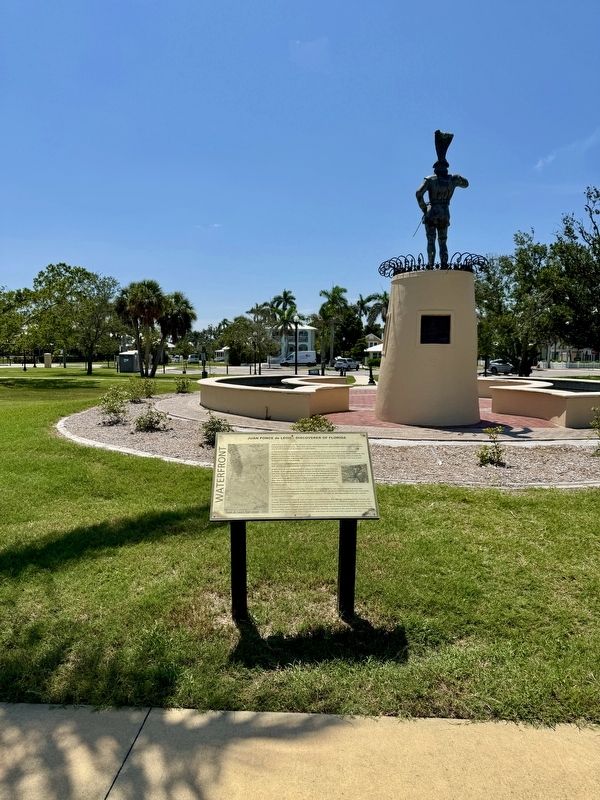
Photographed by Brandon D Cross, July 28, 2025
2. Juan Ponce de Leon - Discoverer of Florida Marker
Topics. This historical marker is listed in these topic lists: Exploration • Notable Events • Settlements & Settlers. A significant historical month for this entry is May 1513.
Location. 26° 56.016′ N, 82° 3.366′ W. Marker is in Punta Gorda, Florida, in Charlotte County. It is at the intersection of West Retta Esplanade and Harvey Street on West Retta Esplanade. The marker is located within Gilchrist Park close to the river. Touch for map. Marker is at or near this postal address: 400 W Retta Esplanade, Punta Gorda FL 33950, United States of America. Touch for directions.

Regionally, this marker is on the Gulf Coast. It is also in the American South and on the Gulf Coast. Globally, it is in the North Atlantic Region, North America, a Gulf of Mexico state, the Western Hemisphere, the Western World, and the Anglosphere. Historically, it finds itself in what was once New Spain, the territory of the Mississippian Culture, one of the Confederate States of America, and the Antebellum South.
Other nearby markers. At least 8 other markers are within walking distance of this marker: First Punta Gorda Home Site (about 700 feet away, measured in a direct line); The Trabue Plat And Waterfront Parks (about 700 feet away); Albert Waller Gilchrist (approx. 0.2 miles away); City of Punta Gorda (approx. 0.2 miles away); The Punta Gorda Bank (approx. ¼ mile away); The Fertilizer Plant in Punta Gorda 1903 (approx. ¼ mile away); Hector House Plaza: The Founding of Punta Gorda (approx. 0.3 miles away); Charlotte County Courthouse (approx. 0.4 miles away). Touch for a list and map of all markers in Punta Gorda.
Another marker is no longer nearby. Site of Hotel Punta Gorda (was approx. 0.3 miles away but has been confirmed missing).
Also see . . .
1. Ponce de Le Leon Florida’s First Spanish Explorer. (Submitted on August 6, 2025, by Brandon D Cross of Flagler Beach, Florida.)
2. European Exploration and Colonization. (Submitted on August 6, 2025, by Brandon D Cross of Flagler Beach, Florida.)
Credits. This page was last revised on August 7, 2025. It was originally submitted on August 6, 2025, by Brandon D Cross of Flagler Beach, Florida. This page has been viewed 243 times since then and 56 times this year. Photos: 1, 2. submitted on August 6, 2025, by Brandon D Cross of Flagler Beach, Florida. • Andrew Ruppenstein was the editor who published this page.
