Zanesville in Muskingum County, Ohio — The American Midwest (Great Lakes)
1854
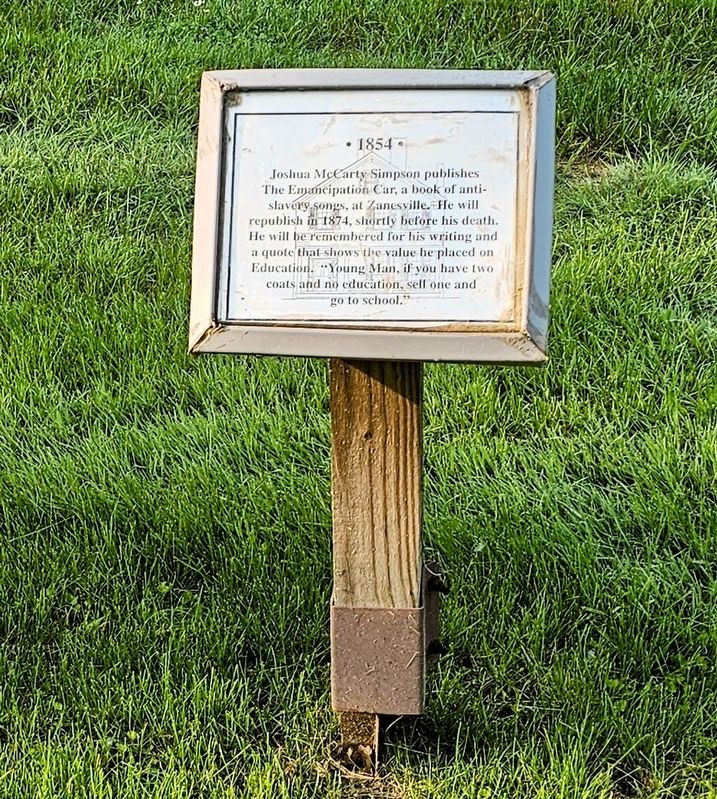
Photographed by Ian Lefkowitz, June 2, 2025
1. 1854 Marker
Topics. This historical marker is listed in these topic lists: Abolition & Underground RR • African Americans • Arts, Letters, Music. A significant historical year for this entry is 1854.
Location. 39° 55.904′ N, 82° 0.41′ W. Marker is in Zanesville, Ohio, in Muskingum County. It can be reached from Putnam Avenue (U.S. 22) north of Jefferson Street, on the right when traveling north. Touch for map. Marker is at or near this postal address: 456 Putnam Ave, Zanesville OH 43701, United States of America. Touch for directions.

Regionally, this marker is in the American Midwest, in Appalachia, and specifically in Northern Appalachia. Globally, it is in North America, the Western Hemisphere, the Western World, and the Anglosphere. Historically, it finds itself in what was once the Haudenosaunee
this page online
Other nearby markers. At least 8 other markers are within walking distance of this marker: 1859 (here, next to this marker); 1852 (here, next to this marker); 1851 (here, next to this marker); 1860 (here, next to this marker); 1861 (here, next to this marker); 1850 (here, next to this marker); 1847 (here, next to this marker); 1863 (here, next to this marker). Touch for a list and map of all markers in Zanesville.
Also see . . . The Emancipation Car, Being an Original Composition Of Anti-Slavery Ballads, Composed Exclusively Fo.
For many years before the Rebellion, my mind was queerly impressed with the awful condition of my Nation as slaves in the South.(Submitted on August 7, 2025, by Ian Lefkowitz of New York, New York.)
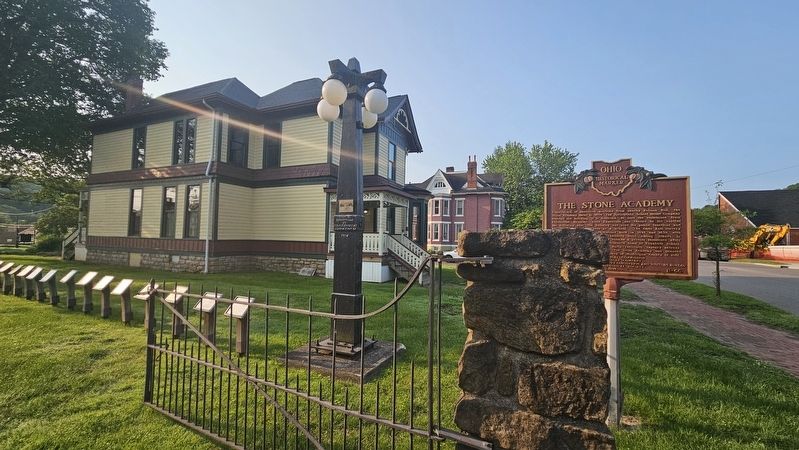
I was educated to believe that it was all right for us to be slaves, though a native of Morgan County, Ohio, I pretended to believe it too; and when quite a boy, would ridicule the Abolitionists as fools, devils, mischief-makers, &c., whenever I was in the presence of my old Boss or the Anti-Abolitionists. Persecutions in 1836 against Abolitionists became quite prevalent,and the man that dared to say “colored men,” “colored ladies and gentlemen,” “Mr.” or “Mrs.” to colored people, did it at the risk of a coat of rotten eggs, or a fancy ride on an ugly rail, or to be dressed up with a shirt of tar and feathers for Sunday, even in Morgan County, but my heart secretly moaned all the time and said “Lord what can be done for my people.” As soon as I could write, which was not until I was past twenty-one years old, a spirit of poetry, (which was always in me,) became revived, and seemed to waft before my mind horrid pictures of the condition of my people, and something seemed to say, “Write and sing about it— you can sing what would be death to speak.” So I began to write and sing. The first piece I wrote and sang in public, was for our School Exhibition on “Big Bottom,” in 1842; it was “Hail thou sweet and Welcome day,” found in this book, with a few changes made in 1846, to suit a West Indian Emancipation Celebration occasion.Photographed by Ian Lefkowitz, June 2, 20252. Putnam Underground Railroad Interpretive CenterThis marker is part of a series of markers that lead up to the abolition of slavery and the end of the Civil War.
Credits. This page was last revised on November 15, 2025. It was originally submitted on August 7, 2025, by Ian Lefkowitz of New York, New York. This page has been viewed 46 times since then and 18 times this year. Photos: 1, 2. submitted on August 7, 2025, by Ian Lefkowitz of New York, New York. • Devry Becker Jones was the editor who published this page.
