Strasburg in Shenandoah County, Virginia — The American South (Mid-Atlantic)
Historic Strasburg
Stop 5
Photographed by Bradley Owen, July 22, 2025
1. Historic Strasburg Marker
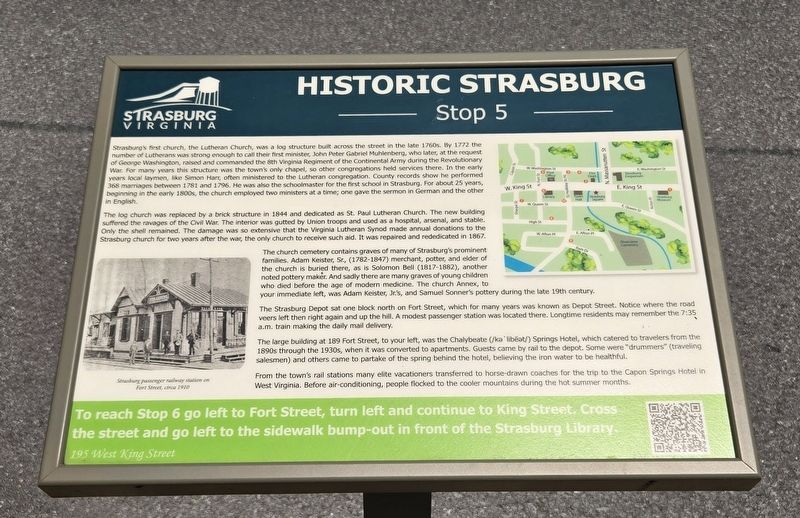
Strasburg's first church, the Lutheran Church, was a log structure built across the street in the late 1760s. By 1772 the number of Lutherans was strong enough to call their first minister, John Peter Gabriel Muhlenberg, who later, at the request of George Washington, raised and commanded the 8th Virginia Regiment of the Continental Army during the Revolutionary War. For many years this structure was the town's only chapel, so other congregations held services there. In the early years local laymen, like Simon Hart, often ministered to the Lutheran congregation. County records show he performed 368 marriages between 1781 and 1796. He was also the schoolmaster for the first school in Strasburg. For about 25 years, beginning in the early 1800s, the church employed two ministers at a time; one gave the sermon in German and the other in English.
The log church was replaced by a brick structure in 1844 and dedicated as St. Paul Lutheran Church. The new building suffered the ravages of the Civil War. The interior was gutted by Union troops and used as a hospital, arsenal, and stable. Only the shell remained. The damage was
this page online
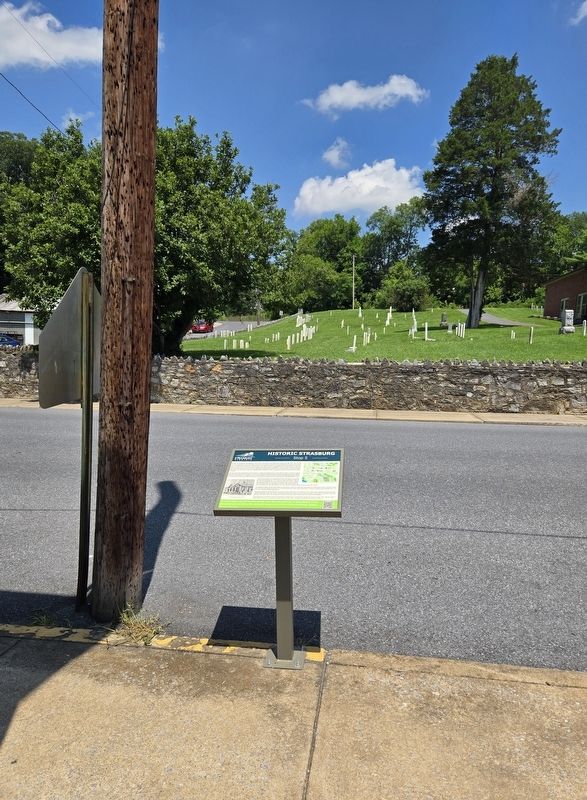
The church cemetery contains graves of many of Strasburg's prominent families. Adam Keister, Sr., (1782-1847) merchant, potter, and elder of the church is buried there, as is Solomon Bell (1817-1882), another noted pottery maker. And sadly there are many graves of young children who died before the age of modern medicine. The church Annex, to your immediate left, was Adam Keister, Jr.'s, and Samuel Sonner's pottery during the late 19th century.
The Strasburg Depot sat one block north on Fort Street, which for many years was known as Depot Street. Notice where the road veers left then right again and up the hill. A modest passenger station was located there. Longtime residents may remember the 7:35 a.m. train making the daily mail delivery.
The large building at 189 Fort Street, to your left, was the Chalybeate Springs Hotel, which catered to travelers from the 1890s through the 1930s, when it was converted to apartments. Guests
Photographed by Bradley Owen, July 22, 2025
2. Historic Strasburg Marker
From the town's rail stations many elite vacationers transferred to horse-drawn coaches for the trip to the Capon Springs Hotel in West Virginia. Before air-conditioning, people flocked to the cooler mountains during the hot summer months.
(Caption):
Strasburg passenger railway station on Fort Street, circa 1910
To reach Stop 6 go left to Fort Street, turn left and continue to King Street. Cross the street and go left to the sidewalk bump-out in front of the Strasburg Library.
195 West King Street
Erected 2023 by The Town of Strasburg and the Strasburg Heritage Association. (Marker Number 5.)
Topics. This historical marker is listed in these topic lists: Cemeteries & Burial Sites • Railroads & Streetcars • Religion & Religious Structures. A significant historical year for this entry is 1772.
Location. 38° 59.445′ N, 78° 21.773′ W. Marker is in Strasburg, Virginia, in Shenandoah County. It is on West Washington Street just east of North Fort Street, on the right when traveling east. Touch for map. Marker is at or near this postal address: 193 West Washington Street, Strasburg VA 22657, United States of America. Touch for directions.

Regionally, this marker is in the Shenandoah Valley. It is also in the American South, specifically in the Upper South, and in the Mid-Atlantic. Globally, it is in North America, the Western Hemisphere, the Western World, and the Anglosphere. Historically, it finds itself in what was once the territory of the Mississippian Culture, one of the original Thirteen Colonies, one of the Confederate States of America, and the Antebellum South.
Other nearby markers. At least 8 other markers are within walking distance of this marker: Saint Paul’s Lutheran Church (a few steps from this marker); Open House (about 400 feet away, measured in a direct line); a different marker also named Historic Strasburg (about 400 feet away); a different marker also named Historic Strasburg (about 500 feet away); Stonewall's Surprise (about 500 feet away); a different marker also named Historic Strasburg (about 800 feet away); American Legion (about 800 feet away); a different marker also named Historic Strasburg (approx. 0.2 miles away). Touch for a list and map of all markers in Strasburg.
Other markers no longer nearby. Historic Strasburg (has been replaced with this marker); a different marker also named Historic Strasburg (was about 400 feet away but has been replaced with another marker now near it); a different marker also named Historic Strasburg (was about 800 feet away but has been replaced with another marker now near it).
Related marker. Click here for another marker that is related to this marker. This marker has replaced another at this location.
Credits. This page was last revised on December 11, 2025. It was originally submitted on August 7, 2025, by Bradley Owen of Morgantown, West Virginia. This page has been viewed 96 times since then and 31 times this year. Photos: 1, 2. submitted on August 7, 2025, by Bradley Owen of Morgantown, West Virginia.
