Rione IX Pigna in Roma in Città metropolitana di Roma Capitale, Latium, Rome, Italy — Central Italy (Tyrrhenian Coast)
Elephant and Obelisk

Photographed by Sean P. Flynn, August 5, 2025
1. Elephant and Obelisk
The statue is often popularly known as Bernini’s Elephant, after the artist who designed it.
[Latin text on the base of the statue facing the church:]
Sapientis aegypti insculptas obelisco figuras ab elephanto bellurarum fortissima gestari quis quis hic vides documentum intellige robusta mentis esse solidam sapientiam sustinere
[Latin text on the base of the statue facing away from the church:]
Veterem obellscum palladis aegyptiae monumentum e tellure erutum et in minervae olim nunc deiparae cenitricis foro erectum divinae sapientiae
Alexander VII dedicatuit anno sal MDCLXVII
[English translation:]
Let any beholder of the carved images of the wisdom of Egypt on the obelisk carried by the elephant, the strongest of beasts, recognize that it takes a robust mind to carry solid wisdom
The ancient obelisk of the Palladium of Egypt, a monument dug out of the earth and erected in the former forum of Minerva to the mother of the goddess to divine wisdom
Dedicated by Alexander VII in A.D. 1667
Erected 1667 by Pope Alexander VII.
Topics. This historical marker is listed in these topic lists: Animals • Anthropology & Archaeology • Religion & Religious Structures. A significant historical year for this entry is 1667.
Location. 41° 53.879′ N,
this page online

Regionally, it is in Europe, the European Union, the Schengen Area, a coastal Mediterranean country, and the Western World. Historically, it finds itself in what was once the Roman Empire.
Other nearby markers. At least 8 other markers are within walking distance of this marker: Tommaso Badia of Modena (a few steps from this marker); Santa Maria sopra Minerva (a few steps from this marker); Tommaso de Vio, Cardinal Cajetan (a few steps from this marker); Grand Hotel de la Minerve (a few steps from this marker); Don José de San Martín (within shouting distance of this marker); Pantheon (about 120 meters away, measured in a direct line); Rione III Colonna / Colonna District III

Photographed by Sean P. Flynn, August 5, 2025
2. The text on the sculpture's base, facing the church
Regarding Elephant and Obelisk. The elephant statue holding the obelisk was designed by Gian Lorenzo Bernini, the Italian artist credited with creating the Baroque style. The statue was Bernini's final commission for Pope Alexander VII, who died in May 1667.
Also see . . .
1. Bernini's Elephant: A Curious Medley. From the About Art blog.
Excerpt: "In 1665, while digging the foundations of a wall in the garden of the monastery next to the church, Dominicans uncovered an obelisk inscribed with Egyptian hieroglyphs. Measuring around 5.5 metres in height, this is Rome’s smallest obelisk. It was most likely brought to Rome in the first half of the 1st century AD by the emperor Diocletian to adorn an Iseum (a temple) originally located underneath the church."(Submitted on August 7, 2025, by Sean P. Flynn of Oak Park, Illinois.)
2. Gian Lorenzo Bernini bio. From the Art Story website.
Excerpt: "Passion, above all else, ruled Italian sculptor and architect Gian Lorenzo Bernini. His extreme religious(Submitted on August 7, 2025, by Sean P. Flynn of Oak Park, Illinois.)piety combined with a lifelong study of the sculptural form led to the introduction of a dynamic and exuberant style, focused on emotional expressionism, which perfectly embodied the Baroque period. Like Michelangelo before him, he became a master of marble, while remaining equally fluent in other media. His manner and vision was so innovative, it pioneered a new era in European sculpture that has influenced the form to this day."Photographed by Sean P. Flynn, August 5, 20253. Bernini’s ElephantThe doors to Santa Maria Sopra Minerva church can be seen in the background. The obelisk the elephant was holding was found intact in a garden nearby in 1665, some 1,500 years after it had been brought to Rome from Egypt.

Additional keywords. Bernini's Elephant

Photographed by Sean P. Flynn, August 5, 2025
4. The text on the sculpture's base, facing away from the church

Photographed by Sean P. Flynn, August 5, 2025
5. Piazza della Minerva
A view from the steps of the church shows Bellini's statue of an elephant holding the Egpytian obelisk, with the Pantheon a short walk away on the right.
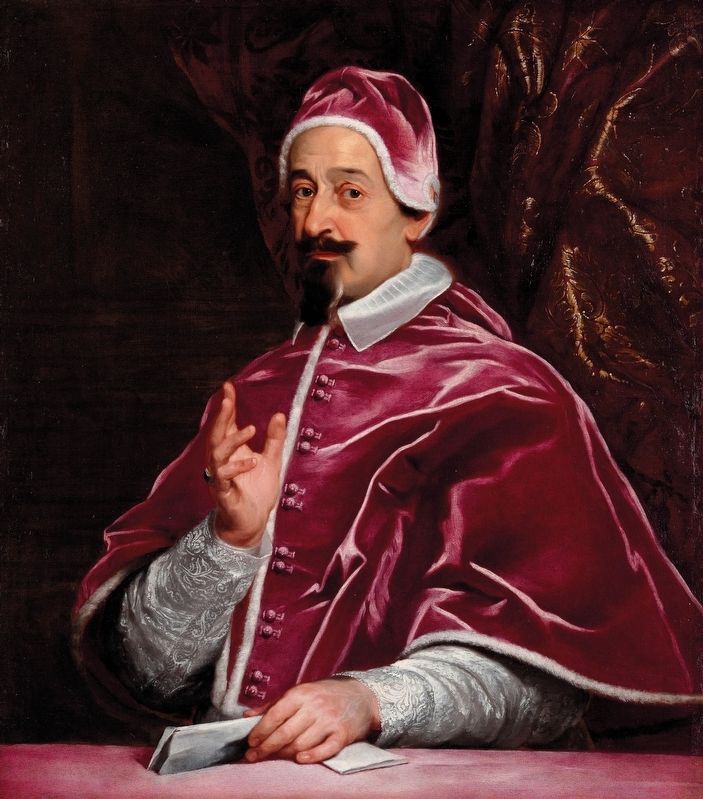
Painting by Giovanni Battista Gaulli (via Wikimedia Commons), circa 1660
6. Pope Alexander VII
Credits. This page was last revised on August 26, 2026. It was originally submitted on August 7, 2025, by Sean P. Flynn of Oak Park, Illinois. This page has been viewed 205 times since then and 48 times this year. Photos: 1, 2, 3, 4, 5. submitted on August 7, 2025, by Sean P. Flynn of Oak Park, Illinois. 6. submitted on August 26, 2026, by Sean P. Flynn of Oak Park, Illinois.
