Poncha Springs in Chaffee County, Colorado — The American Mountains (Southwest)
Crossroads of the Rockies
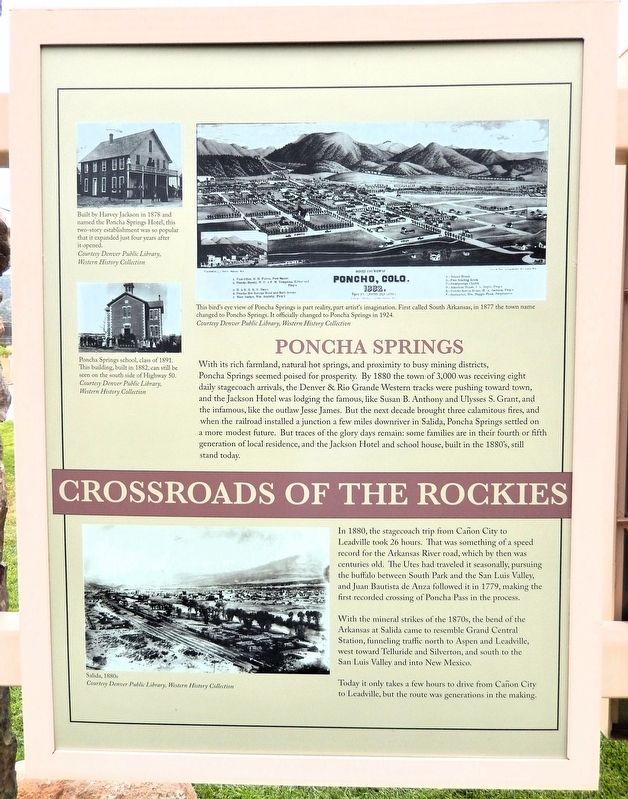
Poncha Springs
Photographed by Cosmos Mariner, July 22, 2025
1. Crossroads of the Rockies Marker
With its rich farmland, natural hot springs, and proximity to busy mining districts, Poncha Springs seemed poised for prosperity. By 1880 the town of 3,000 was receiving eight daily stagecoach arrivals, the Denver & Rio Grande Western tracks were pushing toward town, and the Jackson Hotel was lodging the famous, like Susan B. Anthony and Ulysses S. Grant, and the infamous, like the outlaw Jesse James. But the next decade brought three calamitous fires, and when the railroad installed a junction a few miles downriver in Salida, Poncha Springs settled on a more modest future. But traces of the glory days remain: some families are in their fourth or fifth generation of local residence, and the Jackson Hotel and school house, built in the 1880's, still stand today.
In 1880, the stagecoach trip from Cañon City to Leadville took 26 hours. That was something of a speed record for the Arkansas River road, which by then was centuries old. The Utes had traveled it seasonally, pursuing the buffalo between South Park and the San Luis Valley, and Juan Bautista de Anza followed it in 1779, making the first recorded crossing of Poncha
this page online
With the mineral strikes of the 1870s, the bend of the Arkansas at Salida came to resemble Grand Central Station, funneling traffic north to Aspen and Leadville, west toward Telluride and Silverton, and south to the San Luis Valley and into New Mexico.
Today it only takes a few hours to drive from Cañon City to Leadville, but the route was generations in the making.
Erected by Town of Poncha Springs.
Topics and series. This historical marker is listed in these topic lists: Exploration • Indigenous Peoples and Communities • Industry & Commerce • Railroads & Streetcars. In addition, it is included in the Former U.S. Presidents: #18 Ulysses S. Grant series list. A significant historical year for this entry is 1880.
Location. 38° 31.283′ N, 106° 4.851′ W. Marker is in Poncha Springs, Colorado, in Chaffee County. It can be reached from U.S. 285 just north of U.S. 50, on the right when traveling south. The marker is located at the Poncha Springs Crossroads Welcome Center. Touch for map. Marker is at or near this postal address: 7001 US Highway 285, Poncha Springs CO 81242, United States of America.
Denver Public Library, Western History Collection, circa 1882
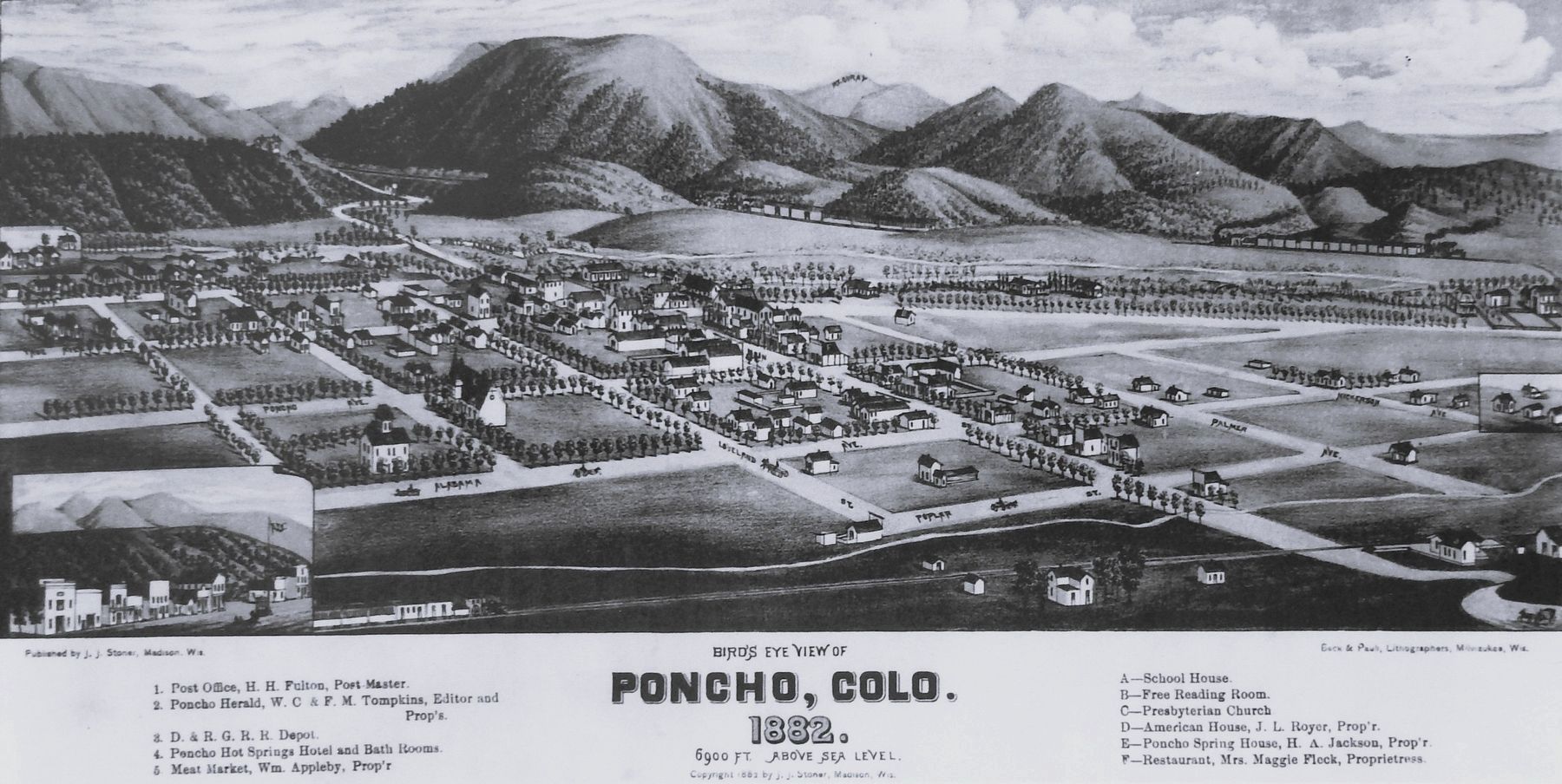
2. Marker detail: Bird’s Eye View of Poncho, Colorado, 1882
This bird’s eye view of Poncha Springs is part reality, part artist’s imagination. First called South Arkansas, in 1877 the town name changed to Poncho Springs. It officially changed to Poncha Springs in 1924.

Regionally, this marker is in the Arkansas River Valley, in the Colorado High Rockies and on the Continental Divide. It is also in the American Mountain West. Globally, it is in North America, the Rocky Mountains, the Western Hemisphere, the Western World, and the Anglosphere.
Other nearby markers. At least 8 other markers are within 4 miles of this marker, measured as the crow flies: Cities in the Wilderness (here, next to this marker); Poncha Springs Country (here, next to this marker); The Roof of the Rockies (here, next to this marker); Crossroads Town (within shouting distance of this marker); Meeting Midpoint (within shouting distance of this marker); Crossing Paths (within shouting distance of this marker); The Jackson Hotel (approx. 0.6 miles away); A Valley Landmark (approx. 3.7 miles away). Touch for a list and map of all markers in Poncha Springs.
Related markers. Click here for a list of markers that are related to this marker.
Also see . . .
1. Poncha Springs, Colorado (Wikipedia).
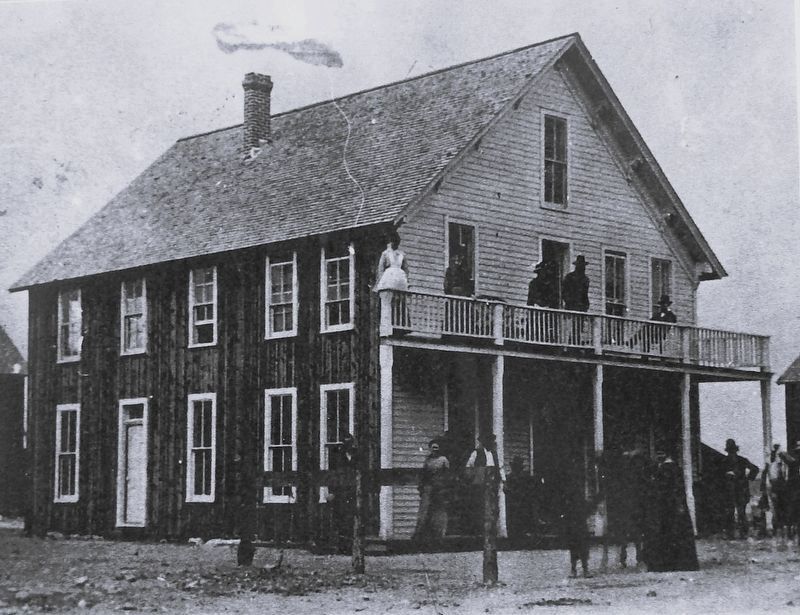
Excerpt: The Ute people used the Poncha Springs area as camping grounds during the(Submitted on August 9, 2025, by Cosmos Mariner of Cape Canaveral, Florida.)winter months on the eve of European settlement of the region. Juan Bautista de Anza led a military expedition over Poncha Pass in 1779, which is about 6 miles south of the present-day town. Following the Spanish exploration, French trappers and fur traders moved in.Denver Public Library, Western History Collection3. Marker detail: Poncha Springs HotelBuilt by Harvey Jackson in 1878 and named the Poncha Springs Hotel, this two-story establishment was so popular that it expanded just four years after it opened.
Around 1860, prospectors began arriving, including Bob Hendricks and Nat Rich, who built the first cabin in town, which is still standing. Nat Rich's son, James, was the first white person born in Poncha Springs in 1867. Indian agent John Burnett homesteaded with his wife, Minerva Maxwell Burnett, who was an early schoolteacher in Poncha Springs. In 1866, Burnett constructed a log building on his ranch to serve as an Indian trading post. Poncha Springs began to grow in the 1870s and was incorporated on December 8, 1880.
2. Ulysses S. Grant in Central Colorado (Colorado Central Magazine).
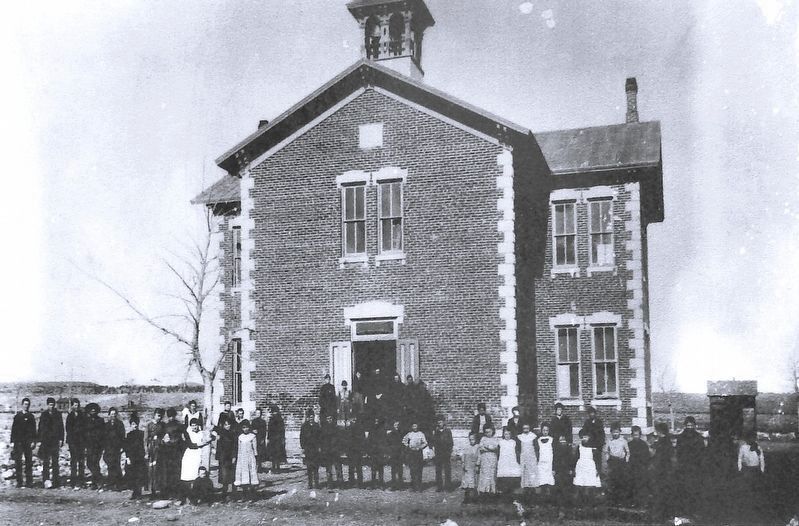
(By Forrest Whitman, 5/1/2018) Excerpt: Central Colorado has special ties to Grant. His three visits to Colorado culminated in an 1880 visit to Salida, Gunnison and Leadville. Grant always(Submitted on August 9, 2025, by Cosmos Mariner of Cape Canaveral, Florida.)had a special place in his heart for Colorado and that was reciprocal. His 1880 visit to Central Colorado was a triumph. He rode the narrow-gauge Denver and Rio Grande train to Salida and was met by a delegation of locals. He then was taken over Monarch Pass in a four-horse stage. He toured mines in Taylor Park and Gunnison and then returned to Salida. Grant then rode the newly completed Denver and Rio Grande Railroad up to Leadville.Denver Public Library, Western History Collection4. Marker detail: Poncha Springs school, class of 1891This building, built in 1882, can still be seen on the south side of US Highway 50.
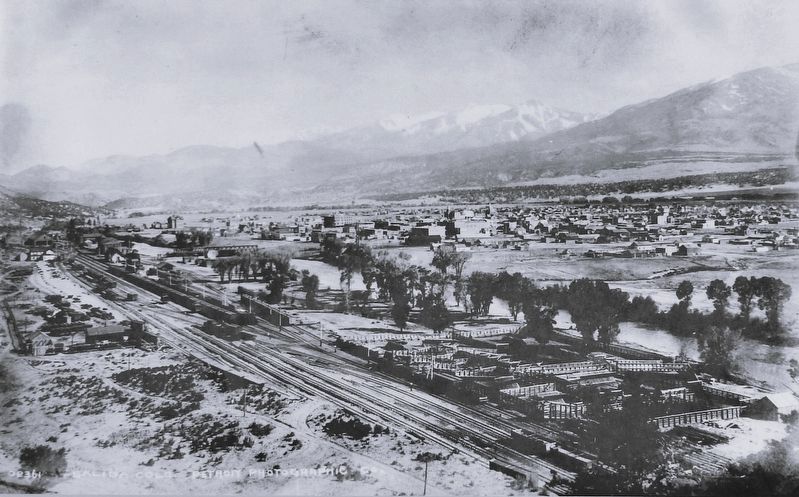
Denver Public Library, Western History Collection
5. Marker detail: Salida, 1880s
Photographed by Cosmos Mariner, July 22, 2025
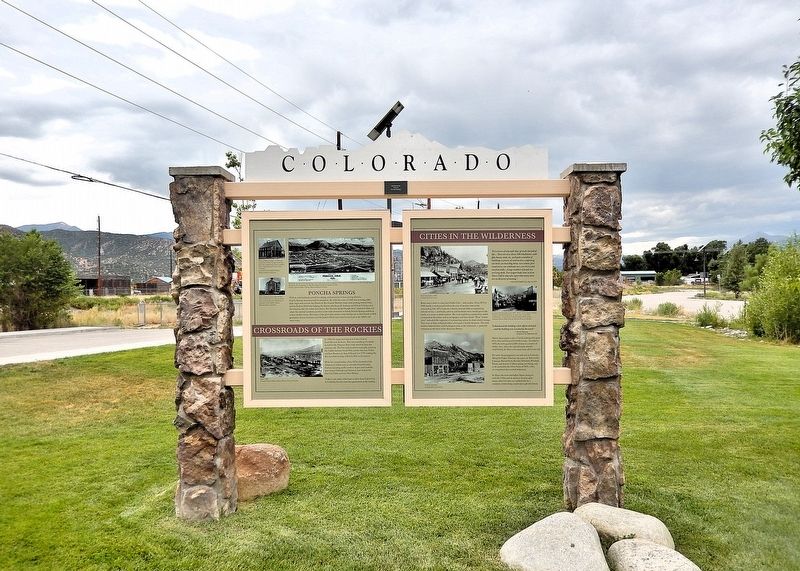
6. Poncha Springs Crossroads Interpretive Kiosk
This marker is the leftmost of 2 interpretive panels on the east side of the kiosk.
Credits. This page was last revised on August 9, 2025. It was originally submitted on August 8, 2025, by Cosmos Mariner of Cape Canaveral, Florida. This page has been viewed 166 times since then and 44 times this year. Photos: 1. submitted on August 8, 2025, by Cosmos Mariner of Cape Canaveral, Florida. 2, 3, 4, 5, 6. submitted on August 9, 2025, by Cosmos Mariner of Cape Canaveral, Florida.
