Near Mountainair in Socorro County, New Mexico — The American Mountains (Southwest)
Gran Quivira
Photographed by James Hulse, April 10, 2025
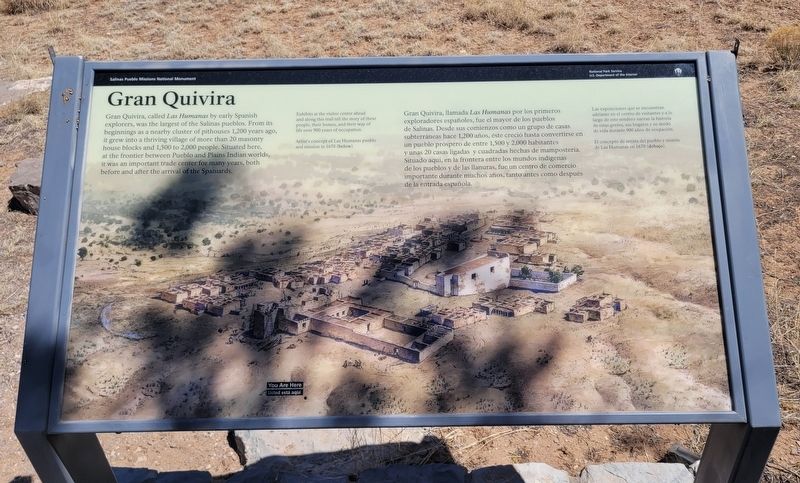
1. Gran Quivira Marker
 Gran Quivira, called Las Humanas by early Spanish explorers, was the largest of the Salinas pueblos. From its beginnings as a nearby cluster of pithouses 1,200 years ago, it grew into a thriving village of more than 20 masonry house blocks and 1,500 to 2,000 people. Situated here, at the frontier between Pueblo and Plains Indian worlds, it was an important trade center for many years, both before and after the arrival of the Spaniards.
Exhibits at the visitor center ahead and along this trail tell the story of these people, their homes, and their way of life over 900 years of occupation.
Artist's concept of Las Humanas pueblo and mission in 1670 (below)
Gran Quivira, llamada Las Humanas por los primeros exploradores españoles, fue el mayor de los pueblos de Salinas. Desde sus comienzos como un grupo de casas subterráneas hace 1,200 años, éste creció hasta convertirse en un pueblo próspero de entre 1,500 y 2,000 habitantes y unas 20 casas ligadas y cuadradas hechas de mampostería. Situado aquí, en la frontera entre los mundos indígenas de los pueblos y de las llanuras, fue un centro de comercio
this page online
Las exposiciones que se encuentran adelante en el centro de visitantes y a lo largo de este sendero narran la historia de estas gentes, sus hogares y su modo de vida durante 900 años de ocupación.
El concepto de artista del pueblo y misión de Las Humanas en 1670 (debajo).
Erected by Salinas Pueblo Missions National Monument and National Park Service, U.S. Department of the Interior.
Topics. This historical marker is listed in these topic lists: Indigenous Peoples and Communities • Settlements & Settlers. A significant historical year for this entry is 1670.
Location. 34° 15.554′ N, 106° 5.598′ W. Marker is near Mountainair, New Mexico, in Socorro County. It is on Wsmr S Rte 41 south of New Mexico Route 55. The marker is located on the grounds of the Salinas Pueblo Missions National Monument - Gran Quivíra Ruins. Touch for map. Marker is in this post office area: Claunch NM 87011, United States of America. Touch for directions.

Regionally, this marker is in Southwest New Mexico and in the Rio Grande Valley. It is also in the American Southwest.
Photographed by James Hulse, April 10, 2025
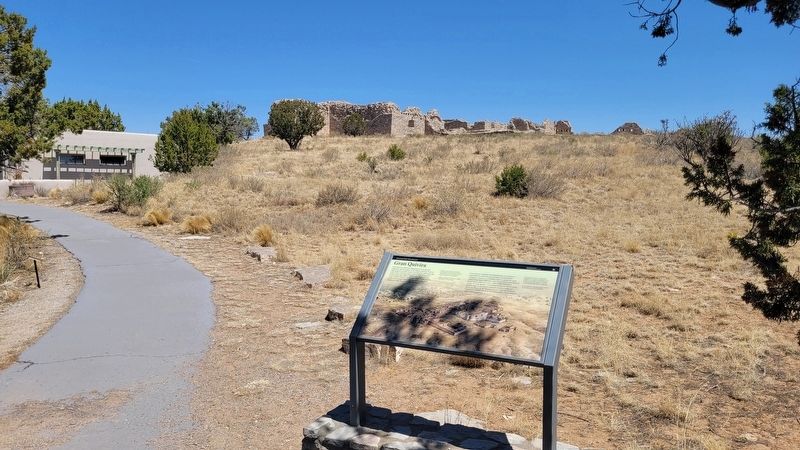
2. The view of the Gran Quivira and Marker along the trail
Other nearby markers. At least 8 other markers are within walking distance of this marker: Power from the sun (a few steps from this marker); Pricklypear (a few steps from this marker); Soaptree yucca (a few steps from this marker); One-seed juniper (a few steps from this marker); Walkingstick cholla (a few steps from this marker); Four-wing saltbush (a few steps from this marker); Las Misiones de los Pueblos de Salinas (within shouting distance of this marker); Exploring Las Humanas / Explorando Las Humanas (within shouting distance of this marker). Touch for a list and map of all markers in Mountainair.
Also see . . . Gran Quivira. National Park Service
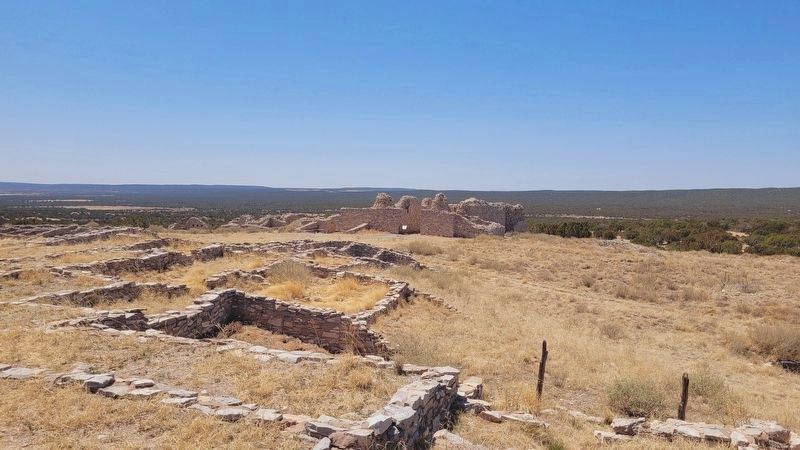
The Gran Quivira unit of Salinas Pueblo Missions National Monument is the largest of the three units at 611 acres. Prior to Spanish contact, Gran Quivira was a vast city with multiple pueblos, and kivas. Mound 7, a 226 room structure from the Pueblo IV period (A.D.1275/1300-1600),(Submitted on August 9, 2025, by James Hulse of Medina, Texas.)is the largest and only fully excavated pueblo at the site. During the excavation, an older Circular Pueblo was discovered under Mound 7. First contact with the Spanish probably happened in 1583 with the arrival of Don Antonio de Espejo who mentions a settlement that sounds very similar to Gran Quivira. The Spanish returned in 1598 with the expedition of Don Juan de Oñate who was the first Spaniard to colonize what would become New Mexico. Oñate visited a pueblo he called Las Humanas which was the southernmost settlements. As part of the mission system, Las Humanas (Gran Quivira) was first placed under the Pecos Mission District. Later, with the arrival of Fray Alonso de Benavides in 1626, Gran Quivira was given more attention and later became a visita (a satellite mission without a resident Father) of Abó in 1629. That same year construction began on the first permanent mission at Gran Quivira. Under the supervision of Fray Francisco Letrado, rooms on the west end of Mound 7 (Letrado's Convento) were used by the Spanish for housing and probably an early chapel. Letrado was moved to the Zuni Pueblo in 1631 and Gran Quivira came under the control of Fray Francisco de Acevedo at the Abó Mission. Construction on Iglesia de San Isidro was completed in 1635. In 1659 Fray Diego de Santander was permanently assigned to Gran Quivira. Soon after, construction on a new larger church, San Buenaventura, began. By 1672 a combination of disease, drought, famine, and Apache raiding led to the abandonment of Gran Quivira.Photographed by James Hulse, April 10, 20253. The view from the top of the Gran Quivira Ruins
Credits. This page was last revised on August 9, 2025. It was originally submitted on August 8, 2025, by James Hulse of Medina, Texas. This page has been viewed 127 times since then and 34 times this year. Photos: 1, 2, 3. submitted on August 9, 2025, by James Hulse of Medina, Texas.
