Ostia Antica in Città metropolitana di Roma Capitale, Latium, Rome, Italy — Central Italy (Tyrrhenian Coast)
Terme di Nettuno. I Mosaici
L'Area a Servizio del Fiume e Il Quartiere Dei Magazzini
⎯⎯⎯
Baths of Neptune. The Mosaics
Area Serving River and Warehouse District

Photographed by Sean P. Flynn, August 5, 2025
1. Terme di Nettuno. I Mosaici / Baths of Neptune. The Mosaics Marker
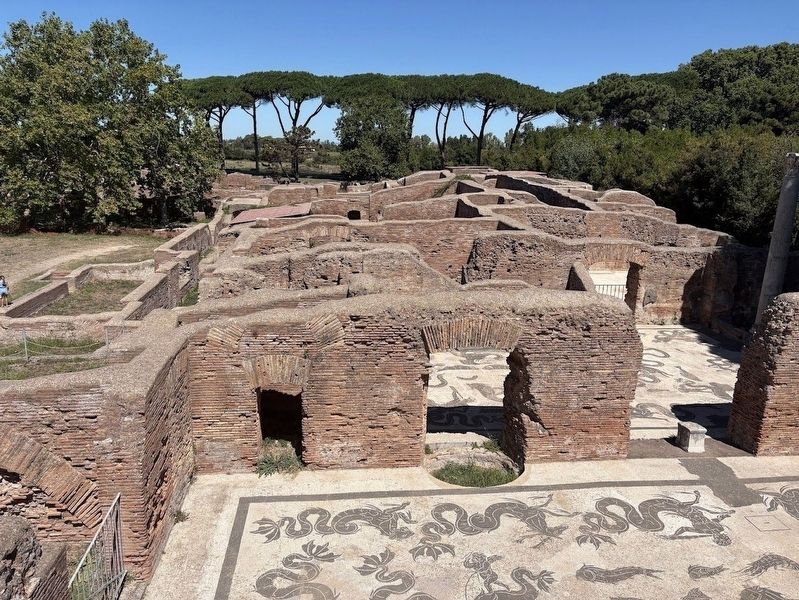
The view from the terrace, on the first floor of the building, allows us to appreciate the uniformity and quality of the baths' mosaic decorations. Deities and marine subjects allude to the theme of water, clearly connected to the building's function as a bath complex. The first room (A) shows Amphitrite, Neptune's wife, riding a sea horse and accompanied by tritons; in the second room (B) is Neptune himself with a trident, driving a four-horse chariot drawn by sea horses, surrounded by dolphins and tritons blowing on shells. The frigidarium (room for cold baths) (C) was also paved with a mosaic depicting Scylla, the monster who killed seafarers, surrounded by marine deities. These mosaics are important evidence of the rich mosaic production of Ostia's workshops at the time of Hadrian (AD 117-138).
Erected by Italian
this page online
Topics. This historical marker is listed in these topic lists: Anthropology & Archaeology • Arts, Letters, Music • Religion & Religious Structures.
Location. 41° 45.385′ N, 12° 17.562′ E. Marker is in Ostia Antica, Lazio (Latium, Rome), in Città metropolitana di Roma Capitale. It is on no nearby street. The marker is in Ostia Antica Archaeological Park, atop a building used as an overlook. Touch for map. Marker is at or near this postal address: Viale degli Scavi, Ostia Antica, Lazio 00119, Italy. Touch for directions.

Regionally, it is in Europe, the European Union, the Schengen Area, a coastal Mediterranean country, and the Western World. Historically, it finds itself in what was once the Roman Empire.
Other nearby markers. At least 8 other markers are within walking distance of this marker: Terme di Nettuno / Baths of Neptune (within shouting distance of this marker); Caserma dei Vigili / Police Barracks (within shouting distance of this marker); L'Area del Teatro e il Centro Delle Corporazioni Commerciali (within shouting

Photographed by Sean P. Flynn, August 5, 2025
2. A view of one of the mosaics
Also see . . . Regio II - Insula IV: Terme di Nettuno.
Excerpt: "To the east of the theatre are very large baths (c. 67 x 67 metres), today known as the Baths of Neptune. The building was excavated by Lanciani in 1888 and Vaglieri in 1909 and 1910. It is famous because of its black-and-white floor mosaics. The complex replaced baths from the late first century AD. The masonry is clearly Hadrianic, confirmed by brick stamps. Modifications took place in the last decade of the third and in the fourth century."(Submitted on August 9, 2025, by Sean P. Flynn of Oak Park, Illinois.)

Photographed by Sean P. Flynn, August 5, 2025
3. The Baths of Neptune and their mosaics
Photographed by Sean P. Flynn, August 5, 2025
4. Baths of Neptune
Credits. This page was last revised on October 9, 2026. It was originally submitted on August 9, 2025, by Sean P. Flynn of Oak Park, Illinois. This page has been viewed 100 times since then and 43 times this year. Photos: 1, 2, 3, 4. submitted on August 9, 2025, by Sean P. Flynn of Oak Park, Illinois.
