Ostia Antica in Città metropolitana di Roma Capitale, Latium, Rome, Italy — Central Italy (Tyrrhenian Coast)
Ninfei Ai Lati del Teatro e c.d. Oratorio Cristiano
L'area del teatro e il centro delle corporazioni commerciali
⎯⎯⎯
Nymphaeums and the Christian Oratorio
Theatre and trading corporations HQ
| — | (Reg. II, Is. VII, 1, 6, 7) | — |

Photographed by Sean P. Flynn, August 5, 2025
1. Ninfei Ai Lati del Teatro e c.d. Oratorio Cristiano / Nymphaeums and the Christian Oratorio Marker
Built to adorn the front of the theatre already during the Domitianic period (late 1st century AD), the two twin nymphaea (A-B) had a semi-circular plan and were incorporated into a small later portico with marble columns (C). An oratory (one of Ostia's few Christian buildings) was installed in the east nymphaeum in the 4th-5th century AD, it consisted of a chamber with an apse and was made of reused bricks (D). The oratory was built to commemorate the martyrs of Ostia (including St Aurea and St Cyriacus), killed in AD 269 near the arch of Caracalla (E) that stands in front of the theatre. It maintained its religious function until the medieval period, when the town was already in ruins.
Erected by Italian
this page online
Topics. This historical marker is listed in these topic lists: Anthropology & Archaeology • Religion & Religious Structures. A significant historical year for this entry is 269 CE.
Location. 41° 45.349′ N, 12° 17.527′ E. Marker is in Ostia Antica, Lazio (Latium, Rome), in Città metropolitana di Roma Capitale. It can be reached from Viale degli Scavi. The marker is in Ostia Antica Archaeological Park. Touch for map. Marker is in this post office area: Ostia Antica, Lazio 00119, Italy. Touch for directions.

Regionally, it is in Europe, the European Union, the Schengen Area, a coastal Mediterranean country, and the Western World. Historically, it finds itself in what was once the Roman Empire.
Other nearby markers. At least 8 other markers are within walking distance of this marker: In Memoriam Sanctae Monnicae / In Memory of Saint Monica (here, next to this marker); The Martyrs of Ostia Tiberina (here, next to this marker); Horrea di Ortensio e Horrea dell'Artemide / The Warehouses of Hortensius and Artemis (here, next to this marker); L'Area del Teatro e il Centro Delle Corporazioni Commerciali
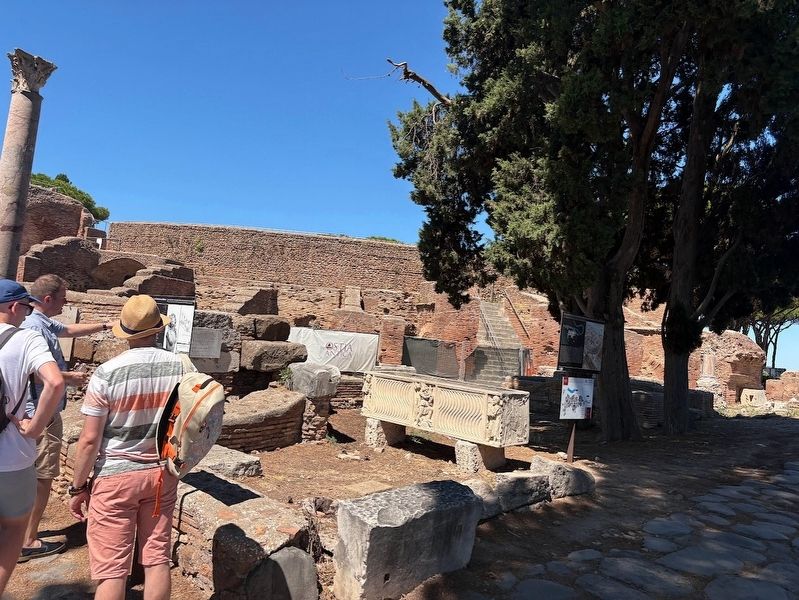
Photographed by Sean P. Flynn, August 5, 2025
2. The area of the Christian Oratory
More about this marker. A nymphaeum is a shrine dedicated to nymphs.
Two nearby markers commemorate the martyrs killed in this area in the 260s AD.
Also see . . . Christian Oratory.
Excerpt: "To the south-east of the theatre are the scanty remains of a little Christian chapel, excavated in 1910 by Dante Vaglieri. The area in which it was built, marked E on the plan, had a long and complex history. Nymphaeum II,VII,7 (B) was a decorative feature from the first three centuries AD. Other constructions in the area (C, D) were razed to the ground. In the late fourth or early fifth century a roughly triangular area was created, flanked to the south by columns, to the west by the theatre, to the north by two columns (on of which is on top of a street), and to the east by block II,VI. The level of this area was raised considerably and covered with many small pieces of marble."(Submitted on August 9, 2025, by Sean P. Flynn of Oak Park, Illinois.)
Credits. This page was last revised on August 9, 2025. It was originally submitted on August 9, 2025, by Sean P. Flynn of Oak Park, Illinois. This page has been viewed 78 times since then and 16 times this year. Photos: 1, 2. submitted on August 9, 2025, by Sean P. Flynn of Oak Park, Illinois.
