Poncha Springs in Chaffee County, Colorado — The American Mountains (Southwest)
Meeting Midpoint
| — | Collegiate Peaks Scenic and Historic Byway | — |
Photographed by Cosmos Mariner, July 23, 2025
1. Meeting Midpoint Marker
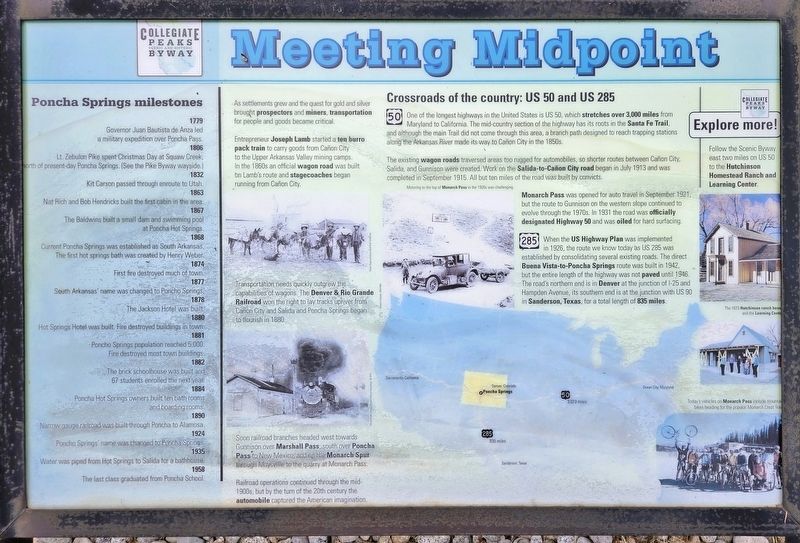
As settlements grew and the quest for gold and silver brought prospectors and miners, transportation for people and goods became critical.
Entrepreneur Joseph Lamb started a ten burro pack train to carry goods from Cañon City to the Upper Arkansas Valley mining camps. In the 1860s an official wagon road was built On Lamb's route and stagecoaches began running from Cañon City.
Transportation needs quickly outgrew the capabilities of wagons. The Denver & Rio Grande Railroad won the right to lay tracks upriver from Cañon City and Salida and Poncha Springs began to flourish in 1880.
Soon railroad branches headed west towards Gunnison over Marshall Pass, south over Poncha Pass to New Mexico, and up the Monarch Spur through Maysville to the quarry at Monarch Pass.
Railroad operations continued through the mid-1900s, but by the turn of the 20th century the automobile captured the American imagination.
Crossroads of the country: US 50 and US 285
US 50
One of the longest highways in the United States is US 50, which stretches over 3,000 miles from Maryland to California. The mid-country section of the highway has its roots in the
this page online
The existing wagon roads traversed areas too rugged for automobiles, so shorter routes between Cañon City, Salida, and Gunnison were created. Work on the Salida-to-Cañon City road began in July 1913 and was completed in September 1915. All but ten miles of the road was built by convicts.
Monarch Pass was opened for auto travel in September 1921, but the route to Gunnison on the western slope continued to evolve through the 1970s. In 1931 the road was officially designated Highway 50 and was oiled for hard surfacing.
US 285
When the US Highway Plan was implemented in 1926, the route we know today as US 285 was established by consolidating several existing roads. The direct Buena Vista-to-Poncha Springs route was built in 1942, but the entire length of the highway was not paved until 1946. The road's northern end is in Denver at the junction of I-25 and Hampden Avenue, its southern end is at the junction with US 90 in Sanderson, Texas, for a total
Photographed by Cosmos Mariner, July 22, 2025
2. Meeting Midpoint Marker
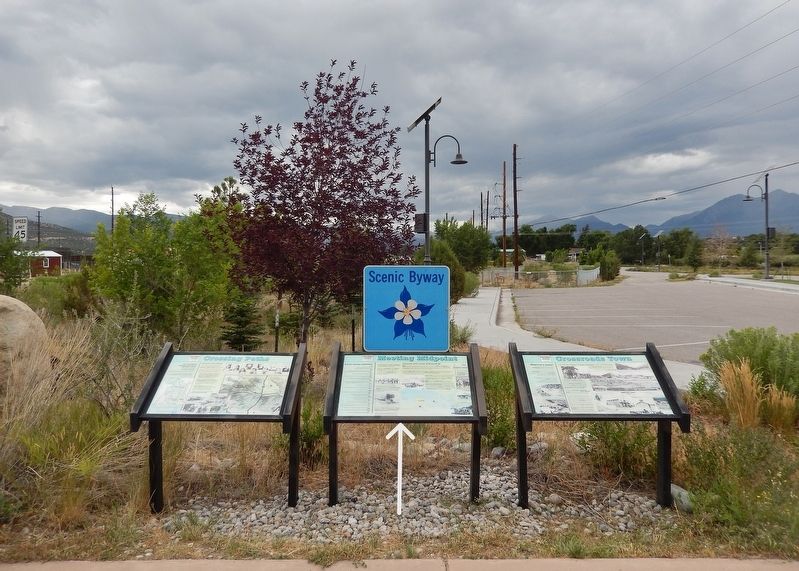
This is the center one of three interpretive panels on the west side of the Poncha Springs Crossroads Welcome Center.
Explore more!
Follow the Scenic Byway east two miles on US 50 to the Hutchinson Homestead Ranch and Learning Center.
Poncha Springs milestones
• 1779 Governor Juan Bautista de Anza led a military expedition over Poncha Pass.
• 1806 Lt. Zebulon Pike spent Christmas Day at Squaw Creek, north of present-day Poncha Springs. (See the Pike Byway wayside.)
• 1832 Kit Carson passed through enroute to Utah.
• 1863 Nat Rich and Bob Hendricks built the first cabin in the area.
• 1867 The Baldwins built a small dam and swimming pool at Poncha Hot Springs.
• 1868 Current Poncha Springs was established as South Arkansas. The first hot springs bath was created by Henry Weber.
• 1874 First fire destroyed much of town.
• 1877 South Arkansas' name was changed to Poncho Springs.
• 1878 The Jackson Hotel was built.
• 1880 Hot Springs Hotel was built. Fire destroyed buildings in town.
• 1881 Poncho Springs population reached 5,000. Fire destroyed most town buildings.
• 1882 The brick schoolhouse was built and 67 students enrolled the next year.
• 1884 Poncha Hot Springs owners built ten bath rooms and boarding rooms.
• 1890 Narrow gauge railroad was built through Poncha to Alamosa.
• 1924 Poncho Springs' name was changed to Poncha Springs.
• 1935 Water was piped from Hot Springs to Salida for a bathhouse.
• 1958 The last class graduated from Poncha School.
[photo captions]
• Motoring to the top of Monarch Pass in the 1920s was challenging.
• Sacramento, California
• The 1873 Hutchinson ranch house and the Learning Center
• Ocean City, Maryland
• Today’s vehicles on Monarch Pass include mountain bikes heading for the popular Monarch Crest Trail.
Topics. This historical marker is listed in these topic lists: Industry & Commerce • Railroads & Streetcars • Roads & Vehicles • Settlements & Settlers. A significant historical year for this entry is 1880.
Location. 38° 31.266′ N, 106° 4.843′ W. Marker is in Poncha Springs, Colorado, in Chaffee County. It can be reached from U.S. 285 just north of U.S. 50, on the right when traveling south. The marker is located at the Poncha Springs Crossroads Welcome Center. Touch for map. Marker is at or near this postal address: 7001 US Highway 285, Poncha Springs CO 81242, United States of America. Touch for directions.

Regionally, this marker is in the Arkansas River Valley, in the Colorado High Rockies and on the Continental Divide. It is also in the American Mountain West. Globally, it is in North America, the Rocky Mountains, the Western Hemisphere, the Western World, and the Anglosphere.
Other nearby markers. At least 8 other markers are within 4 miles of this marker, measured as the crow flies: Crossing Paths (here, next to this marker); Crossroads Town (here, next to this marker); Crossroads of the Rockies (within shouting distance of this marker); Poncha Springs Country (within shouting distance of this marker); Cities in the Wilderness (within shouting distance of this marker); The Roof of the Rockies (within shouting distance of this marker); The Jackson Hotel (approx. 0.6 miles away); A Valley Landmark (approx. 3.7 miles away). Touch for a list and map of all markers in Poncha Springs.
Related markers. Click here for a list of markers that are related to this marker.
Also see . . . Poncha Springs, Colorado (Wikipedia).
Excerpt: The Ute people used the Poncha Springs area as camping grounds during the winter months on the eve of European settlement of the region. Juan Bautista de Anza led a military expedition over Poncha Pass in 1779, which is about 6 miles (10 km) south of the present-day town. Following the Spanish exploration, French trappers and fur traders moved in. Around 1860, prospectors began arriving, including Bob Hendricks and Nat Rich, who built the first cabin in town, which is still standing. Nat Rich's son, James, was the first white person born in Poncha Springs in 1867. Poncha Springs began to grow in the 1870s, and was incorporated on December 8, 1880.(Submitted on August 10, 2025, by Cosmos Mariner of Cape Canaveral, Florida.)
Credits. This page was last revised on August 10, 2025. It was originally submitted on August 10, 2025, by Cosmos Mariner of Cape Canaveral, Florida. This page has been viewed 134 times since then and 37 times this year. Photos: 1, 2. submitted on August 10, 2025, by Cosmos Mariner of Cape Canaveral, Florida.
