Crossroads Town
| — | Collegiate Peaks Scenic and Historic Byway | — |
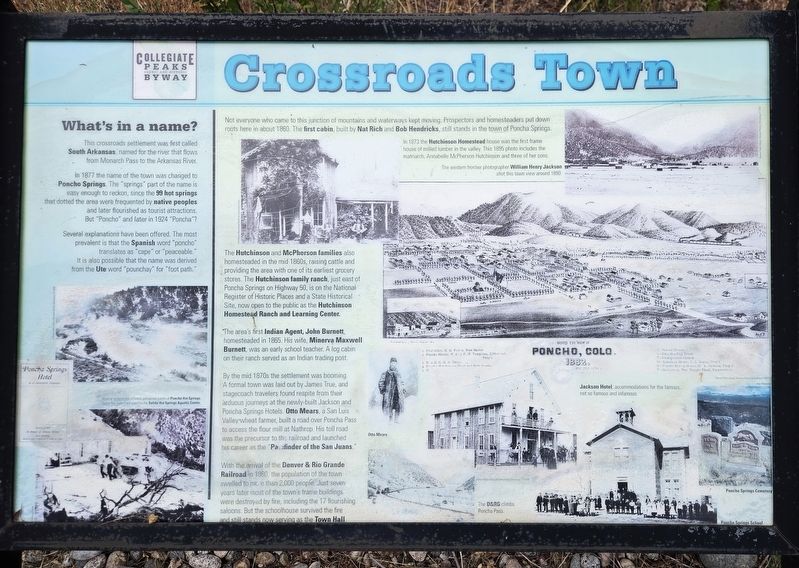
Not everyone who came to this junction of mountains and waterways kept moving. Prospectors and homesteaders put down roots here in about 1860. The first cabin, built by Nat Rich and Bob Hendricks, still stands in the town of Poncha Springs.
In 1873 the Hutchinson Homestead house was the first frame house of milled lumber in the valley.
The Hutchinson and McPherson families also homesteaded in the mid 1860s, raising cattle and providing the area with one of its earliest grocery stores. The Hutchinson family ranch, just east of Poncha Springs on Highway 50, is on the National Register of Historic Places and a State Historical Site, now open to the public as the Hutchinson Homestead Ranch and Learning Center.
The area's first Indian Agent, John Burnett, homesteaded in 1865. His wife, Minerva Maxwell Burnett, was an early school teacher. A log cabin on their ranch served as an Indian trading post.
By the mid 1870s the settlement was booming. A formal town was laid out by James True, and stagecoach travelers found respite from their arduous journeys at the newly-built Jackson and Poncha Springs Hotels. Otto Mears, a San Luis
this page online
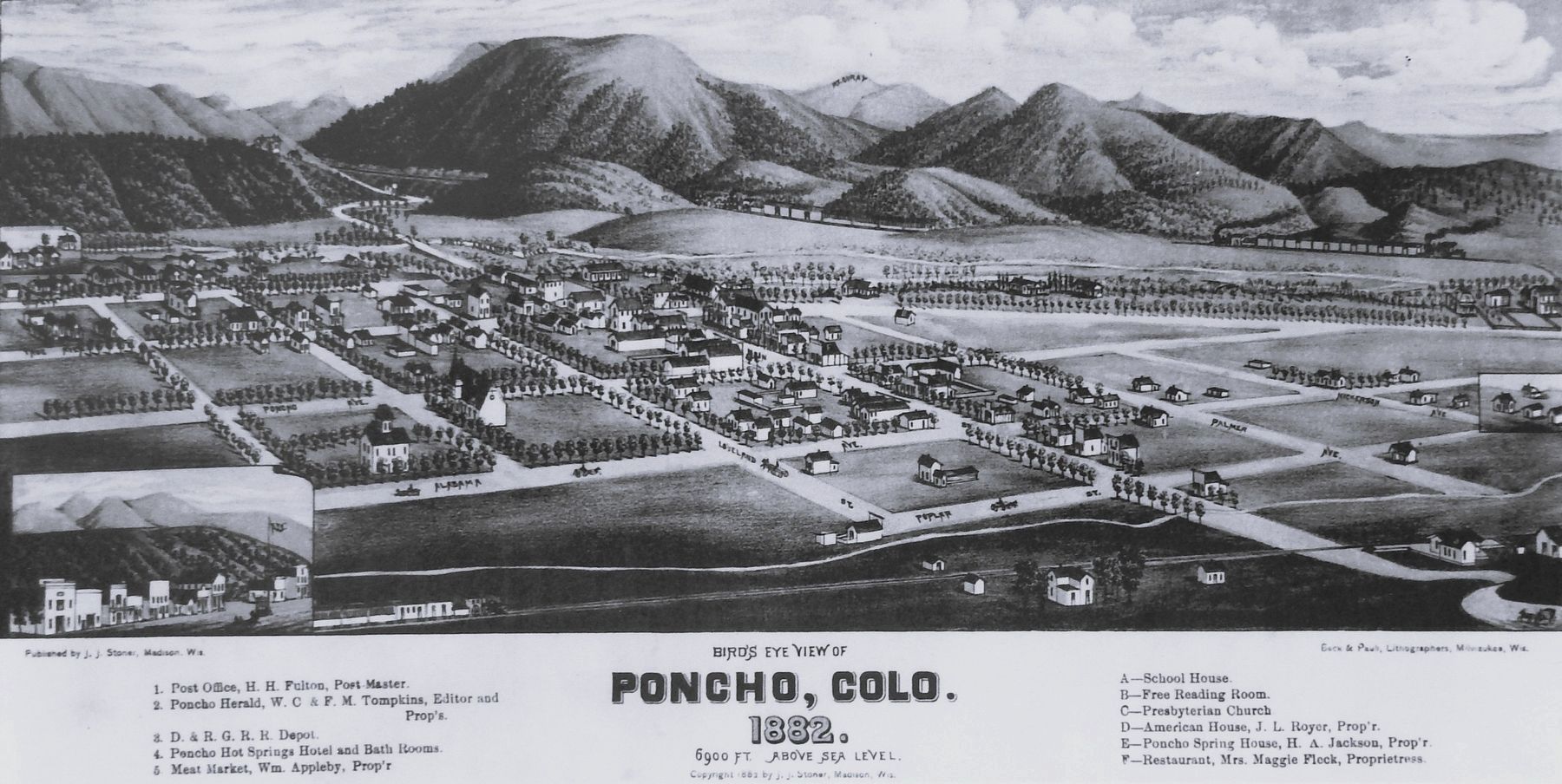
With the arrival of the Denver & Rio Grande Railroad in 1880 the population of the town swelled to more than 2,000 people. Just seven years later most of the town's frame buildings were destroyed by fire, including the 17 flourishing saloons. But the schoolhouse survived the fire and still stands, now servingas the Town Hall.
This crossroads settlement was first called South Arkansas, named for the river that flows from Monarch Pass to the Arkansas River.
In 1877 the name of the town was changed to Poncho Springs. The "springs" part of the name is easy enough to reckon, since the 99 hot springs that dotted the area were frequented by native peoples and later flourished as tourist attractions. But "Poncho" and later in 1924 "Poncha"?
Several explanations have been offered. The most prevalent is that the Spanish word "poncho" translates as "cape" or "peaceable." It is also possible that the name was derived from the Ute
[photo & illustration captions]
• Several generations of hotels pampered guests at Poncha Hot Springs.
• Today the waters are piped to the Salida Hot Springs Aquatic Center.
• The western frontier photographer William Henry Jackson shot this town view around 1890.
• The Hutchinson Homestead. This 1895 photo includes the matriarch, Annabelle McPherson Hutchinson and three of her sons.
• Otto Mears
• Jackson Hotel, accommodations for the famous, not so famous and infamous.
• The D&RG climbs Poncha Pass.
• Poncha Springs Cemetery
• Poncha Springs School
Topics. This historical marker is listed in these topic lists: Industry & Commerce • Railroads & Streetcars • Roads & Vehicles • Settlements & Settlers. A significant historical year for this entry is 1860.
Location. 38° 31.267′ N, 106° 4.843′ W. Marker is in Poncha Springs, Colorado, in Chaffee County. It can be reached from U.S. 285 just north of U.S. 50, on the right when traveling south. The marker is located at the Poncha Springs Crossroads Welcome Center. Touch for map. Marker is at or near this postal address: 7001 US Highway 285, Poncha Springs

Regionally, this marker is in the Arkansas River Valley, in the Colorado High Rockies and on the Continental Divide. It is also in the American Mountain West. Globally, it is in North America, the Rocky Mountains, the Western Hemisphere, the Western World, and the Anglosphere.
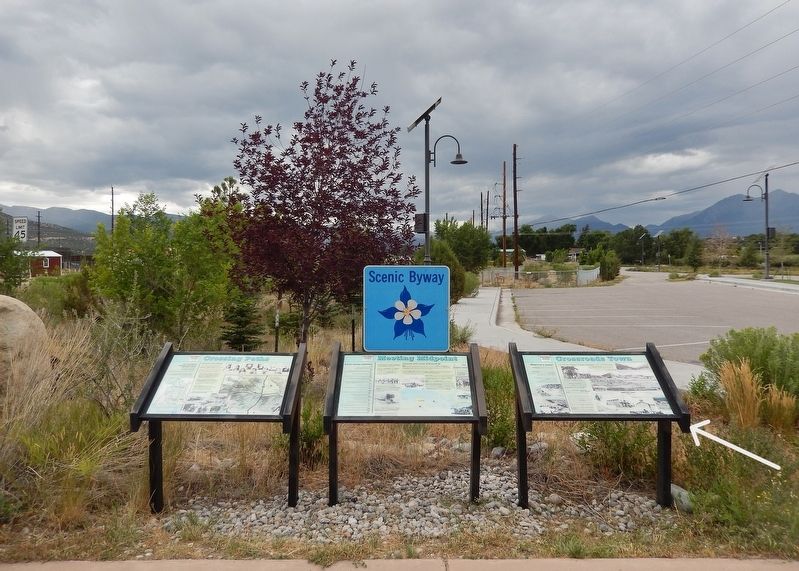
Other nearby markers. At least 8 other markers are within 4 miles of this marker, measured as the crow flies: Meeting Midpoint (here, next to this marker); Crossing Paths (here, next to this marker); Crossroads of the Rockies (within shouting distance of this marker); Poncha Springs Country (within shouting distance of this marker); Cities in the Wilderness (within shouting distance of this marker); The Roof of the Rockies (within shouting distance of this marker); The Jackson Hotel (approx. 0.6 miles away); A Valley Landmark (approx. 3.7 miles away). Touch for a list and map of all markers in Poncha Springs.
Also see . . . About Poncha Springs (Town of Poncha Springs).
Excerpt: With abundant hot springs and the influence of Spanish culture in the area, the community site became known as Poncho (meaning cape and warmth) Springs. The Ute Indians often camped in this area, spending summer high in the Rockies and winters in the lower mountain valleys where the average yearly temperatures are a pleasant 45 degrees Fahrenheit.(Submitted on August 10, 2025, by Cosmos Mariner of Cape Canaveral, Florida.)In 1779, Juan Batista de Anza led a military expedition over Poncha Pass. Trappers soon followed the explorers. Kit Carson, a famous mountain man of the times, is credited by some with the discovery of the hot springs. Prospectors began to arrive on the scene about 1860. Nat Rich and Bob Hendricks built the first cabin (still standing) in town. James Rich, son of Nat Rich, was the first white child born in Poncha Springs in 1867.
Poncha started to boom in the mid 1870's. Construction on the Jackson Hotel was begun in 1876 and completed in 1878. The town incorporated on December 8, 1880. With the building of the railroad in 1880, the population grew to well over 2000. Poncha had the first library in Chaffee county. A major fire in 1887 destroyed almost all of the Town's frame buildings. Another early day structure, the Presbyterian Church, built in 1882 was lost to fire in 1932.
Credits. This page was last revised on August 10, 2025. It was originally submitted on August 10, 2025, by Cosmos Mariner of Cape Canaveral, Florida. This page has been viewed 129 times since then and 33 times this year. Photos: 1, 2, 3. submitted on August 10, 2025, by Cosmos Mariner of Cape Canaveral, Florida.
