Ostia Antica in Città metropolitana di Roma Capitale, Latium, Rome, Italy — Central Italy (Tyrrhenian Coast)
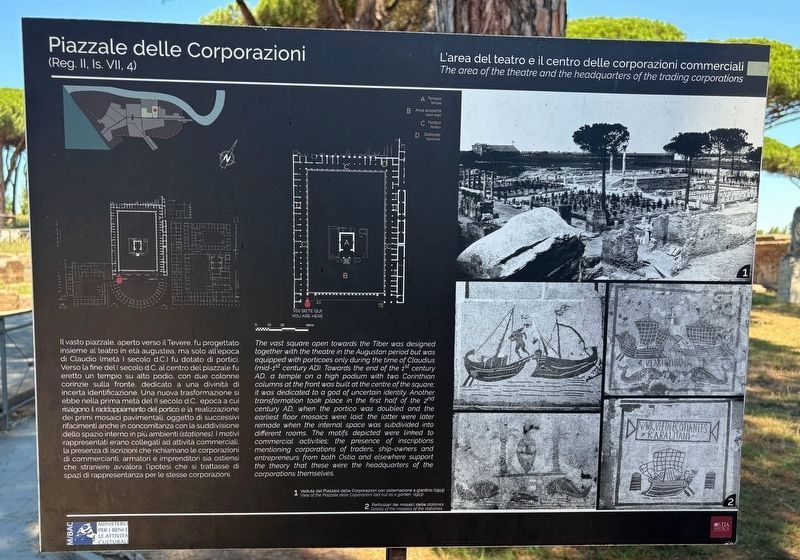
Piazzale delle Corporazioni
L'area del teatro e il centro delle corporazioni commerciali
⎯⎯⎯
Square of the Corporations
Theatre and trading corporations HQ
| — | (Reg. II, Is. VII. 4) | — |
Photographed by Sean P. Flynn, August 5, 2025
1. Piazzale Piazzale delle Corporazioni / Square of the Corporations Marker
The vast square open towards the Tiber was designed together with the theatre in the Augustan period but was equipped with porticoes only during the time of Claudius (mid-1st century AD). Towards the end of the 1st century AD, a temple on a high podium with two Corinthian columns at the front was built at the centre of the square: it was dedicated to a god of uncertain identity. Another transformation took place in the first half of the 2nd century AD, when the portico was doubled and the earliest floor mosaics were laid: the latter were later remade when the internal space was subdivided into different rooms. The motifs depicted were linked to commercial activities: the presence of inscriptions mentioning corporations of traders, ship-owners and entrepreneurs from both Ostia and elsewhere support the theory that these were the headquarters of the corporations themselves.
Erected by Italian
this page online
Topics. This historical marker is listed in these topic lists: Anthropology & Archaeology • Arts, Letters, Music • Industry & Commerce • Religion & Religious Structures.
Location. 41° 45.355′ N, 12° 17.461′ E. Marker is in Ostia Antica, Lazio (Latium, Rome), in Città metropolitana di Roma Capitale. It can be reached from Viale degli Scavi. The marker is in Ostia Antica Archaeological Park, in the sqaure just north of the theater. Touch for map. Marker is in this post office area: Ostia Antica, Lazio 00119, Italy. Touch for directions.

Regionally, it is in Europe, the European Union, the Schengen Area, a coastal Mediterranean country, and the Western World. Historically, it finds itself in what was once the Roman Empire.
Other nearby markers. At least 8 other markers are within walking distance of this marker: A different marker also named Piazzale delle Corporazioni / Square of the Corporations (within shouting distance of this marker); The Theatre of Ostia (within shouting distance of this marker); Gli Interventi di Restauro e Rifunzionalizzazione del Teatro Romano di Ostia

Photographed by Sean P. Flynn, August 5, 2025
2. Piazzale delle Corporazioni / Square of the Corporations Marker
More about this marker. Two identical signs can be found along the walkway through this piazza.
Also see . . . The Piazzale delle Corporazioni.
Excerpt: "The Piazzale delle Corporazioni (Square of the Corporations) is one of the most famous monuments in Ostia. Many mosaic inscriptions and depictions are related to maritime trade, to importing goods for Rome by ship: grain, olive oil, wild animals, and so on. The city of Rome was a major focus of the Mediterranean trade, involving especially the western Mediterranean sea."(Submitted on August 10, 2025, by Sean P. Flynn of Oak Park, Illinois.)

Photographed by Sean P. Flynn, August 5, 2025
3. A rear view of the Square of the Corporations marker, with Ostia's theater in the background

Photographed by Sean P. Flynn, August 5, 2025
4. Mosaics in the Piazzale delle Corporazioni

Photographed by Sean P. Flynn, August 5, 2025
5. Latin words etched onto a stone in Piazzale delle Corporazioni
Credits. This page was last revised on August 21, 2026. It was originally submitted on August 10, 2025, by Sean P. Flynn of Oak Park, Illinois. This page has been viewed 107 times since then and 36 times this year. Photos: 1, 2, 3, 4, 5. submitted on August 10, 2025, by Sean P. Flynn of Oak Park, Illinois.
