Port Dalhousie in St. Catharines in Niagara Region, Ontario — Central Canada (North America)
St. Catharines Horticultural Society
Photographed by Kevin Westell, August 10, 2025
1. St. Catharines Horticultural Society Marker
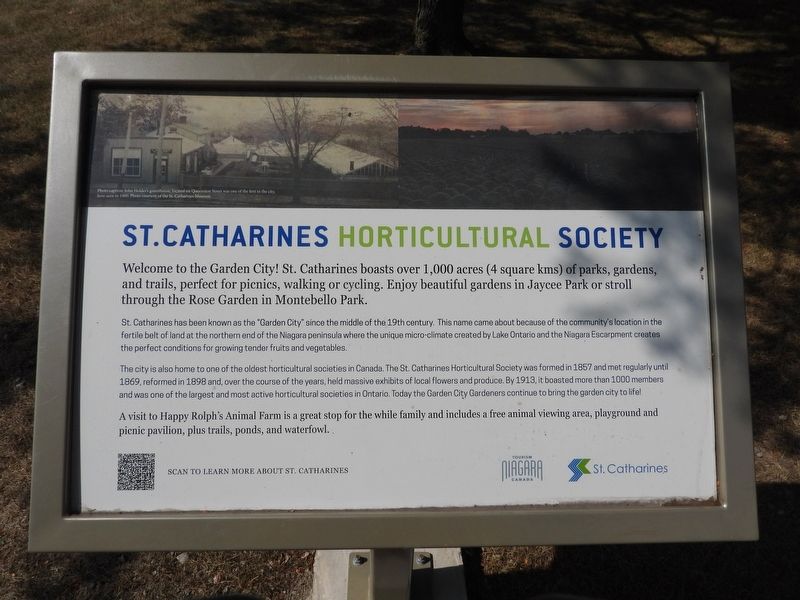
St. Catharines has been known as the "Garden City" since the middle of the 19th century. This name came about because of the community's location in the fertile belt of land at the northern end of the Niagara peninsula where the unique micro-climate created by Lake Ontario and the Niagara Escarpment creates the perfect conditions for growing tender fruits and vegetables.
The city is also home to one of the oldest horticultural societies in Canada. The St. Catharines Horticultural Society was formed in 1857 and met regularly until 1869, reformed in 1898 and, over the course of the years, held massive exhibits of local flowers and produce. By 1913, it boasted more than 1000 members and was one of the largest and most active horticultural societies in Ontario. Today the Garden City Gardeners continue to bring the garden city to life!
A visit to Happy Rolph's Animal
this page online
Erected by City of St. Catharines.
Topics. This historical marker is listed in these topic lists: Agriculture • Entertainment • Horticulture & Forestry. A significant historical year for this entry is 1850.
Location. 43° 12.004′ N, 79° 15.98′ W. Marker is in St. Catharines, Ontario, in Niagara Region. It is in Port Dalhousie. It can be reached from Lakeport Rd, on the right when traveling south. The marker is within 10 metres in the road, on the west side of a paved walking/biking path within Rennie Park. Touch for map. Marker is at or near this postal address: 60 Lakeport Rd, St Catharines ON L2N 4P5, Canada. Touch for directions.

Regionally, this marker is on the Golden Horseshoe and in Niagara Canada. It is also in Central Canada. Globally, it is in North America, on the Great Lakes, in the Western Hemisphere, in the Western World, and in the Anglosphere. Historically, it finds itself in what was once a British colony, the Viceroyalty of New France,

Photographed by Kevin Westell, August 10, 2025
2. St. Catharines Horticultural Society - Marker in context
Photo faces north-west from Lakeport Rd. Behind the marker is the sculpture, "The Heavy Eight". The north end of the Martindale Pond's rowing course is on the left.
Other nearby markers. At least 8 other markers are within walking distance of this marker: Restoring the Henley Rowing Course at Martindale Pond (within shouting distance of this marker); Quakers and Conscientious Objection (within shouting distance of this marker); First Women Rowers In The Royal Canadian Henley Regatta 1948 (within shouting distance of this marker); The Muir Brother's Dry Docks (about 90 meters away, measured in a direct line); Dalhousie House circa 1850 (about 120 meters away); Muir Bros. Dry Dock Shipbuilders (about 120 meters away); Lock One of the Third Welland Canal (about 120 meters away); Lockkeeper's Shanty 1887 (about 150 meters away). Touch for a list and map of all markers in St. Catharines.
Regarding St. Catharines Horticultural Society. From the 1850s, the north side of the Niagara Peninsula, from Hamilton to the Niagara river, became known as "The Garden of Canada", based on its unique climate and soil, and capability to grow fruit and vegetables which cannot grow anywhere else within Upper Canada. The moniker "Garden City" for St. Catharines probably derived from this farming usage. Only later, people started associating the name "Garden City" with urban gardens and horticulture; and there were then and are now plenty of businesses dealing in flowers.
Credits. This page was last revised on August 11, 2025. It was originally submitted on August 10, 2025, by Kevin Westell of St. Catharines, Ontario. This page has been viewed 120 times since then and 29 times this year. Photos: 1. submitted on August 10, 2025, by Kevin Westell of St. Catharines, Ontario. 2. submitted on August 11, 2025, by Kevin Westell of St. Catharines, Ontario. • Andrew Ruppenstein was the editor who published this page.
