Ostia Antica in Città metropolitana di Roma Capitale, Latium, Rome, Italy — Central Italy (Tyrrhenian Coast)
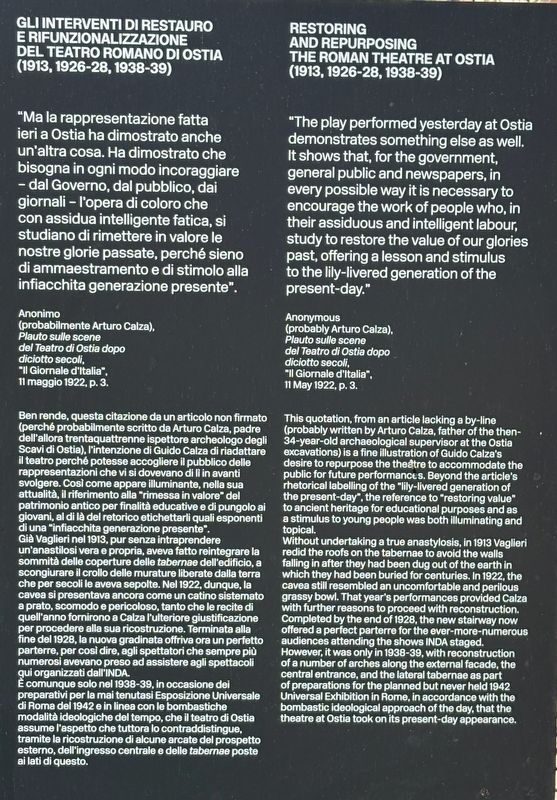
Gli Interventi di Restauro e Rifunzionalizzazione del Teatro Romano di Ostia
Restoring and Repurposing the Roman Theatre of Ostia
| — | (1913, 1926-28, 1938-39) | — |
Photographed by Sean P. Flynn, August 5, 2025
1. Gli Interventi ii Restauro e Rifunzionalizzazione del Teatro Romano di Ostia Marker
Anonimo (probabilmente Arturo Calza), Plauto sulle scene del Teatro di Ostia dopo diciotto secoli, "Il Giornale d'Italia", 11 maggio 1922, p. 3.
Ben rende, questa citazione da un articolo non firmato (perché probabilmente scritto da Arturo Calza, padre dell'allora trentaquattrenne ispettore archeologo degli Scavi di Ostia), l'intenzione di Guido Calza di riadattare il teatro perché potesse accogliere il pubblico delle rappresentazioni che vi si dovevano di li in avanti svolgere. Cosi come appare illuminante, nella sua attualità, il riferimento alla "rimessa in valore" del patrimonio antico per finalità educative e di pungolo ai giovani, al di là del retorico etichettarli quali esponenti di una "infiacchita generazione presente".
Già Vaglieri nel 1913, pur senza intraprendere un'anastilosi vera e propria, aveva
this page online
È comunque solo nel 1938-39, in occasione dei preparativi per la mai tenutasi Esposizione Universale di Roma del 1942 e in linea con le bombastiche modalità ideologiche del tempo, che il teatro di Ostia assume l'aspetto che tuttora lo contraddistingue, tramite la ricostruzione di alcune arcate del prospetto esterno, dell'ingresso centrale e delle tabernae poste ai lati di questo.
"The play performed yesterday at Ostia demonstrates something else as well. It shows that, for the government, general public and newspapers, in every possible way it is necessary to encourage the work of people who, in their assiduous and intelligent labour, study to restore the value of our glories past, offering a lesson and stimulus to the lily-livered generation of the present-day."
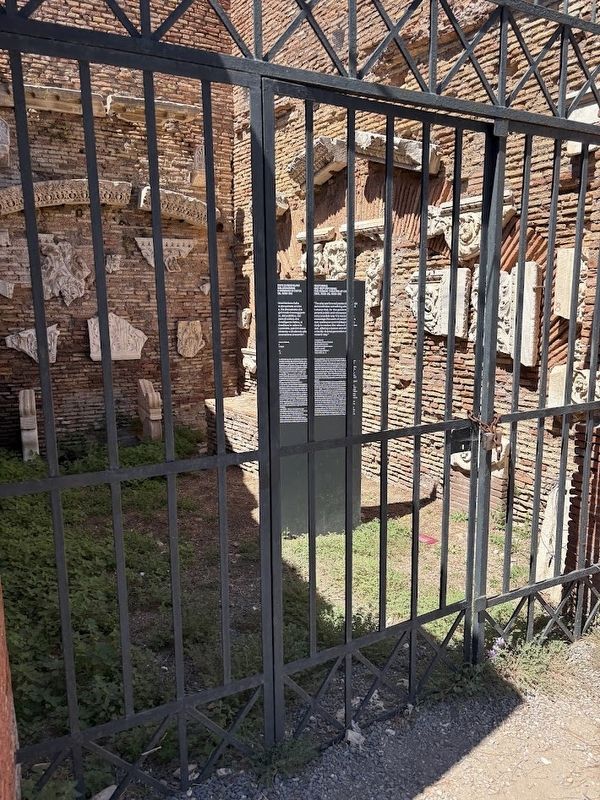
Anonymous(probably Arturo Calza), Plauto sulle scene del Teatro di Ostia dopo diciotto secoli, "Il Giornale d'italia", 11 May 1922, p. 3.Photographed by Sean P. Flynn, August 5, 20252. Gli Interventi ii Restauro e Rifunzionalizzazione del Teatro Romano di Ostia MarkerThe marker is in a "room" of the theatre, near some pieces of the adornments that have been found by archaeologists at Ostia.
This quotation, from an article lacking a by-line (probably written by Arturo Calza, father of the then-34-year-old archaeological supervisor at the Ostia excavations) is a fine illustration of Guido Calza's desire to repurpose the theatre to accommodate the public for future performances. Beyond the article's rhetorical labelling of the "lily-livered generation of the present-day", the reference to "restoring value" to ancient heritage for educational purposes and as a stimulus to young people was both illuminating and topical.
Without undertaking a true anastylosis, in 1913 Vaglieri redid the roofs on the tabernae to avoid the walls falling in after they had been dug out of the earth in which they had been buried for centuries. In 1922, the cavea still resembled an uncomfortable and perilous grassy bowl. That year's performances provided Calza with further reasons to proceed with reconstruction. Completed by the end of 1928, the new stairway now offered a perfect parterre for the ever-more-numerous audiences attending the shows INDA staged.
However, it was only in 1938-39, with reconstruction of a number of arches along the external facade, the central entrance, and the lateral tabernae as part of preparations for
Photographed by Sean P. Flynn, August 5, 2025
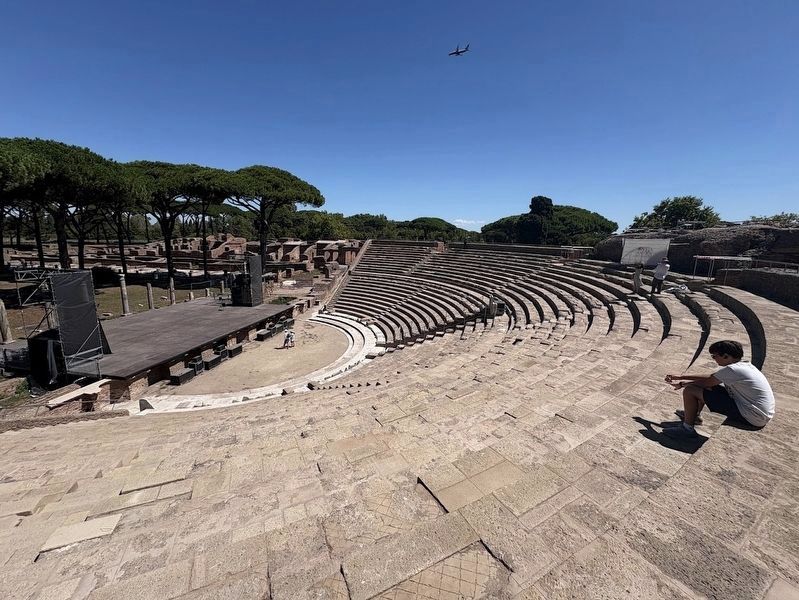
3. The Theatre of Ostia
The theatre was restored during the 20th century to enable its modern use as a site of concerts and performances. This historical marker is in a room that can be found on the outer wall of the theatre in the rear of this photo.
Topics. This historical marker is listed in these topic lists: Anthropology & Archaeology • Entertainment. A significant historical year for this entry is 1913.
Location. 41° 45.365′ N, 12° 17.507′ E. Marker is in Ostia Antica, Lazio (Latium, Rome), in Città metropolitana di Roma Capitale. It is on Viale degli Scavi. The marker is in Ostia Antica Archaeological Park, inside one of the rooms on the outside of the ancient theatre. Touch for map. Marker is in this post office area: Ostia Antica, Lazio 00119, Italy. Touch for directions.

Regionally, it is in Europe, the European Union, the Schengen Area, a coastal Mediterranean country, and the Western World. Historically, it finds itself in what was once the Roman Empire.
Other nearby markers. At least 8 other markers are within walking distance of this marker: The Theatre of Ostia (a few steps from this marker); Piazzale delle Corporazioni / Square of the Corporations (a few steps from this marker); L'Area del Teatro e il Centro Delle Corporazioni Commerciali (within shouting distance of this marker); The Martyrs of Ostia Tiberina (within shouting distance of this marker); Ninfei Ai Lati del Teatro e c.d. Oratorio Cristiano / Nymphaeums and the Christian Oratorio
Photographed by Sean P. Flynn, August 5, 2025
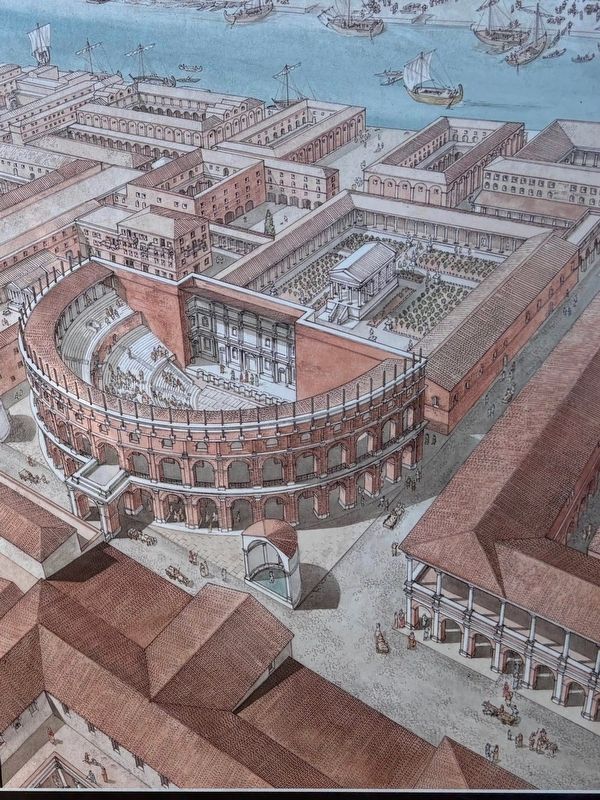
4. The Theatre at Ostia
Another sign at Ostia offers this rendering of what the area of the theatre and square may have looked like during ancient Roman times.
Also see . . .
1. New York Times: Guido Calza's obituary. Published April 24, 1946
Excerpt: "According to newspaper reports published on Jan. 11, 1940, Dr. Calza discovered at Ostia the ruins of what were believed to be the earliest known Christian church, dating from the second century A. D., about 150 years before Christianity became the established religion of the Roman Empire."(Submitted on August 11, 2025, by Sean P. Flynn of Oak Park, Illinois.)
2. Guido Calza.
Excerpt: "Despite the difficulties caused by the wartime events, the activity of Calza, assisted by the designer Italo Gismondi and soprastante Raffaele Finelli, continued without interruption, giving life to some of the most fruitful lines of research in the field of Roman archeology, placing Ostia Antica at the center of the cultural debate and himself at the center of a network of relationships with colleagues and scholars that will last, increased, until his death."(Submitted on August 11, 2025, by Sean P. Flynn of Oak Park, Illinois.)
Credits. This page was last revised on August 20, 2025. It was originally submitted on August 11, 2025, by Sean P. Flynn of Oak Park, Illinois. This page has been viewed 173 times since then and 24 times this year. Photos: 1, 2, 3, 4. submitted on August 11, 2025, by Sean P. Flynn of Oak Park, Illinois.
