Ostia Antica in Città metropolitana di Roma Capitale, Latium, Rome, Italy — Central Italy (Tyrrhenian Coast)
Casa di Diana
⎯⎯⎯
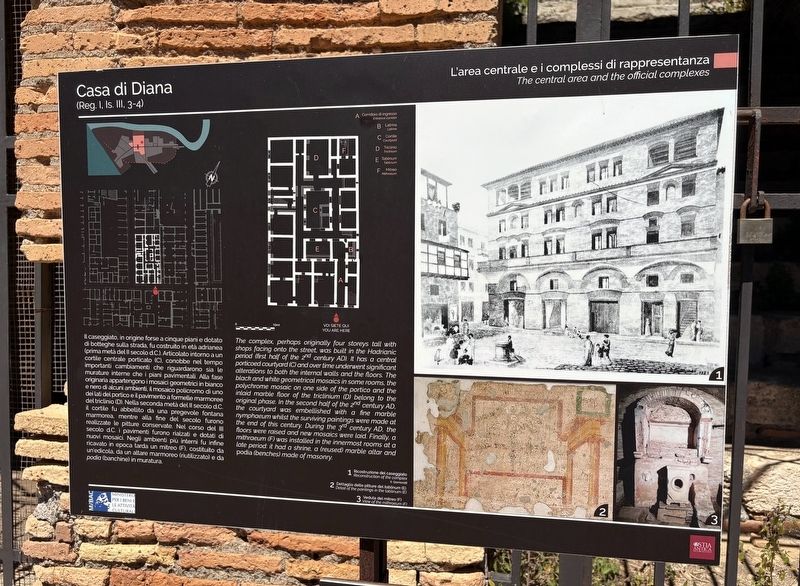
The House of Diana
(Reg. I, Is. III, 3-4)
Photographed by Sean P. Flynn, August 5, 2025
1. Casa di Diana / The House of Diana Marker
Il caseggiato, in origine forse a cinque piani e dotato di botteghe sulla strada, fu costruito in età adrianea (prima metà del II secolo d.C.). Articolato intorno a un cortile centrale porticato (C), conobbe nel tempo importanti cambiamenti che riguardarono sia le murature interne che i piani pavimentali. Alla fase originaria appartengono i mosaici geometrici in bianco e nero di alcuni ambienti, il mosaico policromo di uno dei lati del portico e il pavimento a formelle marmoree del triclinio (D). Nella seconda metà del II secolo d.C. il cortile fu abbellito da una pregevole fontana marmorea, mentre alla fine del secolo furono realizzate le pitture conservate. Nel corso del III secolo d.C. i pavimenti furono rialzati e dotati di nuovi mosaici. Negli ambienti più interni fu infine ricavato in epoca tarda un mitreo (F), costituito da un'edicola, da un altare marmoreo (riutilizzato) e da podia (banchine) in muratura.
The complex, perhaps originally four storeys tall with shops facing onto the street, was built in the Hadrianic period (first half of the 2nd century AD). It has a central porticoed courtyard (C) and over time underwent significant alterations to both the internal walls and the floors. The black and white geometrical mosaics in some rooms, the polychrome mosaic on one side of the portico and the inlaid marble floor of the triclinium (D) belong to the original phase. In the second half of the 2nd century AD, the courtyard was embellished with a fine marble nymphaeum whilst the surviving paintings were made at the end of this century. During the 3rd century AD, the floors were raised and new mosaics were laid. Finally, a mithraeum (F) was installed in the innermost rooms at a late period: it had a shrine, a (reused) marble altar and podia (benches) made of masonry.
Erected by Italian
this page online
Topics. This historical marker is listed in these topic lists: Anthropology & Archaeology • Architecture • Arts, Letters, Music • Religion & Religious Structures.
Location. 41° 45.293′ N, 12° 17.335′ E. Marker is in Ostia Antica, Lazio (Latium, Rome), in Città metropolitana di Roma Capitale. It is on Viale degli Scavi. The marker is in Ostia Antica Archaeological Park. Touch for map. Marker is in this post office area: Ostia Antica, Lazio 00119, Italy. Touch for directions.

Regionally, it is in Europe, the European Union, the Schengen Area, a coastal Mediterranean country, and the Western World. Historically, it finds itself in what was once the Roman Empire.
Other nearby markers. At least 8 other markers are within walking distance of this marker: Thermopolium di Via di Diana (within shouting distance of this marker); Molino del Silvano / The Mill of Silvanus (within shouting distance of this marker); Grandi Horrea / The Great Warehouse (within shouting distance of this marker); Capitolium (about 90 meters away,
Photographed by Sean P. Flynn, August 5, 2025
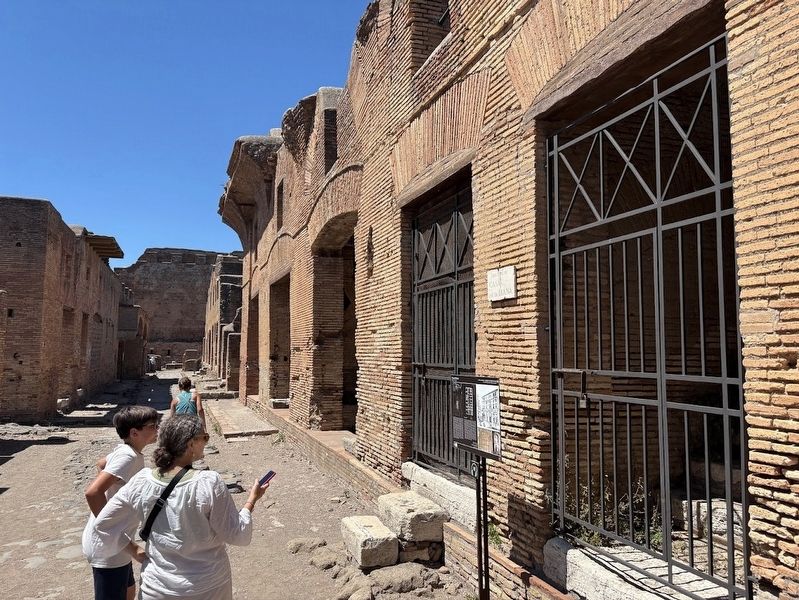
2. Casa di Diana
Also see . . . House of Diana.
Excerpt: "The House of Diana was excavated by Guido Calza in the years 1914-1916. The building is usually dated to the Antonine period (c. 150 AD; yellow opus latericium). Excavations in the years 1994-1997 by Alfredo Marinucci have led to many suggestions for a revision of the chronology. The building is at a higher level than the surrounding streets: Via dei Balconi to the west and Via di Diana to the south. Along the west and south facade is a sidewalk. To the east is an alley, beyond which is the House of the Millstones. To the north is the House of the Mithraeum of Menander."(Submitted on August 11, 2025, by Sean P. Flynn of Oak Park, Illinois.)

Photographed by Sean P. Flynn, August 5, 2025
3. Inside Casa di Diana
Photographed by Sean P. Flynn, August 5, 2025
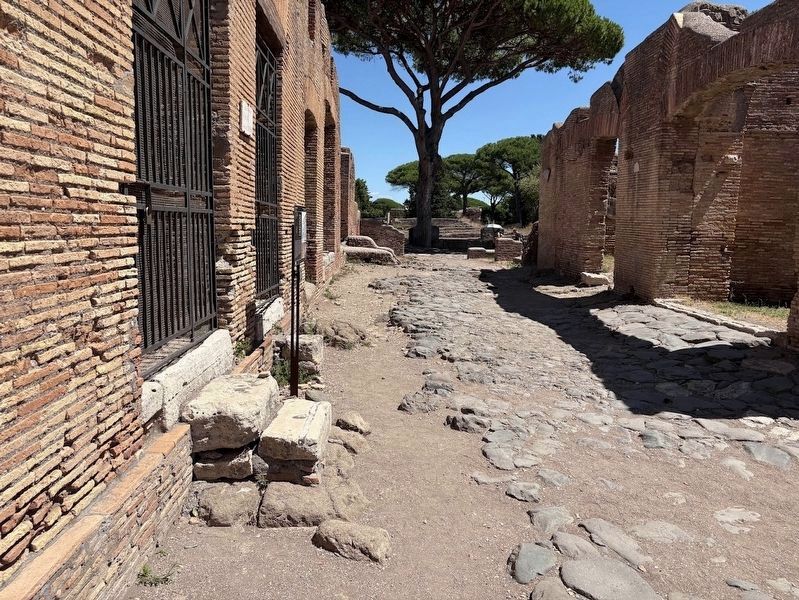
4. Via di Diana
Photographed by Sean P. Flynn, August 5, 2025
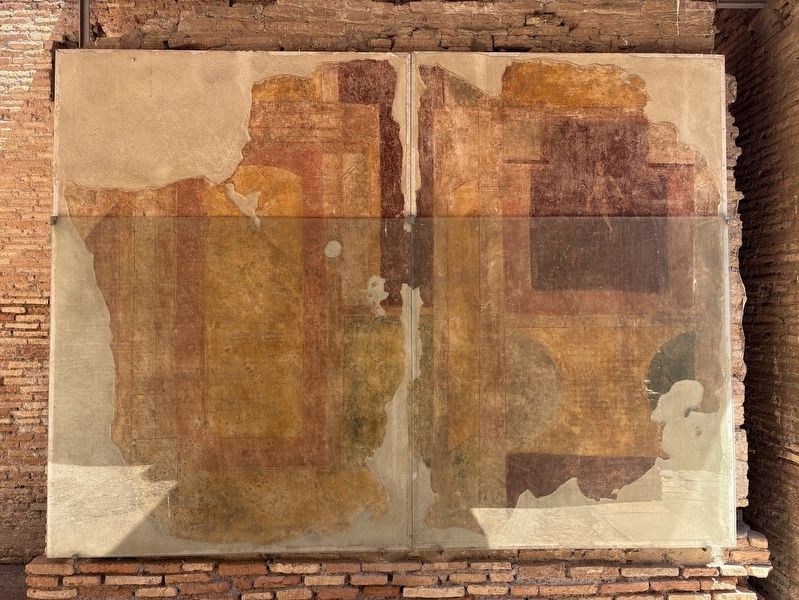
5. Fresco near the entrance into the House of Diana
Credits. This page was last revised on August 11, 2025. It was originally submitted on August 11, 2025, by Sean P. Flynn of Oak Park, Illinois. This page has been viewed 116 times since then and 35 times this year. Photos: 1, 2, 3, 4, 5. submitted on August 11, 2025, by Sean P. Flynn of Oak Park, Illinois.
