Blanca in Costilla County, Colorado — The American Mountains (Southwest)
The San Luis Southern Railway

Photographed by Cosmos Mariner, July 11, 2025
1. The San Luis Southern Railway Marker
Rail transportation reached the San Luis Valley in the form of the narrow gauge Denver & Rio Grande Railway, completed to Alamosa in 1878. The track was standard-gauged in 1899. Meanwhile, efforts to cultivate the Valley demonstrated the soil's fertility along with the need for irrigation. A review of the precipitation data for the decade 1895-1905 suggested that the west slope of the Sangre de Cristo range, with irrigation, could be profitably developed for agriculture. On that basis, Eastern capitalists organized the Costilla Estates Development Company, installing a series of reservoirs, ditches, and townsites. Separately they organized a transportation facility, the San Luis Southern Railway, chartered to build from Blanca to Taos, NM. In 1910 the SLS completed 29 miles of track due south to Jaroso, CO.
The Costilla Estates project, however, turned out to have been based on overly-optimistic precipitation estimates. Harvests and land sales failed to meet expectations and the SLS never progressed beyond Jaroso, its track ending 300 feet short of the New Mexico boundary. In January 1928 the SLS assets were sold at foreclosure
this page online
Finally in 1953 the Interstate Commerce Commission authorized abandonment. However, two local businessmen, W.W. "Bill" McClintock and George Oringdulph, intent on shipping potatoes grown near Mesita, CO, stepped in with a new company, the Southern San Luis Valley Railroad, which acquired the entire property. To replace the SSLV's two aging steam locomotives, in 1954 they started construction of the D500. By 1956, when it was completed, carloadings from the south had fallen drastically, the track was in poor shape and derailments were frequent. By 1958 road trucks were carrying the potatoes, the last steam engine had been
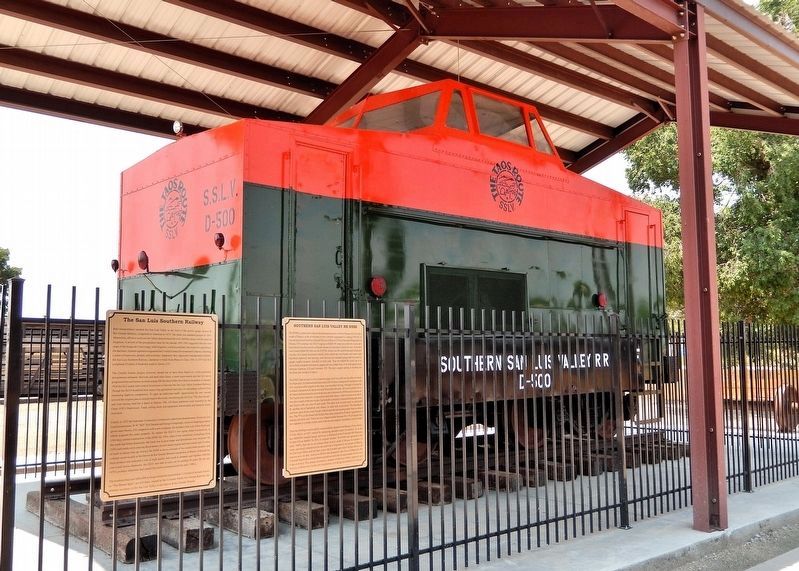
Photographed by Cosmos Mariner, July 11, 2025
2. The San Luis Southern Railway Marker
This is the leftmost of two historical markers mounted on the railing in front of the SSLV D500 Locomotive.
The Southern San Luis Valley RR no longer exists but miraculously 1.53 miles of its track, known as "The Blanca Spur", are still there, owned by the Colorado Pacific Rio Grande Railroad, the ultimate successor, in the San Luis Valley, to the Denver & Rio Grande Western.
Topics. This historical marker is listed in these topic lists: Agriculture • Industry & Commerce • Railroads & Streetcars. A significant historical month for this entry is January 1928.
Location. 37° 26.125′ N, 105° 31.017′ W. Marker is in Blanca, Colorado, in Costilla County. It is at the intersection of U.S. 160 and Smith Avenue, on the right when traveling east on U.S. 160. Touch for map. Marker is

Photographed by Cosmos Mariner, July 11, 2025
3. Southern San Luis Valley Railroad Exhibit
This is the leftmost of two historical markers mounted on the railing in front of the SSLV D500 Locomotive.

Regionally, this marker is in the San Juan Mountains and in the San Luis Valley. It is also in the American Mountain West. Globally, it is in North America, the Rocky Mountains, the Western Hemisphere, the Western World, and the Anglosphere. Historically, it finds itself in what was once New Spain and also the Republic of Texas.
Other nearby markers. At least 8 other markers are within 6 miles of this marker, measured as the crow flies: Southern San Luis Valley RR D500 (here, next to this marker); Trails Through Time (approx. ¼ mile away); Fort Garland / Buffalo Soldiers (approx. 4.8 miles away); a different marker also named Fort Garland (approx. 4.8 miles away); Costilla County Veterans Memorial (approx. 5.3 miles away); "The Magic Dog" (approx. 5½ miles away); On Sacred Ground (approx. 5½ miles away); Welcome "Caminante" to ... (approx. 5½ miles away). Touch for a list and map of all markers in Blanca.
Another marker is no longer nearby. Fort Garland (was approx. 4.8 miles away but has been permanently removed).
Related markers. Click here for a list of markers that are related to this marker.
Also see . . . Southern San Luis Valley Railroad (Wikipedia).
Excerpt: The Southern San Luis Valley Railroad is a fallen flag shortline railroad that was located in Southern Colorado. Best known in its final years of operation, it served a connection with the Denver and Rio Grande Western Railroad at Blanca, Colorado. The diminutive railroad in its final form was approximately 1.53 miles in length. During its life freight traffic included farm produce, fertilizer and volcanic scoria (lava rock). The railroad, as it was originally built, was 31 miles long and besides freight it operated passenger service between Blanca and Jaroso, Colorado, until 1946. The railroad formally ceased all operations December 31, 1996.(Submitted on August 11, 2025, by Cosmos Mariner of Cape Canaveral, Florida.)
Credits. This page was last revised on August 12, 2025. It was originally submitted on August 11, 2025, by Cosmos Mariner of Cape Canaveral, Florida. This page has been viewed 268 times since then and 120 times this year. Photos: 1, 2, 3. submitted on August 11, 2025, by Cosmos Mariner of Cape Canaveral, Florida.
