Ostia Antica in Città metropolitana di Roma Capitale, Latium, Rome, Italy — Central Italy (Tyrrhenian Coast)
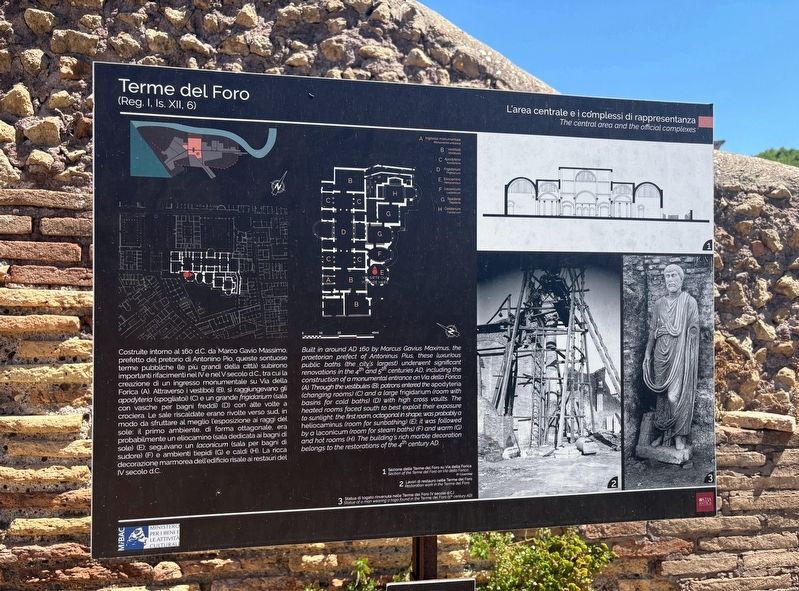
Terme del Foro
⎯⎯⎯
Baths of the Forum
(Reg. I, Is. XII, 6)
Photographed by Sean P. Flynn, August 5, 2025
1. Terme del Foro / Baths of the Forum Marker
Costruite intorno al 160 d.C. da Marco Gavio Massimo, prefetto del pretorio di Antonino Pio, queste sontuose terme pubbliche (le più grandi della città) subirono importanti rifacimenti nel IV e nel V secolo d.C., tra cui la creazione di un ingresso monumentale su Via della Forica (A). Attraverso i vestiboli (B), si raggiungevano gli apodyteria (spogliatoi) (C) e un grande frigidarium (sala con vasche per bagni freddi) (D) con alte volte a crociera. Le sale riscaldate erano rivolte verso sud, in modo da sfruttare al meglio l'esposizione ai raggi del sole: il primo ambiente, di forma ottagonale, era probabilmente un eliocamino (sala dedicata ai bagni di sole) (E); seguivano un laconicum (sala per bagni di sudore) (F) e ambienti tiepidi (G) e caldi (H). La ricca decorazione marmorea dell'edificio risale ai restauri del IV secolo d.C.
Built in around AD 160 by Marcus Gavius Maximus, the praetorian prefect of Antoninus Pius, these luxurious public baths (the city's largest) underwent significant renovations in the 4th and 5th centuries AD, including the construction of a monumental entrance on Via della Forica (A). Through the vestibules (B), patrons entered the apodyteria (changing rooms) (C) and a large frigidarium (room with basins for cold baths) (D) with high cross vaults. The heated rooms faced south to best exploit their exposure to sunlight: the first room, octagonal in shape, was probably a heliocaminus (room for sunbathing) (E); it was followed by a laconicum (room for steam baths) (F) and warm (G) and hot rooms (H). The building's rich marble decoration belongs to the restorations of the 4th century AD.
Erected by Italian
this page online
Topics. This historical marker is listed in these topic lists: Anthropology & Archaeology • Architecture. A significant historical year for this entry is 160 CE.
Location. 41° 45.203′ N, 12° 17.339′ E. Marker is in Ostia Antica, Lazio (Latium, Rome), in Città metropolitana di Roma Capitale. It is on Viale degli Scavi. The marker is in Ostia Antica Archaeological Park. Touch for map. Marker is in this post office area: Ostia Antica, Lazio 00119, Italy. Touch for directions.

Regionally, it is in Europe, the European Union, the Schengen Area, a coastal Mediterranean country, and the Western World. Historically, it finds itself in what was once the Roman Empire.
Other nearby markers. At least 8 other markers are within walking distance of this marker: Ninfeo degli Eroti / Nymphaeum of the Erotes (a few steps from this marker); L'Area Centrale e i Complessi di Rappresentanza / The Central Area and the Official Complexes (a few steps from this marker); Tempio di Roma e Augusto / Temple of Rome and Augustus (within shouting distance of this marker); a different marker also named Terme del Foro / Baths of the Forum
Photographed by Sean P. Flynn, August 5, 2025
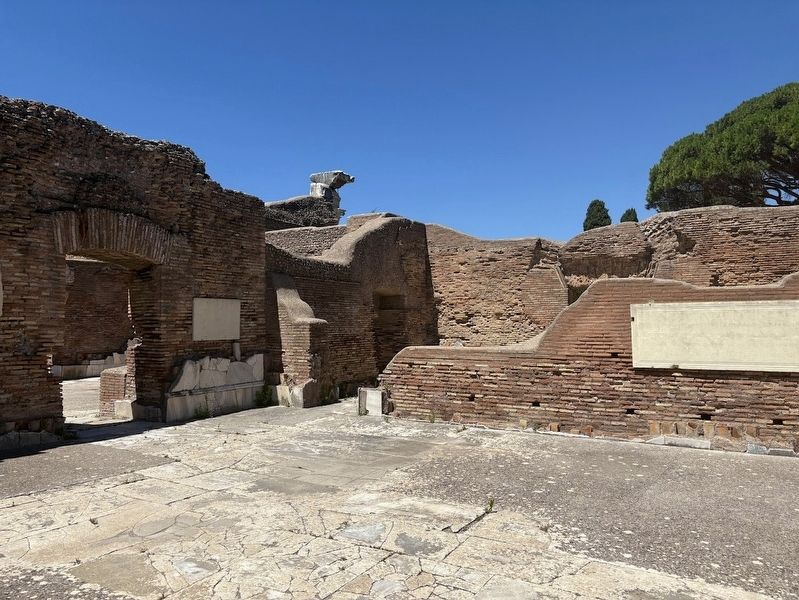
2. Photo inside the ruins of the Baths of the Forum
More about this marker. An identical sign can be found inside the baths.
Also see . . . Terme del Foro o di Gavio Massimo.
Excerpt: "To the south-east of the Forum is one of the largest baths in Ostia, the Baths of the Forum. The total area is c. 3200 square meters. The building was plundered in the early 19th century and probably at other moments. The final excavation took place during a long period, in the years 1920-1941. Some minor work was carried out in 1959 and 1980.(Submitted on August 12, 2025, by Sean P. Flynn of Oak Park, Illinois.)
Several phases can be distinguished, on the basis of inscriptions and brick stamps. All masonry is opus latericium, with the exception of the last phase, which also has some opus vittatum.
•The baths were built in the third quarter of the second century, c. 160 AD, by Marcus Gavius Maximus, praefectus praetorio.
• Early-Severan period (193-225 AD).
• Reign of Maxentius and Constantine (306-337 AD; possibly two phases).
• Restorations financed by Flavius Octavius Victor, praefectus annonae at some point in time after 331 AD (possibly the same as the Constantinian phase).
• Reign of Theodosius (379-395 AD), probably financed by Ragonius Vincentius Celsus, praefectus annonae in the years 385-389 AD."
Credits. This page was last revised on August 12, 2025. It was originally submitted on August 12, 2025, by Sean P. Flynn of Oak Park, Illinois. This page has been viewed 79 times since then and 20 times this year. Photos: 1, 2. submitted on August 12, 2025, by Sean P. Flynn of Oak Park, Illinois.
