Ostia Antica in Città metropolitana di Roma Capitale, Latium, Rome, Italy — Central Italy (Tyrrhenian Coast)
Caseggiato dei Doli
⎯⎯⎯
The Dolia Building
(Reg. I, Is. IV, 5)
Photographed by Sean P. Flynn, August 5, 2025
1. Caseggiato dei Doli Marker
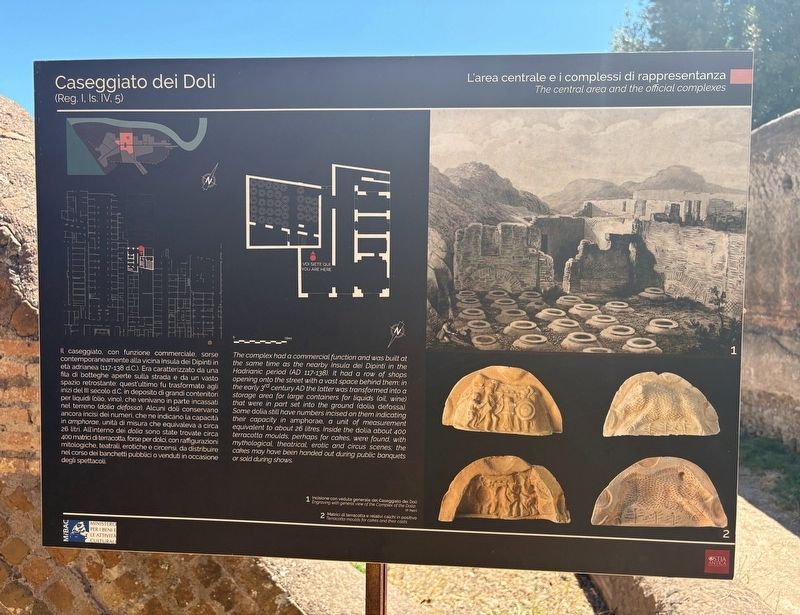
Il caseggiato, con funzione commerciale, sorse contemporaneamente alla vicina Insula dei Dipinti in età adrianea (117-138 d.C.). Era caratterizzato da una fila di botteghe aperte sulla strada e da un vasto spazio retrostante: quest'ultimo fu trasformato agli inizi del III secolo d.C. in deposito di grandi contenitori per liquidi (olio, vino), che venivano in parte incassati nel terreno (dolia defossa). Alcuni doli conservano ancora incisi dei numeri, che ne indicano la capacità in amphorae, unità di misura che equivaleva a circa 26 litri. All'interno dei dolia sono state trovate circa 400 matrici di terracotta, forse per dolci, con raffigurazioni mitologiche, teatrali, erotiche e circensi, da distribuire nel corso dei banchetti pubblici o venduti in occasione degli spettacoli.
The complex had a commercial function and was built at the same time as the nearby Insula dei Dipinti in the Hadrianic period (AD 117-138). It had a row of shops opening onto the street with a vast space behind them: in the early 3rd century AD the latter was transformed into a storage area for large containers for liquids (oil, wine) that were in part set into the ground (dolia
this page online
Erected by Italian Ministry of Cultural Heritage and Activities.
Topics. This historical marker is listed in these topic lists: Anthropology & Archaeology • Arts, Letters, Music • Entertainment • Industry & Commerce. A significant historical year for this entry is 117 CE.
Location. 41° 45.319′ N, 12° 17.273′ E. Marker is in Ostia Antica, Lazio (Latium, Rome), in Città metropolitana di Roma Capitale. It can be reached from Viale degli Scavi. The marker is in Ostia Antica Archaeological Park. Touch for map. Marker is in this post office area: Ostia Antica, Lazio 00119, Italy. Touch for directions.

Regionally, it is in Europe, the European Union, the Schengen Area, a coastal Mediterranean country, and the Western World. Historically, it finds itself in what
Photographed by Sean P. Flynn, August 5, 2025
2. Caseggiato dei Doli / The Dolia Building Marker
Other nearby markers. At least 8 other markers are within walking distance of this marker: Mensola della Sinagoga / Synagogue Corbel (here, next to this marker); Dante Vaglieri (a few steps from this marker); Italo Gismondi (a few steps from this marker); Giovanni Becatti (within shouting distance of this marker); Raissa Samojlovna Gurevič Calza (within shouting distance of this marker); Thermopolium di Via di Diana (about 90 meters away, measured in a direct line); Casa di Diana / The House of Diana (about 90 meters away); Dolia (about 90 meters away). Touch for a list and map of all markers in Ostia Antica.
Also see . . . Caseggiato dei Doli.
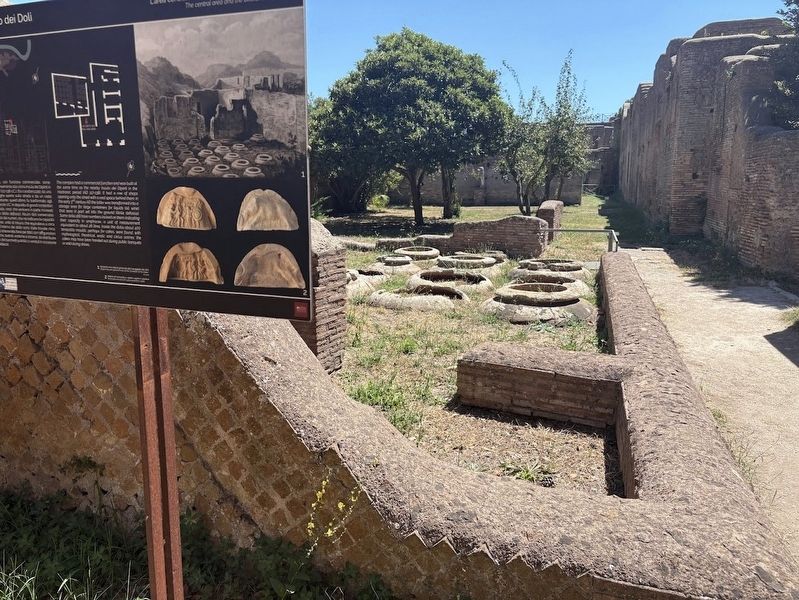
Excerpt: "This building was erected in the late-Hadrianic or early-Antonine period (opus mixtum). In the Severan period some modifications took place (opus latericium), and 35 dolia defossa (buried jars) were installed for storing wine or olive-oil. The building was excavated partially in the early 20th century by Angelo Pasqui."(Submitted on August 12, 2025, by Sean P. Flynn of Oak Park, Illinois.)
Credits. This page was last revised on August 12, 2025. It was originally submitted on August 12, 2025, by Sean P. Flynn of Oak Park, Illinois. This page has been viewed 134 times since then and 26 times this year. Photos: 1, 2. submitted on August 12, 2025, by Sean P. Flynn of Oak Park, Illinois.
