Esquilino in Roma in Città metropolitana di Roma Capitale, Latium, Rome, Italy — Central Italy (Tyrrhenian Coast)
Archetipo Cosmico
di Michele Ciribifera
| — | a cura di Daniele Brocchi | — |

Photographed by Sean P. Flynn, July 24, 2025
1. Archetipo Cosmico Marker
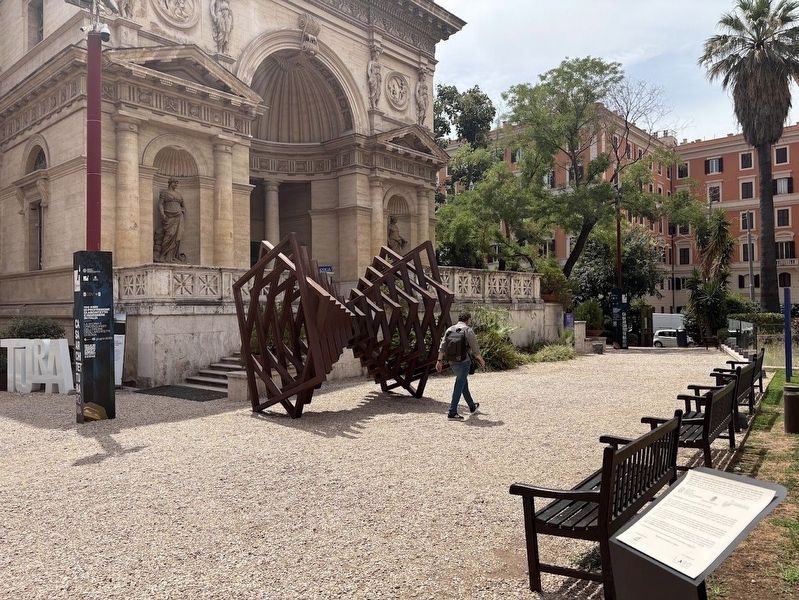
Torri Orbitanti, scultura di nuova fattura in acciaio inox specchiato, presenta tre sculture sorelle che si ripetono ma con dimensioni e altezze diverse. Come se fossero alberi del futuro, forse traducibili in oggetti funzionali come elementi mobili per produrre energia pulita o razzi vettori per raggiungere mete sconosciute. Un richiamo di fatto al progresso che accelera in ogni settore. Corpi centrali autoportanti che si sviluppano ad incastro come a formare chiome, nuclei che terminano verso il cielo. Twister, opera di dimensioni più piccole, molto complessa fatta di sovrapposizioni geometriche. Linee di ferro saldate tra loro, il concetto è sempre quello cosmico con riferimenti lontani del passato come le tarsie rinascimentali, alle simbologie dell'infinito e del rapporto tra architettura costruita e architettura terrestre naturale. Un gioco che confonde lo spettatore, lo diverte, lo invita ad entrare all'interno della scultura.
Michele Ciribifera nasce a Perugia nel 1969, dove vive e lavora. Nelle sue sculture sono presenti tensioni strutturali di elementi tratti direttamente dal contesto naturale, legate allo spazio e alfarchitettura futuribile. I suoi lavori creano spazi immaginari conducendo Posservatore salinterna di forme che pasiono organiche, e verso dimensioni spaziali coinvolgenti Prima era il legno il suo materiale prediletto poi i ferro, due materiali primordial appartenenti convenzionalmente all'arte povera ma che per Ciribifera povera non lo e, visto che le saldature, le fusioni e le costruzioni delle sculture danno una visione clisticadi pregio. Oggi arriva alfacciaio inox, materiale lavorato di grande impatto che si sposa di "ntleeso" con l'ambiente circostante. Michele ama ricordare anche uno scritto di Max Bil nel 1936. riferito al "mezzo creativo", "è dato da colare, spazio, luce e movimento, e con la composizione di questi elementi si originano nuove realtà. Idee astratto che esistevano dapprima solamente nel concetto vengono rese visibili se realizzate in forma coricreta".
Click or scan to see
this page online
[English translation of the Italian text:]
"Cosmic Archetype" explores the relationship between the universe, nature, and geometry with the two sculptures on display. Lines and interlocking shapes redefine visual space, often through a mathematical language, in relation to natural elements and the cosmos.
Torri Orbitanti,, a newly crafted sculpture in mirrored stainless steel, presents three sister sculptures that repeat each other but with different sizes and heights. They are as if they were trees of the future, perhaps translatable into functional objects such as mobile elements to produce clean energy or rockets to reach unknown destinations. A reminder of accelerating progress
Photographed by Sean P. Flynn, July 24, 2025
2. Archetipo Cosmico Marker
The marker is partially obscured by the pole on the left side of the photo. The Roman Acquarium is in the background.
Michele Ciribifera was born in Perugia in 1969, where he lives and works. His sculptures feature structural tensions of elements drawn directly from the natural context, linked to space and futuristic architecture. His works create imaginary spaces, leading the observer into an interior of passionately organic forms and toward engaging spatial dimensions. Wood was his preferred material, then iron, two primordial materials conventionally associated with Arte Povera, but which for Ciribifera are not, given that the welding, casting, and construction of the sculptures convey a visually valuable aesthetic. Today, he turns to stainlesssteel, a highly impactful, worked material that seamlessly blends with its surroundings. Michele also likes to recall a 1936 text by Max Bill. Referring to the "creative medium," it "is given by flow, space, light, and movement, and with the composition of these elements new realities arise. Abstract ideas that previously existed only in concept are made visible when realized in concrete form."Photographed by Sean P. Flynn, July 24, 20253. Archetipo Cosmico Marker

Erected 2025 by L'ordine degli Architetti di Roma;.
Topics. This historical marker is listed in these topic lists: Air & Space • Arts, Letters, Music • Environment. A significant historical year for this entry is 1969.
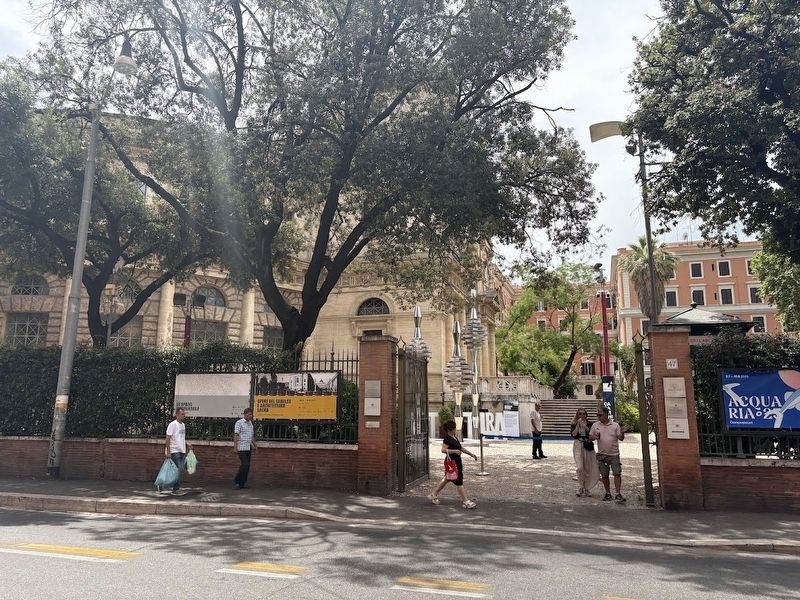
Location. 41° 53.879′ N, 12° 30.166′ E. Marker is in Roma, Lazio (Latium, Rome), in Città metropolitana di Roma Capitale. It is in Esquilino. It is on Piazza Manfredo Fanti, on the right when traveling east. The marker is near the stairway into the Acquario Romano from the park at Piazza Mafredo Fanti. Touch for map. Marker is at or near this postal address: Piazza Manfredo Fanti 47, Roma, Lazio 00185, Italy. Touch for directions.

Regionally, it is in Europe, the European Union, the Schengen Area, a coastal Mediterranean
Photographed by Sean P. Flynn, July 24, 2025
4. Piazza Manfredo Fanti
Other nearby markers. At least 8 other markers are within walking distance of this marker: Cobblestone (a few steps from this marker); Acquario Romano / Mura Serviane (a few steps from this marker); Enrico Fermi (approx. 0.3 kilometers away); Le Terme di Diocleziano e La Certosa si Santa Maria Degli Angeli (approx. 0.6 kilometers away); Il Giardivο / The Garden (approx. 0.6 kilometers away); Altari Funerari Iscritti / Inscribed Funerary Altars (approx. 0.6 kilometers away); a different marker also named Altari Funerari Iscritti / Inscribed Funerary Altars (approx. 0.6 kilometers away); Cratere Colossale / Colossal Krater (approx. 0.7 kilometers away). Touch for a list and map of all markers in Roma.
Also see . . . Michele Ciribifera bio.
Excerpt: "In 1993 he won the first prize at the sculpture symposium in S. Elena (CA), and in 1997 he exhibited on the first solo show in Sansepolcro (AR), a series of sculptures in which are present the structural tensions of elements directly drawn from natural context. He searches in them those invisible forces through which life is shaped."(Submitted on August 13, 2025, by Sean P. Flynn of Oak Park, Illinois.)
Credits. This page was last revised on August 13, 2025. It was originally submitted on August 13, 2025, by Sean P. Flynn of Oak Park, Illinois. This page has been viewed 64 times since then and 14 times this year. Photos: 1, 2, 3, 4. submitted on August 13, 2025, by Sean P. Flynn of Oak Park, Illinois.
