San Giovanni in Firenze in Città Metropolitana di Firenze, Tuscany, Italy — Southern and Western Europe (Mediterranean)
Firenze — Piazza della Signoria
⎯⎯⎯
Florence — Piazza della Signoria
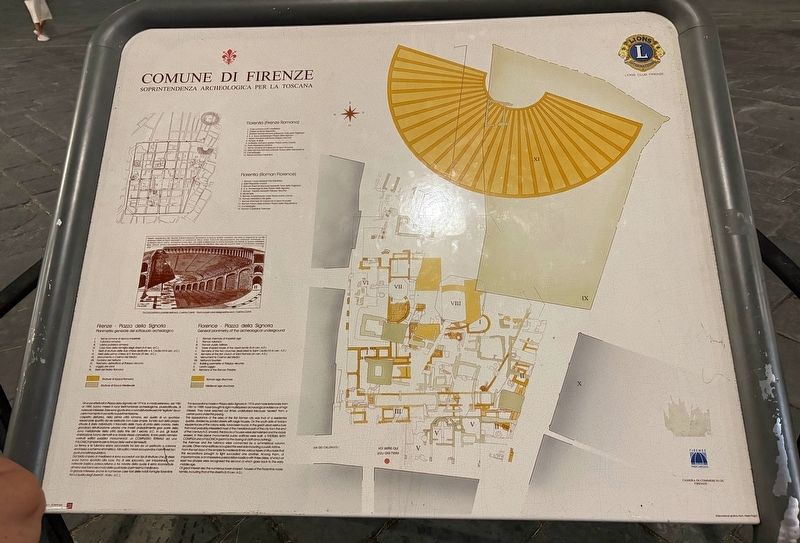
Photographed by Sean P. Flynn, July 24, 2025
1. Firenze - Piazza della Signoria / Florence - Piazza della Signoria Marker
L'aspetto dell'area, nella prima città romana, era quello di un quartiere residenziale spartito da vie lastricate con case ampie. Sul lato sud della piazza attuale è stato individuato il tracciato delle mura di cinta della colonia. Nella grandiosa ristrutturazione urbana che investi probabilmente gran parte della zona meridionale della città dalla fine del I secolo d.C. in poi, gli isolati d'abitazione furono demoliti e le strade stesse cancellate. Al loro posto vennero costruiti edifici pubblici monumentali: un COMPLESSO TERMALE ed una FULLONICA (impianto per la tintura delle vesti e dei tessuti).
La terma e la fullonica erano raccordate tra loro da un porticato a colonne anch'esso a schema simmetrico. Altri edifici minori occupavano il lato vest tra i quali una latrina pubblica. Dal tardo impero al medioevo si sono succeduti
this page online
Di grande interesse anche le numerose case torri delle nobili famiglie fiorentine fra cui quella degli Uberti (X-XI sec. d.C.).
The excavations made in Piazza della Signoria in 1974 and more extensively from 1981 to 1989, have brought to light multilayered archeological evidence of high interest. They have reached our times undisturbed because "sealed" from a certain point under the paving.
The appearance of the area of the first Roman city was that of a residential quarter, divided by paved streets with large houses. On the south side of today's square traces of the colony walls, have been found. In the great urban restructure that most probably interested most of the meridional part of the city from the end of the I century A.D. onward, the blocks of houses were demolished and the roads erased. In their place monumental public edifices were built: a THERMAL BATH COMPLEX
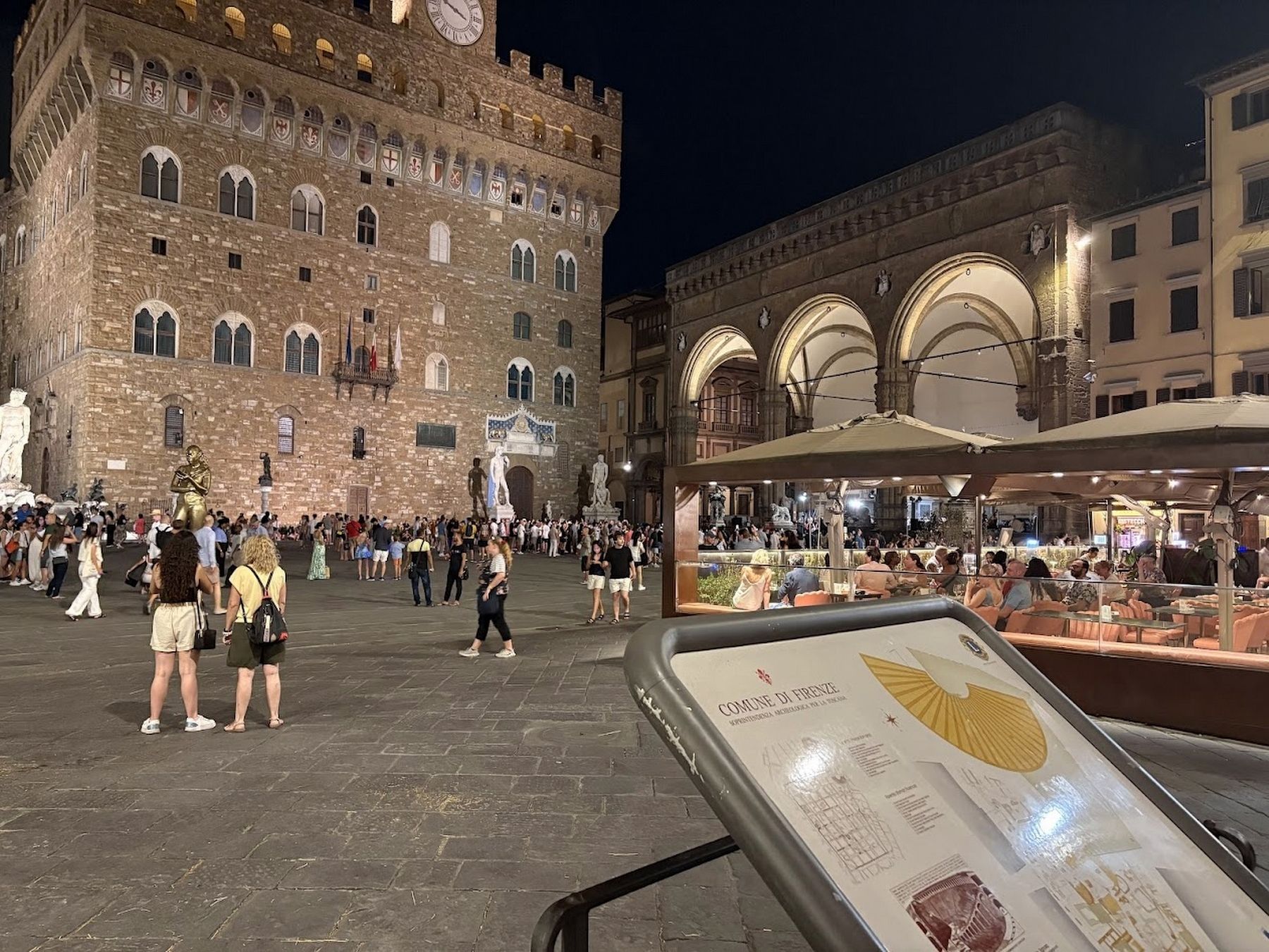
Photographed by Sean P. Flynn, July 24, 2025
2. Piazza della Signoria
The thermae and the fullonica were connected by a symmetrical column arcade. Other minor edifices occupied the west side including a public latrine.
From the last days of the empire to medieval times various types of structures that the excavations brought to light succeded one another. Among them, of important note, is an impressive paleocristian basilica with three aisles, of which at least two phases were recognised the second of which goes back to the early middle age.
Of great interest also the numerous tower shaped houses of the Florentine noble famille, including that of the Uberti's (X-XI cen. A.D.)
Topics. This historical marker is listed in this topic list: Anthropology & Archaeology. A significant historical year for this entry is 1974.
Location. 43° 46.172′ N, 11° 15.325′ E. Marker is in Firenze, Toscana (Tuscany), in Città Metropolitana di Firenze. It is in San Giovanni. It is at the intersection of Piazza della Signoria and Via Calimaruzza on Piazza della Signoria. The marker is on the western edge of Piazza della Signora. Touch for map. Marker is in

Photographed by Sean P. Flynn, July 24, 2025
3. Piazza map on the marker

Regionally, it is in Europe, the European Union, the Schengen Area, a coastal Mediterranean country, and the Western World. Historically, it finds itself in what was once the Roman Empire and specifically also the Holy Roman Empire.
Other nearby markers. At least 8 other markers are within walking distance of this marker: Site of the Execution of Girolamo Savonarola (within shouting distance of this marker); Ex Chiesa di San Pier Scheraggio / Former Church of San Pier Scheraggio (about 90 meters away, measured in a direct line); The Liberation of Florence, 1944 (about 90 meters away); “Il Porcellino” / “The Metal Pig” (about 90 meters away); Site of the Via dei Georgofili Bombing (about 120 meters away); John Brampton Philpot (about 120 meters away); Giuseppe e Vittorio Jacquier (about 120 meters away); Torre de' Pulci (about 120 meters away). Touch for a list and map of all markers in Firenze.
More about this marker. The marker includes an archaeological map with a key pointing out key sites that were located within what is now the piazza. The historical text above can be found in the bottom left corner.
Credits. This page was last revised on September 4, 2025. It was originally submitted on August 14, 2025, by Sean P. Flynn of Oak Park, Illinois. This page has been viewed 115 times since then and 28 times this year. Photos: 1, 2, 3. submitted on August 14, 2025, by Sean P. Flynn of Oak Park, Illinois.
