Centennial Hill in Montgomery in Montgomery County, Alabama — The American South (East South Central)
Swayne College ⎯⎯⎯ Booker T. Washington School
Photographed by Tim Carr, August 1, 2009
1. Swayne College Marker
Inscription.
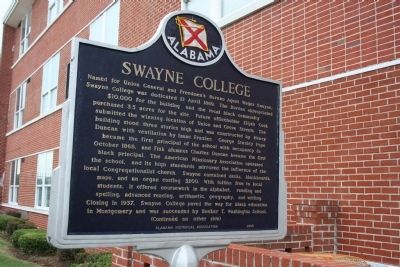
Swayne College
Named for Union General and Freemen’s Bureau Agent Wager Swayne, Swayne College was dedicated 21 April 1869. The Bureau appropriated $10,000 for the building and the local black community purchased 3.5 acres for the site. Future officeholder Elijah Cook submitted the winning location of Union and Grove Streets. The building stood three stories high and was constructed by Henry Duncan with ventilation by Isaac Frazier. George Stanley Pope became the first principal of the school with occupancy in October 1868, and Fisk alumnus Charles Duncan became the first black principal. The American Missionary Association operated the school, and its high standards mirrored the influence of the local Congregationalist church. Swayne contained desk, blackboards, maps and an organ costing $200. With tuition free to local students, it offered coursework in the alphabet, reading and spelling, advanced reading, arithmetic, geography, and writing. Closing in 1937, Swayne College paved the way for black education in Montgomery and was succeeded by Booker T. Washington School.
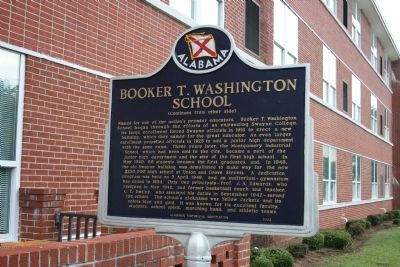
Booker T. Washington School
Named for one of
Click or scan to see this page online
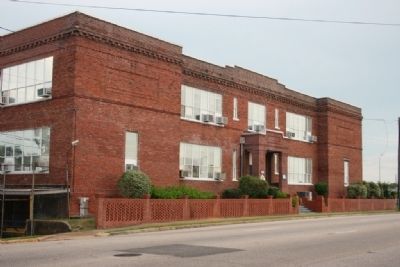
the nation’s premier educators, Booker T. Washington School began through the efforts of an expanding Swayne College. Its large enrollment forced Swayne officials in 1916 to erect a new building, which they named for the great educator. An even larger enrollment propelled officials in 1925 to add a junior high department with the same name. Three years later, the Montgomery Industrial School, which had been sold to the city, became a part of the junior high department and the site of the first high school. In May 1940, 88 students became the first to graduates, and, in 1948, the old Swayne building was demolished to make way for the new $250,000 high school at Union and Grove Streets. A dedication program was held on 3 April 1949, and an auditorium - gymnasium was added in 1954. Only two principals - Prof. J. A. Edwards, who resigned in May 1942, and former basketball coach and teacher C. T. Smiley, who assumed his duties in September 1942 - served the school. The school’s nickname was Yellow Jackets and its colors blue and gold. It was known for its excellent faculty, students, school spirit, marching band, and athletic teams.
Erected 2003
Photographed by Tim Carr, August 1, 2009
2. Booker T. Washington School Marker
by Alabama Historical Association.
Topics and series. This historical marker is listed in these topic lists: African Americans • Education • Sports. In addition, it is included in the Alabama Historical Association series list. A significant historical date for this entry is April 21, 1869.
Location. 32° 22.185′ N, 86° 18.003′ W. Marker is in Montgomery, Alabama, in Montgomery County. It is in Centennial Hill. It is on South Union Street, on the left when traveling north. Touch for map. Marker is at or near this postal address: 632 S Union St, Montgomery AL 36104, United States of America. Touch for directions.
Regionally, this marker is in the Tri-Counties River Region. It is also in the American South, specifically in the Deep South, and in the Black Belt. Globally, it is in North America, a Gulf of Mexico state, the Western Hemisphere, the Western World, and the Anglosphere. Historically, it finds itself in what was once the territory of the Mississippian Culture, one of the Confederate States of America, and the Antebellum South.
Other nearby markers. At least 8 other markers are within walking distance of this marker:
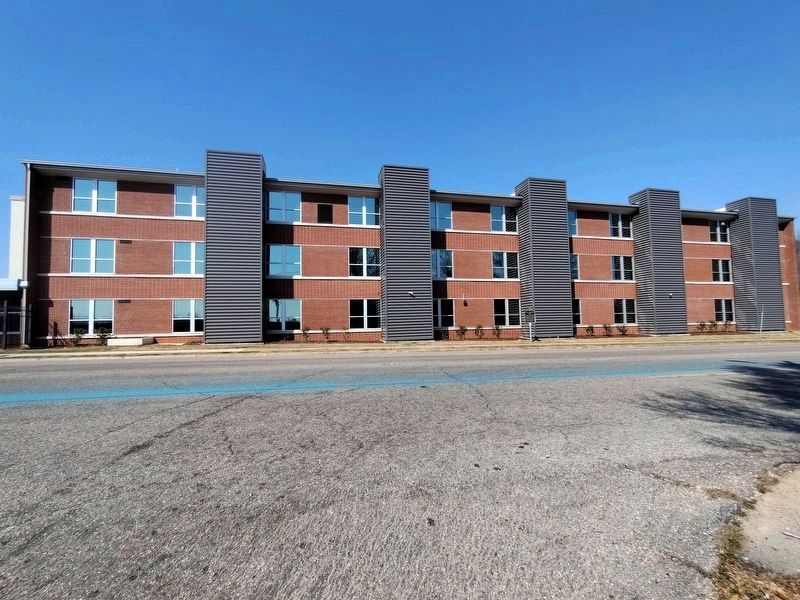
4. Swayne College / Booker T. Washington School Marker
Credits. This page was last revised on March 5, 2025. It was originally submitted on March 4, 2010, by Timothy Carr of Birmingham, Alabama. This page has been viewed 2,605 times since then and 62 times this year. Photos:1, 2, 3. submitted on March 4, 2010, by Timothy Carr of Birmingham, Alabama. 4. submitted on March 5, 2025, by Craig Doda of Napoleon, Ohio. • Bill Pfingsten was the editor who published this page.