Cañon City in Fremont County, Colorado — The American Mountains (Southwest)
Cañon City
Railroads Moving Goods, Moving People
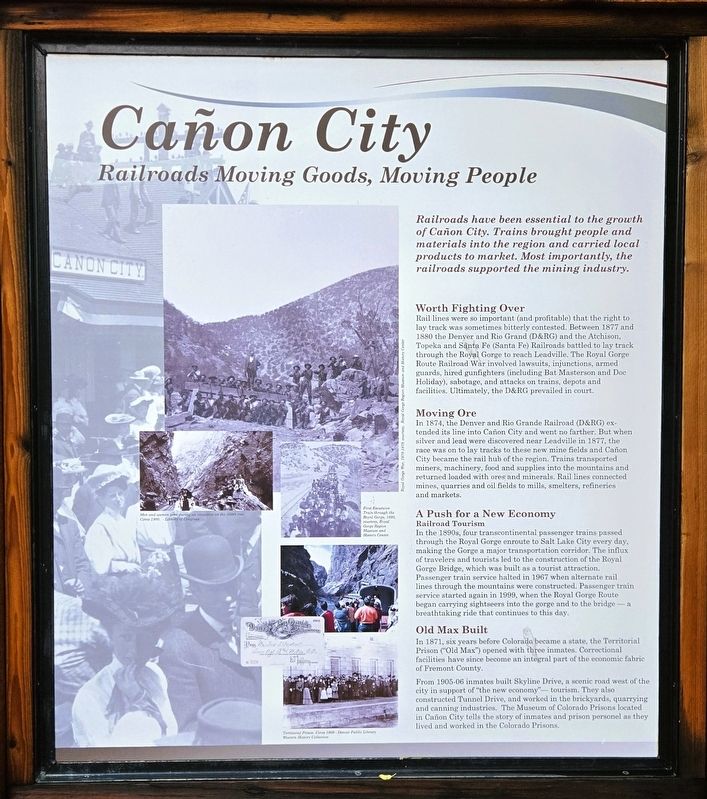
Photographed by Cosmos Mariner, July 23, 2025
1. Cañon City Marker
Railroads have been essential to the growth of Cañon City. Trains brought people and materials into the region and carried local products to market. Most importantly, the railroads supported the mining industry.
Worth Fighting Over
Rail lines were so important (and profitable) that the right to lay track was sometimes bitterly contested. Between 1877 and 1880 the Denver and Rio Grande (D&RG) and the Atchison, Topeka and Santa Fe (Santa Fe) Railroads battled to lay track through the Royal Gorge to reach Leadville. The Royal Gorge Route Railroad War involved lawsuits, injunctions, armed guards, hired gunfighters (including Bat Masterson and Doc Holiday), sabotage, and attacks on trains, depots and facilities. Ultimately, the D&RG prevailed in court.
Moving Ore
In 1874, the Denver and Rio Grande Railroad (D&RG) extended its line into Cañon City and went no farther. But when silver and lead were discovered near Leadville in 1877, the race was on to lay tracks to these new mine fields and Cañon City became the rail hub of the region. Trains transported miners, machinery, food and supplies into the mountains and returned loaded
this page online
A Push for a New Economy
Railroad Tourism
In the 1890s, four transcontinental passenger trains passed through the Royal Gorge enroute to Salt Lake City every day, making the Gorge a major transportation corridor. The influx of travelers and tourists led to the construction of the Royal Gorge Bridge, which was built as a tourist attraction. Passenger train service halted in 1967 when alternate rail lines through the mountains were constructed. Passenger train service started again in 1999, when the Royal Gorge Route began carrying sightseers into the gorge and to the bridge — a breathtaking ride that continues to this day.
Old Max Built
In 1871, six years before Colorado became a state, the Territorial Prison ("Old Max") opened with three inmates. Correctional facilities have since become an integral part of the economic fabric of Fremont County.
From 1905-06 inmates built Skyline Drive, a scenic road west of the city in support of “the new economy” — tourism. They also constructed Tunnel Drive, and worked in the brickyards,
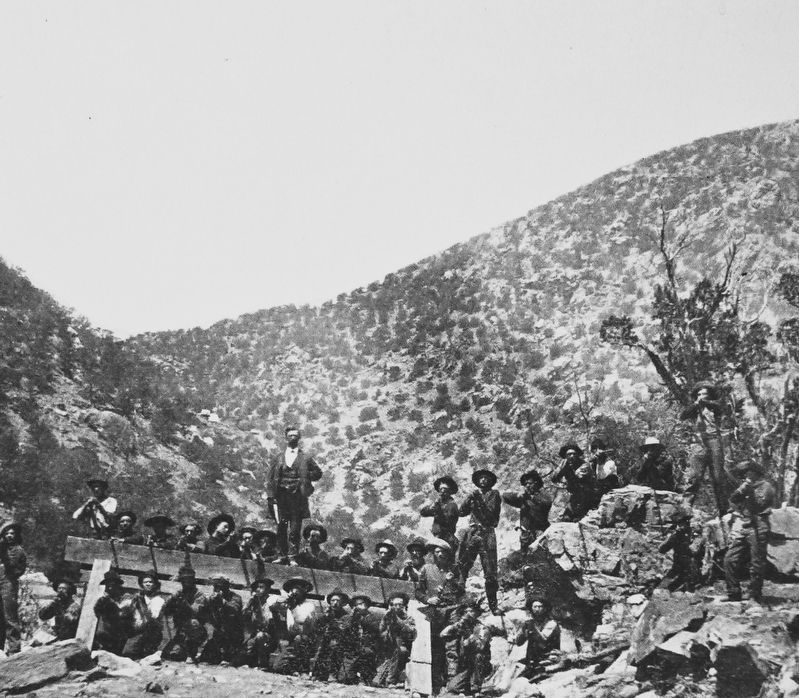
Courtesy Royal Gorge Regional Museum and History Center
2. Marker detail: Royal Gorge War, 1878-1879
[other photo captions]
• First Excursion Train through the Royal Gorge, 1880
• Territorial Prison, circa 1900
Topics. This historical marker is listed in these topic lists: Bridges & Viaducts • Industry & Commerce • Law Enforcement • Railroads & Streetcars. A significant historical year for this entry is 1877.
Location. 38° 26.241′ N, 105° 14.508′ W. Marker is in Cañon City, Colorado, in Fremont County. It is on South 3rd Street 0.1 miles south of Royal Gorge Boulevard (U.S. 50), on the right when traveling south. The marker is located at the east end of the Royal Gorge Railroad parking lot. Touch for map. Marker is at or near this postal address: 403 Water Street, Canon City CO 81212, United States of America. Touch for directions.

Regionally, this marker is in the Arkansas River Valley and in Pikes Peak Region. It is also in the American Mountain West. Globally, it is in North America, the Rocky Mountains, the Western Hemisphere,
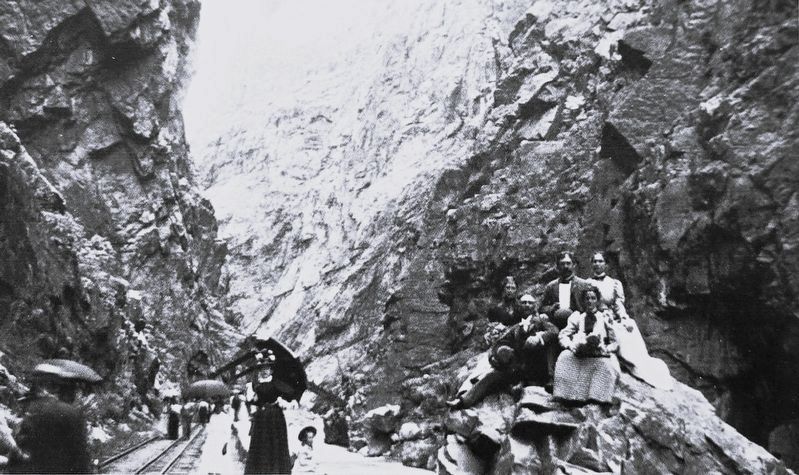
Library of Congress
3. Marker detail: 100th Royal Gorge Excursion, c. 1900
Men and women pose during an excursion on the 100th run.
Other nearby markers. At least 8 other markers are within walking distance of this marker: Health, Wellness ~ Entertainment (here, next to this marker); W. C. Catlin (about 800 feet away, measured in a direct line); The Gold Belt Tour National Scenic Byway (approx. 0.2 miles away); Filmed in Cañon (approx. 0.2 miles away); Lt. Zebulon Pike's Southwestern Expedition (approx. 0.2 miles away); Canon City - Bustling Center for Trade, Transportation, and Tourism (approx. 0.2 miles away); Raynolds Bank (approx. 0.2 miles away); Raynolds-McGee Block (1883) / McClure/Strathmore Hotel (1874) (approx. 0.2 miles away). Touch for a list and map of all markers in Cañon City.
Also see . . . Railroad Wars: The Colorado Railroad War (Wikipedia).
Excerpt: The Colorado Railroad War, also known as the Royal Gorge Railroad War, was fought in the late 1870s between the Atchison, Topeka and Santa Fe Railway and the smaller Denver and Rio Grande company. In 1878, the Atchison, Topeka and Santa Fe was(Submitted on August 17, 2025, by Cosmos Mariner of Cape Canaveral, Florida.)competing against the Denver and Rio Grande to put the first line through Raton Pass. Both railroads had extended lines into Trinidad, Colorado and the pass was the only access to continue on to New Mexico. There was a great deal of legal maneuvering, and even threatened violence between rival gangs of railroad workers. To break the impasse, Atchison, Topeka and Santa Fe hired a number of local gunfighters in February 1878. Faced with this threat, and running out of money, the Denver and Rio Grande was forced to cede the pass to its rivals. The initial dispute was over without a shot being fired. However, the next year a silver strike in Leadville brought the struggle back to life.Photographed by Cosmos Mariner, July 23, 20254. Cañon City MarkerLooking east from the Royal Gorge Railroad parking lot. This marker is the rightmost of three panels in the interpretive kiosk. The station is in the background, behind the panels.Now both railroads were competing to put track along the narrow Royal Gorge. The Denver and Rio Grande had hired its own gunfighters so the Atchison, Topeka and Santa Fe decided to strengthen its forces. On March 20, 1879 the railroad hired Bat Masterson to put together a group of gunmen. Masterson's force included such famous fighters as Doc Holliday, Ben Thompson, Dave Rudabaugh and Mysterious Dave Mather, as well as about seventy others. This impressive
force had great success through early June 1879, but, on June 10, the state Fourth Judicial Circuit, with the later concurrence of the federal courts, ruled in favor of the Denver and Rio Grande, changing matters entirely. With the assistance of the sheriffs in the counties through which the railroads passed, the Denver and Rio Grande mounted an attack on its rival's forces. There was heavy fighting at the Santa Fe's garrisons in Colorado. The garrisons in Denver and Colorado Springs fell quickly. Masterson's headquarters in Pueblo held out the longest, but they eventually conceded defeat. Later, there were some bloodless skirmishes, but the war was essentially over with the Denver and Rio Grande in control of the Royal Gorge.

Credits. This page was last revised on August 17, 2025. It was originally submitted on August 16, 2025, by Cosmos Mariner of Cape Canaveral, Florida. This page has been viewed 133 times since then and 35 times this year. Photos: 1, 2, 3, 4. submitted on August 17, 2025, by Cosmos Mariner of Cape Canaveral, Florida.
