San Giovanni in Firenze in Città Metropolitana di Firenze, Tuscany, Italy — Southern and Western Europe (Mediterranean)
John Brampton Philpot
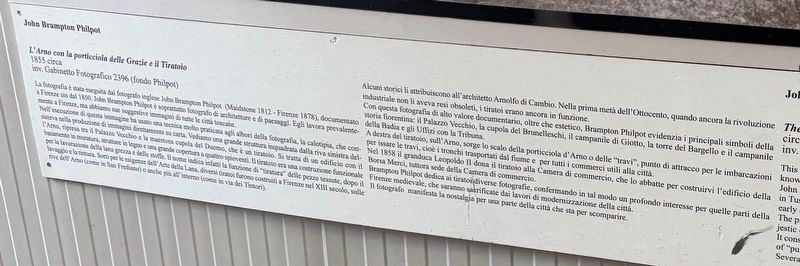
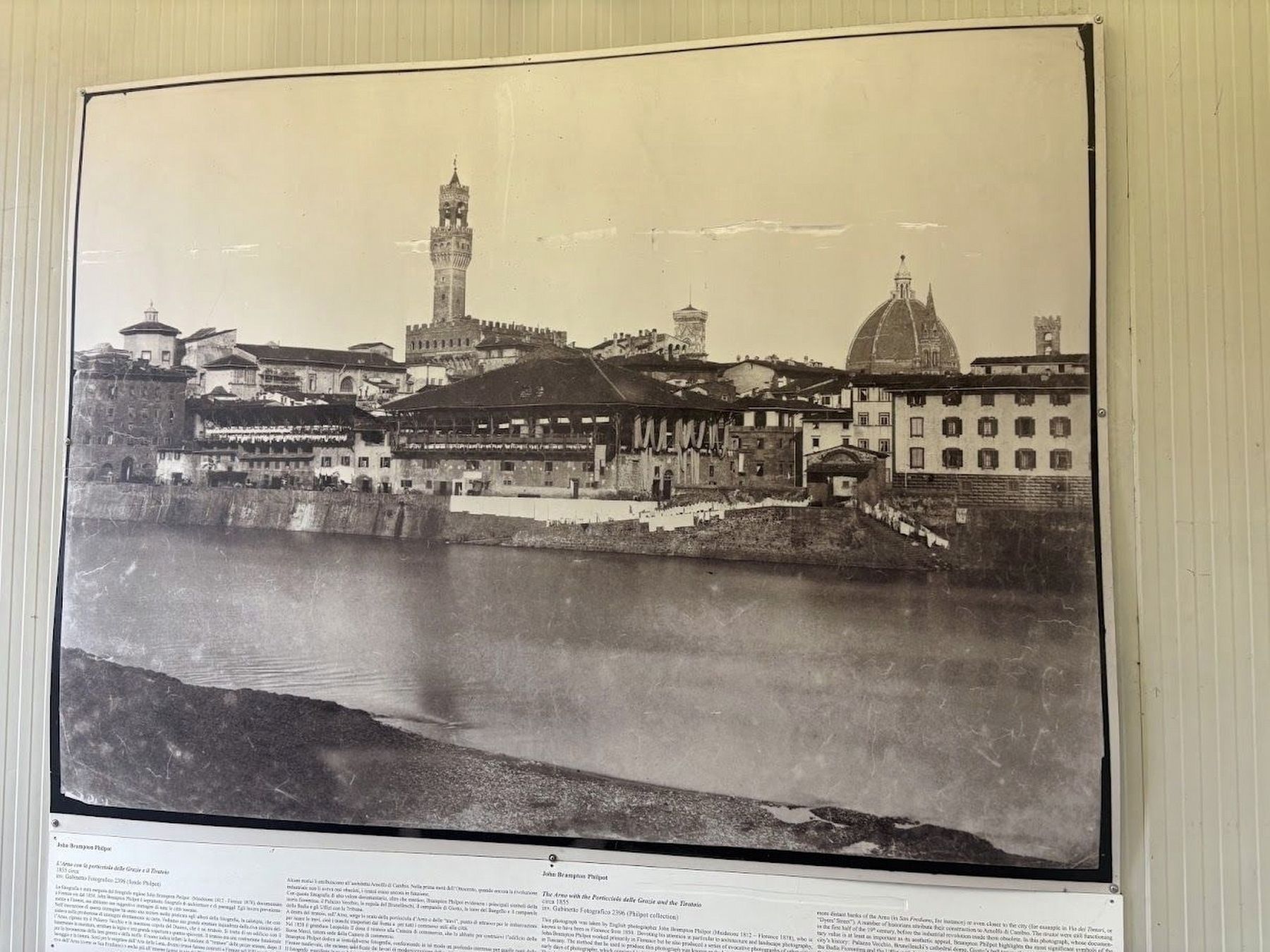
L'Arno con la porticciola delle Grazie e il Tiratoio
| — | 1855 circa; inv. Gabinetto Fotografico 2396 (Philpot Collection) | — |
Photographed by Sean P. Flynn, July 25, 2025
1. John Brampton Philpot caption (Italian text)

[Italian caption on the left:]
La fotografia è stata eseguita dal fotografo inglese John Brampton Philpot (Maidstone 1812 – Firenze 1878), documentato a Firenze sin dal 1850. John Brampton Philpot è soprattutto fotografo di architetture e di paesaggi. Egli lavora prevalente-mente a Firenze, ma abbiamo sue suggestive immagini di tutte le città toscane.
Nell'esecuzione di questa immagine ha usato una tecnica molto praticata agli albori della fotografia, la calotipia, che consisteva nella produzione di immagini direttamente su carta. Vediamo una grande struttura inquadrata dalla riva sinistra dell'Arno, ripresa tra il Palazzo Vecchio e la maestosa cupola del Duomo, che è un tiratoio. Si tratta di un edificio con il basamento in muratura, strutture in legno e una grande copertura a quattro spioventi. Il tiratoio era una costruzione funzionale per la lavorazione della lana grezza e delle stoffe. Il nome indica infatti la funzione di "tiratura" delle pezze tessute, dopo il lavaggio e la tintura. Sorti per le esigenze dell' Arte della Lana, diversi tiratoi furono costruiti a Firenze nel XIII secolo, sulle rive
this page online
Alcuni storici li attribuiscono all'architetto Arnolfo di Cambio. Nella prima metà dell'Ottocento, quando ancora la rivoluzione industriale non li aveva resi obsoleti, i tiratoi erano ancora in funzione.
Con questa fotografia di alto valore documentario, oltre che estetico, Brampton Philpot evidenzia i principali simboli della storia fiorentina: il Palazzo Vecchio, la cupola del Brunelleschi, il campanile di Giotto, la torre del Bargello e il campanile della Badia e gli Uffizi con la Tribuna.
A destra del tiratoio, sull'Arno, sorge lo scalo della porticciola d'Arno o delle "travi", punto di attracco per le imbarcazioni per issare le travi, cioè i tronchi trasportati dal fiume e per tutti i commerci utili alla città.
Nel 1858 il granduca Leopoldo II dona il tiratoio alla Camera di commercio, che lo abbatte per costruirvi l'edificio della Borsa Merci, tuttora sede della Camera di commercio.
Brampton Philpot dedica ai tiratoi diverse fotografie, confermando in tal modo un profondo interesse per quelle parti della Firenze medievale, che saranno
Photographed by Sean P. Flynn, July 25, 2025
2. John Brampton Philpot caption (English text)
Il fotografo manifesta la nostalgia per una parte della città che sta per scomparire.
[English caption on the right:]
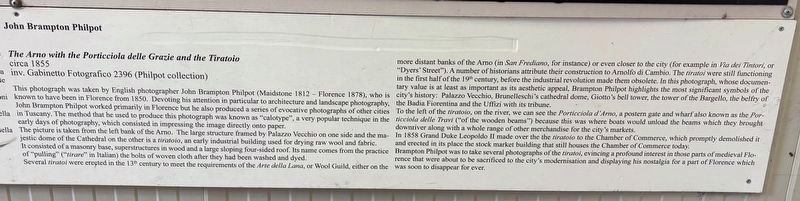
This photograph was taken by English photographer John Brampton Philpot (Maidstone 1812 – Florence 1878), who is known to have been in Florence from 1850. Devoting his attention in particular to architecture and landscape photography, John Brampton Philpot worked primarily in Florence but he also produced a series of evocative photographs of other cities in Tuscany. The method that he used to produce this photograph was known as "calotype", a very popular technique in the early days of photography, which consisted in impressing the image directly onto paper.
The picture is taken from the left bank of the Arno. The large structure framed by Palazzo Vecchio on one side and the majestic dome of the Cathedral on the other is a tiratoio, an early industrial building used for drying raw wool and fabric. It consisted of a masonry base, superstructures in wood and a large sloping four-sided roof. Its name comes from the practice of "pulling" ("tirare" in Italian)
Photographed by Sean P. Flynn, July 25, 2025
3. John Brampton Philpot photo
Several tiratoi were erected in the 13th century to meet the requirements of the Arte della Lana, or Wool Guild, either on the more distant banks of the Arno (in San Frediano, for instance) or even closer to the city (for example in Via dei Tintori, or "Dyers' Street"). A number of historians attribute their construction to Arnolfo di Cambio. The tiratoi were still functioning in the first half of the 19th century, before the industrial revolution made them obsolete. In this photograph, whose documentary value is at least as important as its aesthetic appeal, Brampton Philpot highlights the most significant symbols of the city's history: Palazzo Vecchio, Brunelleschi's cathedral dome, Giotto's bell tower, the tower of the Bargello, the belfry of the Badia Fiorentina and the Uffizi with its tribune.
To the left of the tiratoio, on the river, we can see the Porticciola d'Arno, a postern gate and wharf also known as the Porricciola delle Travi ("of the wooden beams") because this was where boats would unload the beams which they brought downriver along with a whole range

Photographed by Sean P. Flynn, July 25, 2025
4. The photo at the Uffizi exit
In 1858 Grand Duke Leopoldo II made over the the tiratoio to the Chamber of Commerce, which promptly demolished it and erected in its place the stock market building that still houses the Chamber of Commerce today.
Brampton Philpot was to take several photographs of the tiratoi, evincing a profound interest in those parts of medieval Florence that were about to be sacrificed to the city's modernisation and displaying his nostalgia for a part of Florence which was soon to disappear for ever.
Topics. This historical marker is listed in these topic lists: Architecture • Arts, Letters, Music • Waterways & Vessels. A significant historical year for this entry is 1855.
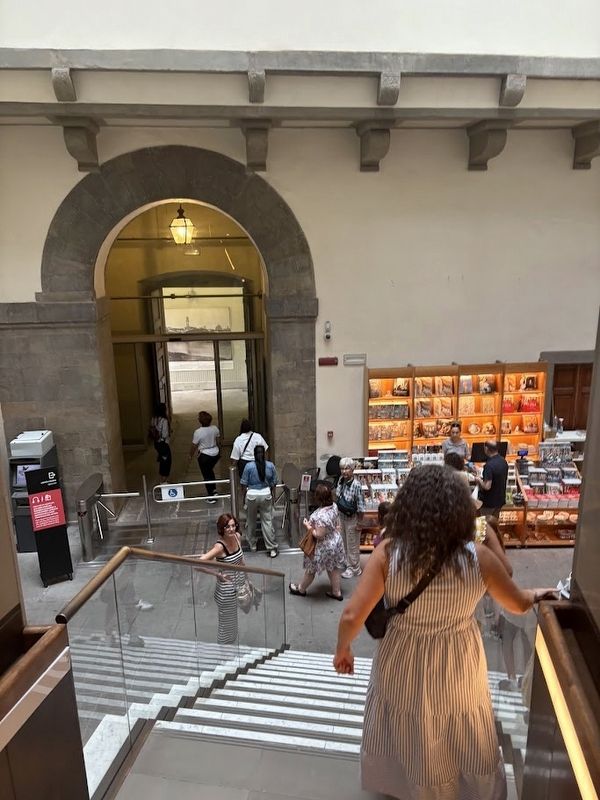
Location. 43° 46.112′ N, 11° 15.368′ E. Marker is in Firenze, Toscana (Tuscany), in Città Metropolitana di Firenze. It is in San Giovanni. It can be reached from Via dei Leoni, on the left when traveling north. The marker is a caption below the reprint of a photograph that can be found at the exit to the Uffizi Gallery. Touch for map. Marker is in this post office area: Firenze, Toscana 50122, Italy. Touch for directions.

Regionally,
Photographed by Sean P. Flynn, July 25, 2025
5. John Brampton Philpot Marker
The photo is one of two that can be found just outisde the exit to the Uffizi Gallery.
Other nearby markers. At least 8 other markers are within walking distance of this marker: Giuseppe e Vittorio Jacquier (here, next to this marker); Ex Chiesa di San Pier Scheraggio / Former Church of San Pier Scheraggio (within shouting distance of this marker); Meridiana Monumentale / Monumental Sundial (about 90 meters away, measured in a direct line); Site of the Via dei Georgofili Bombing (about 90 meters away); Torre de' Pulci (about 90 meters away); Palazzo Castellani (about 90 meters away); The Liberation of Florence, 1944 (about 120 meters away); Firenze — Piazza della Signoria / Florence — Piazza della Signoria (about 120 meters away). Touch for a list and map of all markers in Firenze.
More about this marker. The full English title of the photograph is "The Arno with the Porticciola delle Grazie and the Tiratoio."
Also see . . . John Brampton Philpot and the calotype in Florence. An Uffizi Gallery webpage discusses to the Philpot Collection of photographs taken by English photographer John Brampton Philpot in the mid-19th century.
Excerpt: "One of the prides of the Uffizi Photographic Dept. is undoubtedly the collection of 28 calotypes by John Brampton Philpot, an English photographer allegedly active in Florence as of 1850. It is the historic period that sees the origin of photography, born in 1839 with the invention of daguerreotypes. Florence, the capital of the Grand Duchy, is one of the first cities where the new technique and its first experiments developed, attracting photographers eager to rise to the new challenge. Philpot is among the first to use the ‘calotype’ process, finding his favourite clients among the growing number of English tourists."(Submitted on August 18, 2025, by Sean P. Flynn of Oak Park, Illinois.)
Credits. This page was last revised on May 14, 2026. It was originally submitted on August 18, 2025, by Sean P. Flynn of Oak Park, Illinois. This page has been viewed 117 times since then and 16 times this year. Photos: 1, 2, 3, 4, 5. submitted on August 18, 2025, by Sean P. Flynn of Oak Park, Illinois.
