
East Roanoke in Randolph County, Alabama — The American South (East South Central)
Clark Funeral Home
Randolph County
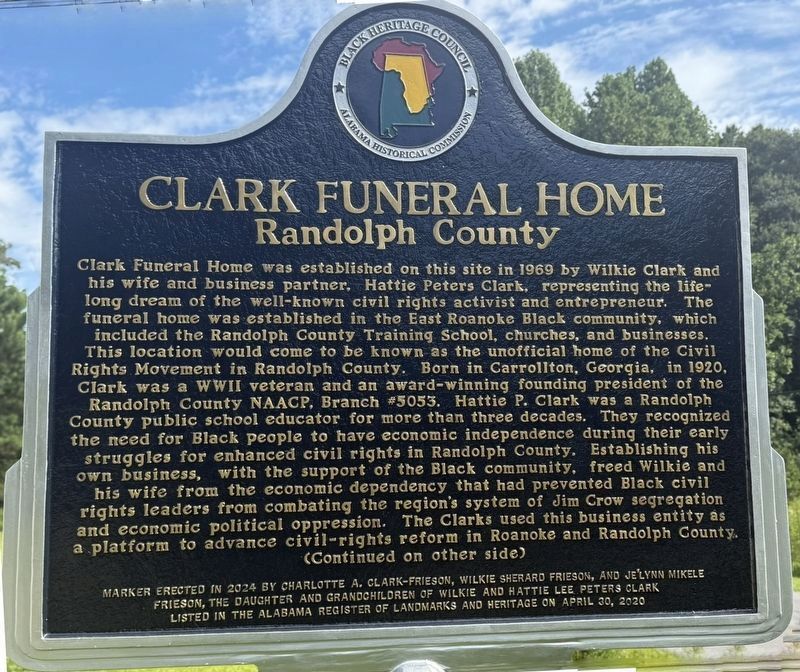
Photographed by Charlotte A. Clark-Frieson
1. Clark Funeral Home Marker, side one
this page online
A long-time advocate for the education of Black students, Wilkie Clark was the first Black candidate for a seat on the Randolph County Board of Education. He was also instrumental in advocating for the hiring of the first Black police officers in Roanoke and desegregating the city’s recreation facilities. Wilkie and Hattie Lee also petitioned the city of Roanoke to pave streets in the Black community and provide water and sewer services, which were only available in White neighborhoods. The Clarks were especially active during the 1980s as key members of a coalition pushing for enforcement of the 1965 Voting Rights Act. The coalition included education, civic, clerical, and business leaders and supported a lawsuit, in which Clark was a plaintiff, designed to strengthen the Voting Rights Act. The coalition successfully advocated for additional polling sites and the inclusion of Blacks as poll workers and creating new single member voting districts from which Black residents could be elected. Renaissance man Wilkie Clark was among
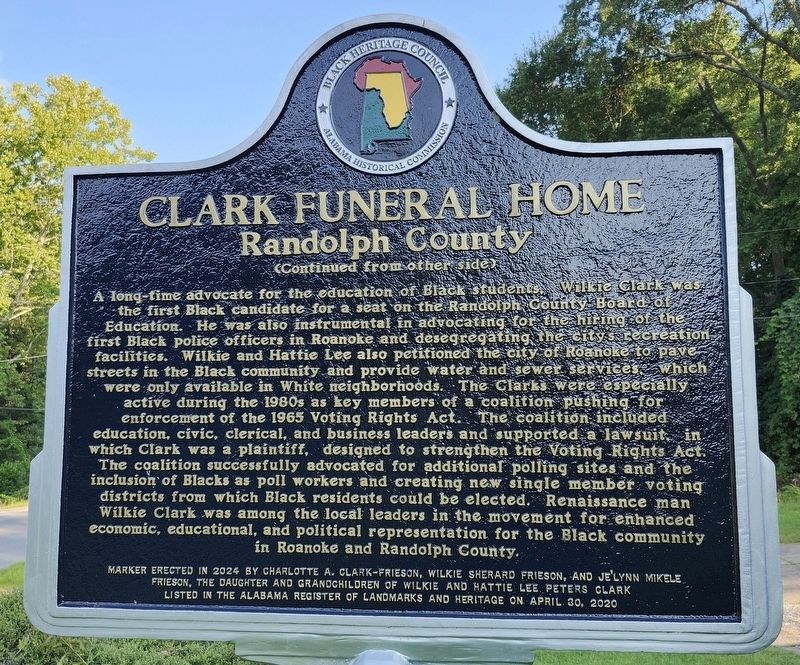
Photographed by Charlotte A. Clark-Frieson, July 6, 2025
2. Clark Funeral Home Marker, side two
Erected 2024 by Clark Memorial Funeral Service and Charlotte A. Clark-Frieson, Wilkie Sherard Frieson, and Je’lynn Mikele Frieson, the daughter and grandchildren of Wilkie and Hattie Lee Peters Clark. Listed in the Alabama Register of Landmarks and Heritage on April 30, 2020.
Topics. This historical marker is listed in these topic lists: African Americans • Charity & Public Work • Civil Rights • Education. A significant historical date for this entry is April 30, 2020.
Location. 33° 8.87′ N, 85° 21.689′ W. Marker is in Roanoke, Alabama, in Randolph County. It is in East Roanoke. It is on Lafayette Highway (Local Route 252) 0.2 miles south of Main Street (Alabama Route 22), on the right when traveling south. Touch for map. Marker is at or near this postal address: 252 Lafayette Hwy, Roanoke AL 36274, United States of America. Touch for directions.

Regionally, this marker is in East Alabama. It is also in the American South, specifically in the Deep South, in Appalachia,
Photographed by Charlotte A. Clark-Frieson, July 6, 2025
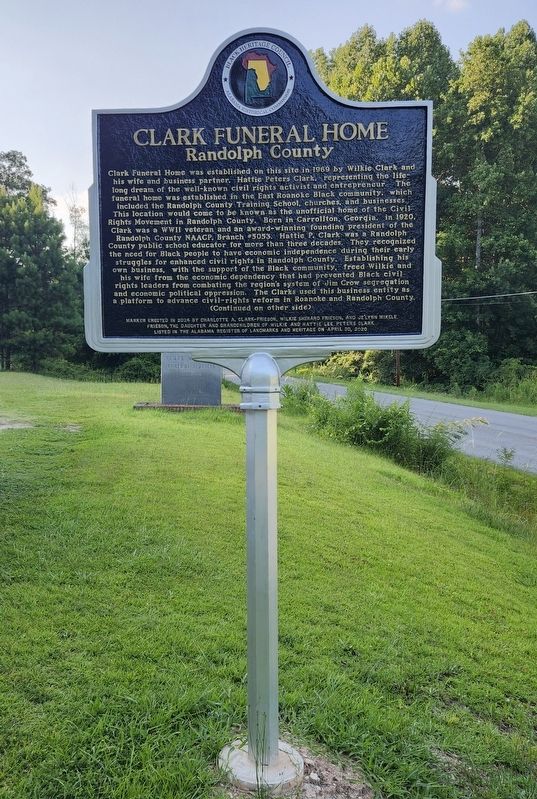
3. Clark Funeral Home Marker
Other nearby markers. At least 8 other markers are within 9 miles of this marker, measured as the crow flies: Randolph County Training School (approx. 0.6 miles away); First Baptist Church (approx. 0.7 miles away); The Martin Theatre (approx. 0.8 miles away); Lebanon Christian Church (approx. 3 miles away); Pottery Shops in Rock Mills / The Potters of Rock Mills (approx. 3.9 miles away); Wehadkee Yarn Mills (approx. 4.2 miles away); Pottery-Making Families of Randolph County / Early Pottery Shops of Randolph County (approx. 4.3 miles away); First Consolidated High School in the State of Alabama (approx. 9 miles away). Touch for a list and map of all markers in Roanoke.
Another marker is no longer nearby. Roanoke Doll Factory (was approx. 0.6 miles away but has been confirmed
Photographed by Charlotte A. Clark-Frieson, July 6, 2025
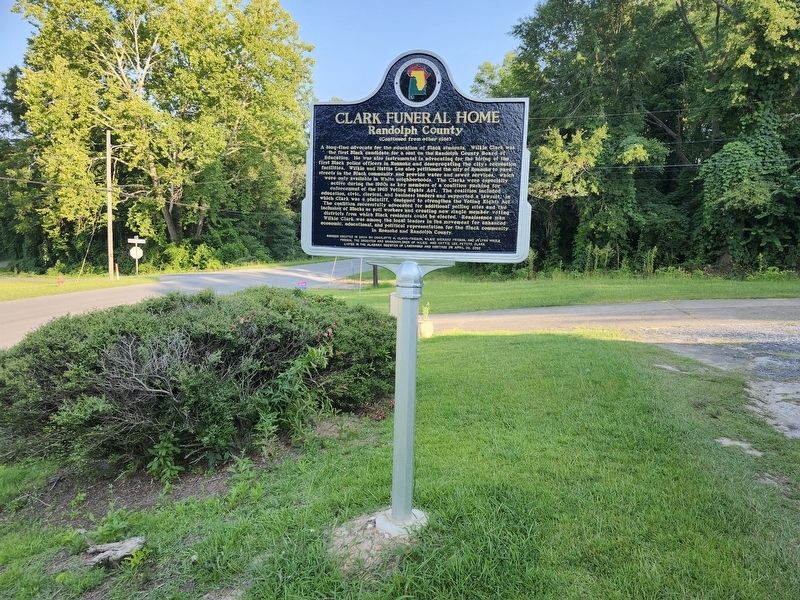
4. Clark Funeral Home Marker
More about this marker. Nearby Landmarks include the Historic Downtown Roanoke District, The Randolph County Training School (R.C.T.S.), and the Home of Professor James Riley. All of these nearby landmarks are within walking distance of the Clark Funeral Home, Randolph County.
Regarding Clark Funeral Home. Clark Funeral Home is an historic business institution in Roanoke, Randolph County, Alabama, established in the late 1960s by two of this area's most formidable civil rights activists Wilkie Clark and his wife, Hattie Lee Peters Clark. Our listing in the Alabama Register of Landmarks and Heritage is based solely on the historical impact of its founder and long-standing occupants, the late Mr. and Mrs. Wilkie Clark, and his wife, Hattie Lee (Peters) Clark. Clark Funeral Home in Roanoke ably served our community not only during times of death, losses and bereavement; but it also served as "The Epicenter of Black Movement" during times of racial unrest, discontent and crisis—throughout the whole county and beyond. As you will see based on the historical artifacts we have included herein, the Clark's were—in essence—two extraordinary black "Legends At Work."
Be that as it may, over the years The Clark's family homestead, Funeral Home business, AND the family itself became somewhat of a "Nucleus" of the community, serving as a vital point of contact for anybody in trouble, in need of help, trying to navigate the oppressive racist machine that was so pervasive not only throughout our little community, but across the nation. Wilkie Clark's understanding of racism, and thus his activism was heightened by the fact that his company was serving black people who — because of the racial barriers — were limited in their ability to do anything to advance themselves socially, politically, or economically. Thus, as a consequence of the times that formed the setting in which he came into the world, he literally devoted his entire lifetime, from early adulthood until his passing in 1989, to the Civil and Human Rights for the benefit of black people in our area.
By the time he died on July 29, 1989, he had become a very well-known and respected self-made man, who had devoted most of his life to his community, to helping others, serving the cause of Freedom, Justice and Equality for all people.
Also see . . .
1. Clark Historic Landmark Site, Roanoke, Alabama. A Guided Digital Tour Of The Lives, Legacies and Works Of Wilkie And Hattie Lee (Peters) Clark as presented by their offspring: their only daughter, Mrs. Charlotte A. Clark-Frieson; grandson, Wilkie S. Frieson, and Granddaughter, Je'Lynn M. Frieson. (Submitted on August 19, 2025.)
2. The Clark Memorial Foundation. Honoring the lives of Wilkie and Hattie Lee Peters Clark through education, civic engagement, and the preservation of The Clark Historic Landmark Site. (Submitted on August 19, 2025.)
Additional keywords. Roanoke Alabama, Randolph County Training School, R.C.T.S., "Separate-But-Equal" Voting Rights
Credits. This page was last revised on August 19, 2025. It was originally submitted on August 18, 2025, by Charlotte A. Clark-Frieson of Roanoke, Alabama, Randolph. This page has been viewed 214 times since then and 98 times this year. Photos: 1. submitted on August 18, 2025, by Charlotte A. Clark-Frieson of Roanoke, Alabama, Randolph. 2, 3, 4. submitted on August 19, 2025, by Charlotte A. Clark-Frieson of Roanoke, Alabama, Randolph. • J. J. Prats was the editor who published this page.
