Inner Harbor in Baltimore, Maryland — The American Northeast (Mid-Atlantic)
The Great Baltimore Fire

Photographed by Christopher Busta-Peck, March 12, 2008
1. The Great Baltimore Fire Marker
On Sunday morning, February 7, 1904, a spark ignited blankets and cotton goods in the firm of John E. Hurst and Company, which stood between Hopkins Place and Liberty on the south side of German (now Redwood) Street. Flames leapt out of control from building to building due to high winds. A total of 1,231 fireman and 400 volunteers sprayed 20 million gallons of water on the flames. By the time the fire was under control on Monday evening, it had consumed 1,500 buildings over approximately 140 acres. Many people sustained substantial material loss. Damage was estimated to be more than 125 million dollars. Miraculously, however, there were no serious injuries and only one reported fatality.
The leaders of Baltimore decided to use this disaster as an opportunity to improve their city and make it more appealing. As a result of careful and thoughtful planning, civic leaders created a thriving, modern port city with wider streets, more efficient docks, an improved sewer system, and sturdy masonry and steel buildings.
Topics. This historical marker is listed in these topic lists: Disasters • Industry & Commerce •
this page online
Location. Marker has been permanently removed. It was located near 39° 16.997′ N, 76° 36.707′ W. Marker was in Baltimore, Maryland. It was in the Inner Harbor. It was at the intersection of Light Street (Maryland Route 2) and Barre Street, on the right when traveling north on Light Street. Touch for map. Marker was at or near this postal address: 399 E Pratt St, Baltimore MD 21230, United States of America.
We have been informed that this marker is no longer there and will not be replaced. This page is an archival view of what was.
Regionally, this marker was in Central Maryland. It was also in the American Mid-Atlantic, in the Chesapeake Bay Region, and on the Eastern Seaboard. Globally, it was in the North Atlantic Region, North America, the Western Hemisphere, the Western World, and the Anglosphere. Historically, it found itself in what was once one of the original Thirteen Colonies and also the Antebellum South.

Other nearby markers. At least 8 other markers are within walking distance of this location: Pride of Baltimore
Photographed by Christopher Busta-Peck, March 12, 2008
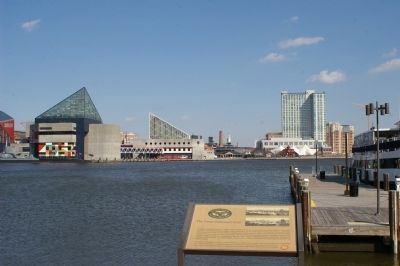
2. Marker with the Baltimore harbor in the background
The National Aquarium can be seen in the background.
Other markers no longer nearby. Baltimore’s Maritime Heritage (was a few steps from this marker but has been permanently removed); Baltimore’s Part in Saving the Bay (was about 500 feet away but has been permanently removed); a different marker also named Baltimore’s Maritime Heritage (was about 600 feet away but has been permanently removed).
Also see . . .
1. Great Baltimore Fire. Wikipedia entry (Submitted on January 31, 2023, by Larry Gertner of New York, New York.)
2. Baltimore History: The Great Fire of 1904. Enoch Pratt Free Library Blog entry (Submitted on January 25, 2024, by Larry Gertner of New York, New York.)
circa 1907
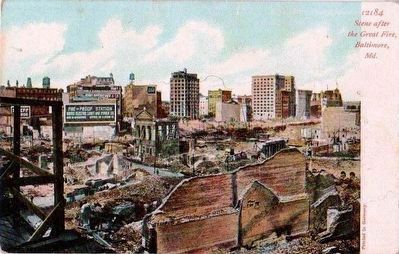
3. Scene After the Great Fire, Baltimore, Md.

Frederick W. Mueller, from the Library of Congress Collection, circa February 8, 1904
4. Cycloramic view of the burned area of Baltimore's Fire

Frederick W. Mueller, from the Library of Congress Collection, circa February 8, 1904
5. Cycloramic view of Baltimore's Fire from Hanover St.
Photographed by Allen C. Browne, September 5, 2015
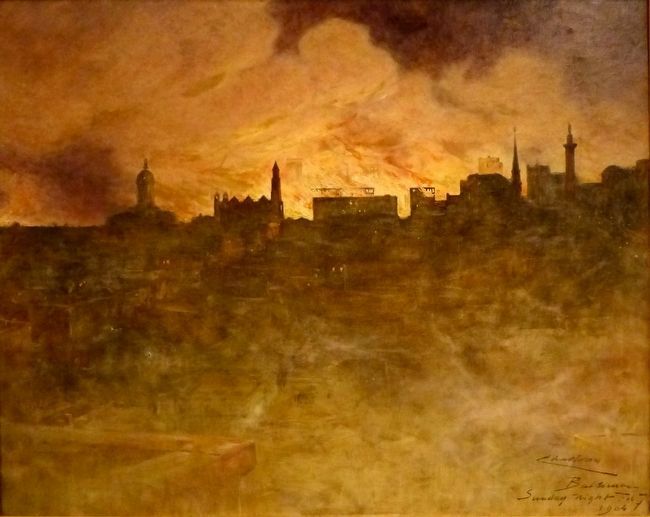
6. Baltimore Fire
This eye-witness painting of the Baltimore Fire by Theobald Chartran hangs in the Maryland Historical Society Museum in Baltimore, Maryland. The signature block reads: T. Chartran, Baltimore, Sunday night Feb 7 1904.
“This impressionistic scene depicts a birds-eye view of the Baltimore fire of February 7, 1904. Chartran, a French artist, was best known for his portraits of famous Europeans and Americans, including Cardinal Gibbons, and his work for the magazine, Vanity Fair. He is said to have almost lost his life while painting the fire, working in dangerous proximity to the disaster in order to capture the terror of the destruction.” — Maryland Historical Society
“This impressionistic scene depicts a birds-eye view of the Baltimore fire of February 7, 1904. Chartran, a French artist, was best known for his portraits of famous Europeans and Americans, including Cardinal Gibbons, and his work for the magazine, Vanity Fair. He is said to have almost lost his life while painting the fire, working in dangerous proximity to the disaster in order to capture the terror of the destruction.” — Maryland Historical Society
Credits. This page was last revised on September 16, 2025. It was originally submitted on March 12, 2008, by Christopher Busta-Peck of Shaker Heights, Ohio. This page has been viewed 4,311 times since then and 85 times this year. Last updated on August 18, 2025, by Evan Dwyer of Richmond, Virginia. Photos: 1, 2. submitted on March 12, 2008, by Christopher Busta-Peck of Shaker Heights, Ohio. 3. submitted on September 24, 2015. 4, 5. submitted on May 21, 2008, by Tabitha Preast of Hanover, Maryland. 6. submitted on September 21, 2015, by Allen C. Browne of Silver Spring, Maryland. • Devry Becker Jones was the editor who published this page.
