Bamberg, Bavaria, Germany — Central Europe
Mühlen im 20. Jahrhundert
⎯⎯⎯
Mills in the 20th Century
Photographed by James Hulse, July 8, 2025
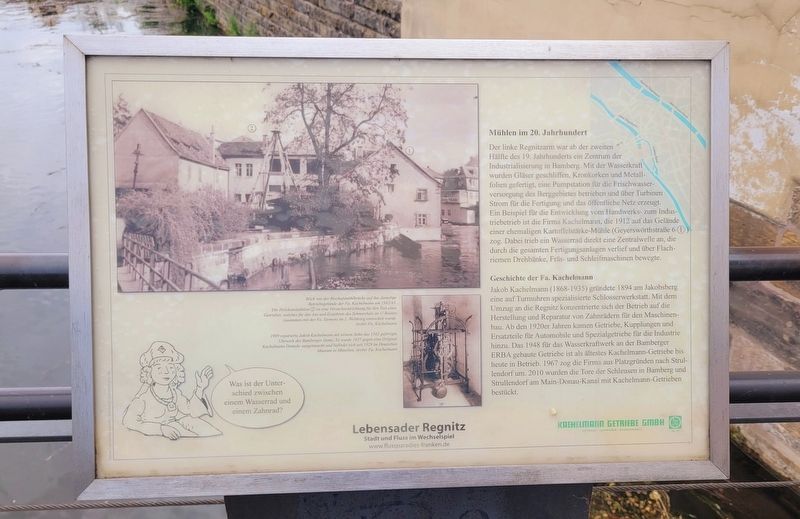
1. Mühlen im 20. Jahrhundert / Mills in the 20th Century Marker

Mühlen im 20. Jahrhundert
Der linke Regnitzarm war ab der zweiten Hälfte des 19. Jahrhunderts ein Zentrum der Industrialisierung in Bamberg. Mit der Wasserkraft wurden Gläser geschliffen, Kronkorken und Metallfolien gefertigt, eine Pumpstation für die Frischwasserversorgung des Berggebietes betrieben und über Turbinen Strom für die Fertigung und das öffentliche Netz erzeugt. Ein Beispiel für die Entwicklung vom Handwerks- zum Industriebetrieb ist die Firma Kachelmann, die 1912 auf das Gelände einer ehemaligen Kartoffelstärke-Mühle (Geyerswörthstraße 6① zog. Dabei trieb ein Wasserrad direkt eine Zentralwelle an, die durch die gesamten Fertigungsanlagen verlief und über Flachriemen Drehbänke, Fräs- und Schleifmaschinen bewegte.
Geschichte der Fa. Kachelmann
Jakob Kachelmann (1868-1935) gründete 1894 am Jakobsberg eine auf Turmuhren spezialisierte Schlosserwerkstatt. Mit dem Umzug an die Regnitz konzentrierte sich der Betrieb auf die Herstellung und Reparatur von Zahnrädern für den Maschinenbau. Ab den 1920er Jahren kamen Getriebe, Kupplungen und Ersatzteile für Automobile und Spezialgetriebe für
this page online
Untertitel
(Foto #1) Blick von der Bischofsmühlbrücke auf das damalige Betriebsgelände der Fa. Kachelmann um 1942/43. Die Holzkonstruktion ② ist eine Versuchseinrichtung für den Test eines Getriebes, welches für das Aus und Einfahren des Schnorchels an U-Booten zusammen mit der Fa. Siemens im 2. Weltkrieg entwickelt wurde. Archiv Fa. Kachelmann.
(Foto #2) 1909 reparierte Jakob Kachelmann mit seinem Sohn das 1562 gefertigte Uhrwerk des Bamberger Doms. Es wurde 1927 gegen eine Original Kachelmann Domuhr ausgetauscht und befindet sich seit 1929 im Deutschen Museum in München. Archiv Fa. Kachelmann.
Was ist der Unterschied zwischen einem Wasserrad und einem Zahnrad?
Mills in the 20th Century
The left arm of the Regnitz became a center of industrialization in Bamberg from
Photographed by James Hulse, July 8, 2025
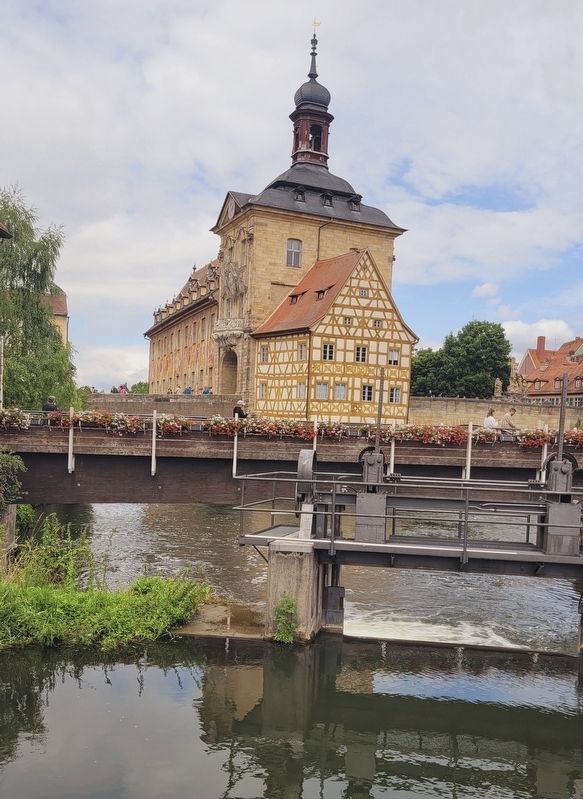
2. The view of the Rathaus across the river
An example of the development from a craft workshop to an industrial enterprise is the Kachelmann company, which in 1912 moved onto the grounds of a former potato starch mill (Geyerswörthstraße 6①). A waterwheel directly powered a central shaft that ran through the entire plant and, by means of flat belts, drove lathes, milling, and grinding machines.
History of the Kachelmann Company
Jakob Kachelmann (1868–1935) founded a locksmith’s workshop specializing in tower clocks in 1894 on Jakobsberg. After relocating to the Regnitz, the company focused on the production and repair of gears for mechanical engineering. From the 1920s, gearboxes, clutches, and spare parts for automobiles, as well as special gear units for industry, were added.
The gearbox built in 1948 for the hydroelectric plant at the Bamberg ERBA is the oldest Kachelmann
Photographed by James Hulse, July 8, 2025
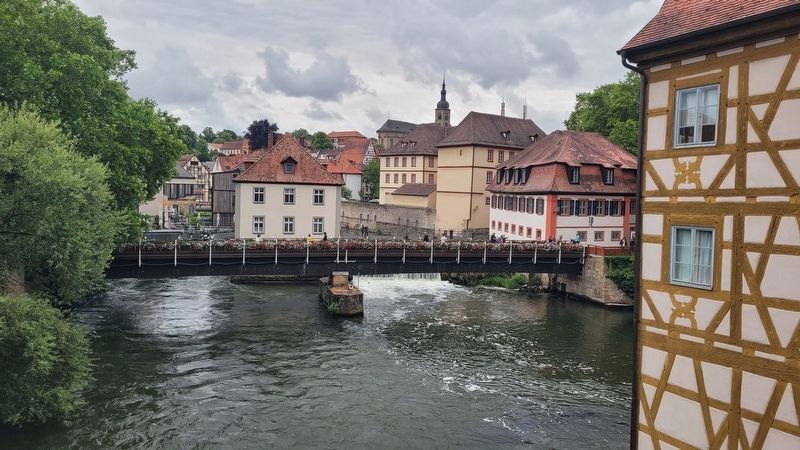
3. The view of the marker and bridge from the Rathaus
The marker is located on the second bridge.
Captions
(Photo #1) View from the Bischofsmühl Bridge of the former Kachelmann factory premises around 1942/43. The wooden structure ② is a test facility for testing a gear system developed in collaboration with Siemens during World War II for extending and retracting the snorkel on submarines. Kachelmann Archives.
(Photo #2) In 1909, Jakob Kachelmann and his son repaired the clockwork of Bamberg Cathedral, which had been made in 1562. It was replaced with an original Kachelmann cathedral clock in 1927 and has been housed in the Deutsches Museum in Munich since 1929. Kachelmann Archive.
What is the difference between a water wheel and a gear wheel?
Erected by Kachelmann Gears Ltd. - Gearboxes · Precision Gears · Mechanical Engineering.
Topics. This historical marker is listed in this topic list: Industry & Commerce. A significant historical year for this entry is 1912.
Location. 49° 53.447′ N, 10° 53.214′ E. Marker is in Bamberg, Bayern (Bavaria). It is on Untere Mühlbrücke just east of Schranne, on the right when traveling east. The marker is located on the bridge. Touch for map. Marker is at or near this postal address: Schranne 2, Bamberg BY 96047, Germany. Touch for directions.

Regionally, it is in Europe, the European Union, Atlantic Europe, Central Europe, the Schengen Area, Western Europe, and the Western World. Historically, it finds itself in what was once the Holy Roman Empire.
Other nearby markers. At least 8 other markers are within walking distance of this marker: Untere Mühlen / Lower Mills (here, next to this marker); Franziskanerkirch / Franciscan Church (within shouting distance of this marker); Upper Bridge and City Hall on the Bridge (within shouting distance of this marker); Schranne 2/3 (within shouting distance of this marker); Claus Graf Stauffenberg (within shouting distance of this marker); Altes Rathaus / Old City Hall (within shouting distance of this marker); Ehem. Bibra-Palais / Former Bibra Palace (about 90 meters away, measured in a direct line); Kaiserin Kunigund / Empress Kunigund (about 120 meters away). Touch for a list and map of all markers in Bamberg.
Also see . . . Lifeline Regnitz – City and River in Interaction. (Submitted on August 20, 2025, by James Hulse of Medina, Texas.)
Credits. This page was last revised on August 21, 2025. It was originally submitted on August 19, 2025, by James Hulse of Medina, Texas. This page has been viewed 85 times since then and 14 times this year. Photos: 1, 2, 3. submitted on August 21, 2025, by James Hulse of Medina, Texas.
