Niagara Falls in Niagara Region, Ontario — Central Canada (North America)
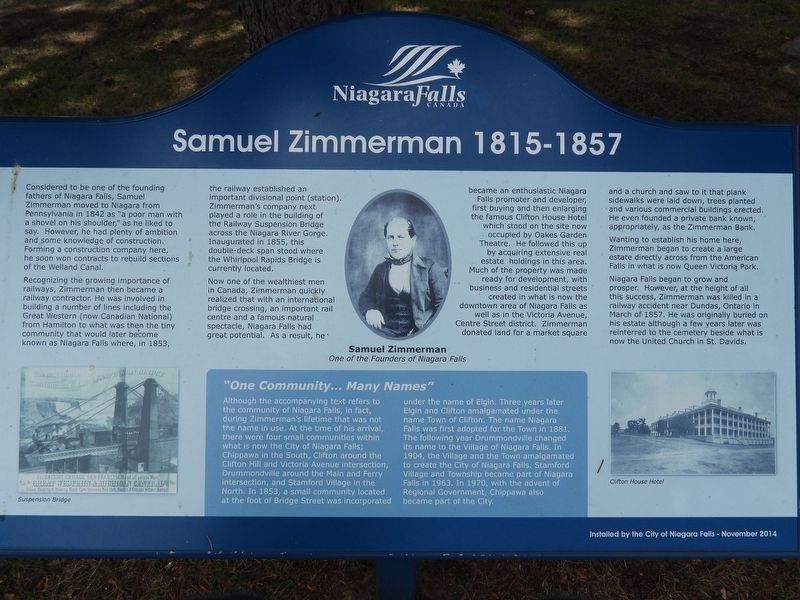
Samuel Zimmerman 1815 - 1857
Photographed by Kevin Westell, August 18, 2025
1. Samuel Zimmerman 1815 - 1857 Marker
Recognizing the growing importance of railways, Zimmerman then became a railway contractor. He was involved in building a number of lines including the Great Western (now Canadian National) from Hamilton to what was then the tiny community that would later become known as Niagara Falls where, in 1853, the railway established an important divisional point (station). Zimmerman's company next played a role in the building of the Railway Suspension Bridge across the Niagara River Gorge. Inaugurated in 1855, this double-deck span stood where the Whirlpool Rapids Bridge is currently located.
Now one of the wealthiest men in Canada, Zimmerman quickly realized that with an international bridge crossing, an important rail centre and
this page online
Wanting to establish his home here, Zimmerman began to create a large estate directly across from the American Falls in what is now Queen Victoria Park.
Niagara Falls began to grow and prosper. However, at the height of all this success, Zimmerman was killed in a railway accident near Dundas, Ontario in March of 1857.
Photographed by Kevin Westell, August 18, 2025
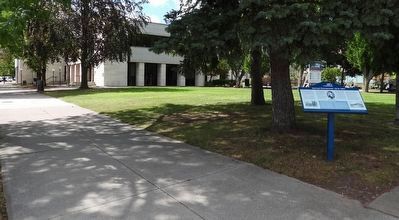
2. Samuel Zimmerman 1815 - 1857 - Marker in context
Marker is at the corner of Erie Ave (on the left) and Queen Street, on the north-east corner of the lawn of the City Hall.
"One Community... Many Names"
Although the accompanying text refers to the community of Niagara Falls, in fact, during Zimmerman's lifetime that was not the name in use. At the time of his arrival, there were four small communities within what is now the City of Niagara Falls; Chippawa in the South, Clifton around the Clifton Hill and Victoria Avenue intersection, Drummondville around the Main and Ferry intersection, and Stamford Village in the North. In 1853, a small community located at the foot of Bridge Street was incorporated under the name of Elgin. Three years later Elgin and Clifton amalgamated under the name Town of Clifton. The name Niagara Falls was first adopted for the Town in 1881. The following year Drummondville changed its name to the Village of Niagara Falls. In 1904, the Village and the Town amalgamated to create the City of Niagara Falls. Stamford Village and Township became part of Niagara Falls in 1963. In 1970, with the advent of Regional Government, Chippawa also became part of the City.
Erected 2014 by City of Niagara Falls.
Topics and series. This historical marker is listed in these topic lists: Charity & Public Work • Industry & Commerce • Railroads & Streetcars • Waterways & Vessels. In addition, it is included in the The Welland Canals series list. A significant historical year for this entry is 1842.
Location. 43° 6.391′ N, 79° 3.815′ W. Marker is in Niagara Falls, Ontario, in Niagara Region. It is at the intersection of Queen St and Erie Avenue, on the right when traveling east on Queen St. Touch for map. Marker is at or near this postal address: 4310 Queen St, Niagara Falls ON L2E 2L1, Canada. Touch for directions.

Regionally, this marker is on the Golden Horseshoe and in Niagara Canada. It is also in Central Canada. Globally, it is in North America, on the Great Lakes, in the Western Hemisphere, in the Western World, and in the Anglosphere. Historically, it finds itself in what was once a British colony, the Viceroyalty of New France, the Haudenosaunee (Iroquois) Confederacy, and Rupert’s Land.
Other nearby markers. At least 8 other markers are within walking distance of this marker: Binational Heritage Peace Garden Trail (within shouting distance of this marker); Olympic Torch Run Legacy Trail (within shouting distance of this marker); Rosberg Family Park (within shouting distance of this marker); McClive Rosberg Block - Erected in 1904 (within shouting distance of this marker); Rededication of Centennial Square and Dedication of the Peace Park (within shouting distance of this marker); Terry Fox (within shouting distance of this marker); 1904 - 2004 City of Niagara Falls Canada Celebrating 100 Years (within shouting distance of this marker); Gay Brothers Bakery Building - Erected In 1907 (about 180 meters away, measured in a direct line). Touch for a list and map of all markers in Niagara Falls.
Credits. This page was last revised on August 30, 2025. It was originally submitted on August 20, 2025, by Kevin Westell of St. Catharines, Ontario. This page has been viewed 93 times since then and 21 times this year. Photos: 1, 2. submitted on August 20, 2025, by Kevin Westell of St. Catharines, Ontario. • Andrew Ruppenstein was the editor who published this page.
