San Giovanni in Firenze in Città Metropolitana di Firenze, Tuscany, Italy — Southern and Western Europe (Mediterranean)
Il Palazzo
⎯⎯⎯
The Palazzo
Museo Nazionale del Bargello
Photographed by Sean P. Flynn, July 26, 2025
1. Il Palazzo / The Palazzo Marker
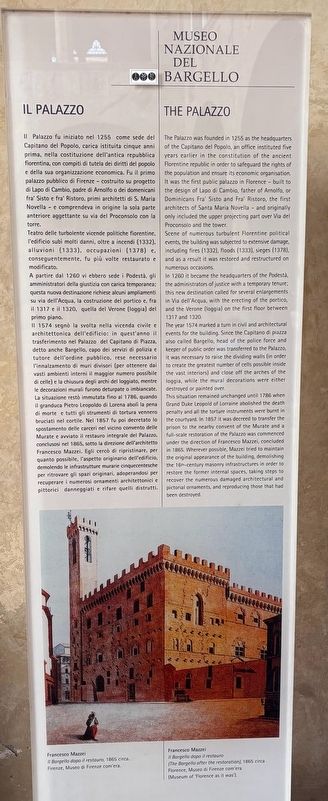
Il Palazzo fu iniziato nel 1255 come sede del Capitano del Popolo, carica istituita cinque anni prima, nella costituzione dell'antica repubblica fiorentina, con compiti di tutela dei diritti del popolo e della sua organizzazione economica. Fu il primo palazzo pubblico di Firenze costruito su progetto di Lapo di Cambio, padre di Arnolfo o dei domenicani fra Sisto e fra Ristoro, primi architetti di S. Maria Novella e comprendeva in origine la sola parte anteriore aggettante su via del Procansolo con la torre.
Teatro delle turbolente vicende politiche fiorentine, l'edificio subi molti danni, oltre a incendi (1332), alluvioni (1333), occupazioni (1378) e, conseguentemente, fu più volte restaurato e modificato.
A partire dal 1260 vi ebbero sede i Podestà, gli amministratori della giustizia con carica temporanea: questa nuova destinazione richiese alcuni ampliamenti su via dell'Acqua, la costruzione del portico e, fra il 1317 e il 1320. quella del Verone (loggia) del primo piano.
Il 1574 segnò la svolta nelia vicenda civile e architettonica dell'edificio: in quest'anno il trasferimento nel Palazzo del Capitano di Piazza, detto anche Bargello, cape dei servizi di polizia tutore dell'ordine pubblica, rest necessarie T'innalzamento di muri divisari (per ottenere dal vasti ambienti interni il maggior numero possibile di celle) e la chiusura degli archi del loggiata, mentre le decorazioni murali furono deturpate o imbiancate.
La situazione resto immutata fino al 1786, quando granduca Pietro Leopolda di Lorena shall la pena di morte e tutti gli strumenti di tortura vennero bruciati nel cortile. Nel 1857 fu poi decretato lo spostamento delle carceri nel vicino convento delle Murate e avviato il restauro integrale del Palazzo, conclusosi nel 1865, sotto la direzione dell'architetto Francesco Mazzei. Egli cerco
this page online
The Palazzo was founded in 1255 as the headquarters of the Capitano del Popolo, an office instituted five years earlier in the constitution of the ancient Florentine republic in order to safeguard the rights of the population and ensure its economic organisation. It was the first public palazzo in Florence - built to the design of Lapo di Cambio, father of Amalfo, or Dominicans Fra Sisto and Fra Ristoro, the first architects of Santa Maria Novella and originally only included the upper projecting part over Via del Proconsole and the tower.
Scene of numerous turbulent Florentine political events, the building was subjected to extensive damage, including fires (1332), floods (1333), sieges (1378), and as a result it was restored and restructured on numerous occasions.
In 1260 it became the headquarters of the Podesta, the administrators of justice with a

Photographed by Sean P. Flynn, July 26, 2025
2. Il Palazzo / The Palazzo Marker
The marker is inside the courtyard area of the Bargello. The nearby sculptures are The Coronation of Fernando I and Six Musicians.
The year 1574 marked a turn in civil and architectural events for the building. Since the Capitano di piazza also called Bargello, head of the police force and keeper of public onder was transferred to the Palazzo it was necessary to raise the dividing walls fin onder to create the greatest number of cells possible inside the vast interiors and close off the arches of the loggia, while the mural decorations were either destroyed or painted over.
This situation remained unchanged until 1786 when Grand Duke Leopold of Lorraine abolished the death penalty and all the torture instruments were burnt in the courtyard. In 1857 it was decreed to transfer the prison to the nearby convent of the Murate and a full-scale restoration of the Palazzo was commenced under the direction of Francesco Mazzei, concluded in 1865. Wherever possible, Marze tried to maintain the original appearance of the building, demolishing the 19-century masonry infrastructures

Photographed by Sean P. Flynn, July 26, 2025
3. The Bargello
The Palazzo marker is visible just to the right of the second pillar in this photo taken from the first story above the ground level at the Bargello museum.
Topics. This historical marker is listed in these topic lists: Architecture • Arts, Letters, Music • Disasters • Law Enforcement. A significant historical year for this entry is 1255.
Location. 43° 46.234′ N, 11° 15.505′ E. Marker is in Firenze, Toscana (Tuscany), in Città Metropolitana di Firenze. It is in San Giovanni. It can be reached from Via Ghibellina near Via del Proconsolo. The marker is inside the open-air courtyard of the Bargello museum (Museo Nazionale del Bargello). Touch for map. Marker is at or near this postal address: Via del Proconsolo 4, Firenze, Toscana 50122, Italy. Touch for directions.

Regionally, it is in Europe, the European Union, the Schengen Area, a coastal Mediterranean country, and the Western World. Historically, it finds itself in what was once the Roman Empire and specifically also the Holy Roman Empire.
Other nearby markers. At least 8 other markers are within walking distance of this marker: Il Museo / The Museum (here, next to this marker); L'incoronazione di Ferdinando I d'Aragona e Sei Musici (a few steps from this marker); Sarcofago / Sarcophagus (a few steps from this marker); Fontana di Sala Grande / Fountain for the Sala Grande (a few steps from this marker); Gli Stemmi / The Coats of Arms (within shouting distance of this marker); Il Pescatore / The Fisher Boy (within shouting distance of this marker); Cannone di San Paolo / Cannon (within shouting distance of this marker); Verone (within shouting distance of this marker). Touch for a list and map of all markers in Firenze.
Also see . . . Museo Nazionale del Bargello official site.
Excerpt: "The palace, founded in 1255, is a monument of great fascination: built to serve as the first public building in medieval Florence, it was soon destined as the seat of the Podestà, the chief city magistrates whose many coats of arms are still set in the walls of the courtyard. Starting from the second half of the 1500s, the building became the seat of the 'Bargello', i.e. the head of the city police, and was used as a prison for the following centuries. After a complete restoration, it was opened in 1865 as the first National Museum of the then newborn Kingdom of Italy, dedicated to the arts of the Middle Ages and the Renaissance."(Submitted on August 20, 2025, by Sean P. Flynn of Oak Park, Illinois.)
Credits. This page was last revised on August 21, 2025. It was originally submitted on August 20, 2025, by Sean P. Flynn of Oak Park, Illinois. This page has been viewed 82 times since then and 13 times this year. Photos: 1, 2, 3. submitted on August 20, 2025, by Sean P. Flynn of Oak Park, Illinois.
