
Monteagle in Marion County, Tennessee — The American South (East South Central)
Tullahoma Campaign
June 24-July 4, 1863
Photographed by Darren Jefferson Clay, July 17, 2021
1. Tullahoma Campaign Marker
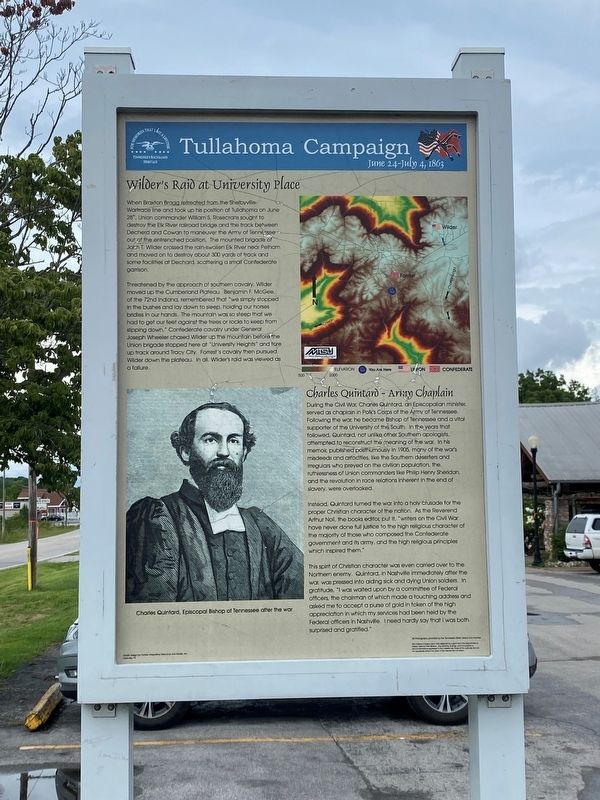
Wilder's Raid at University Place
When Braxton Bragg retreated from the Shelbyville-Wartrace line and took up his position at Tullahoma on June 28, Union commander William S. Rosecrans sought to destroy the Elk River railroad bridge and the track between Decherd and Cowan to maneuver the Army of Tennessee out of the entrenched position. The mounted brigade of John T. Wilder crossed the rain-swollen Elk River near Pelham and moved on to destroy about 300 yards of track and some facilities at Dechard, scattering a small Confederate garrison.
Threatened by the approach of southern cavalry, Wilder moved up the Cumberland Plateau. Benjamin F. McGee, of the 72nd Indiana, remembered that "we simply stopped in the bushes and lay down to sleep, holding our horses bridles in our hands. The mountain was so steep that we had to get our feet against the trees or rocks to keep from slipping down.” Confederate cavalry under General Joseph Wheeler chased Wilder up the mountain beforê the Union brigade stopped here at "University Heights” and tore up track around Tracy City. Forrest's cavalry then pursued Wilder down the
this page online
Charles Quintard - Army Chaplain
During the Civil War, Charles Quintard, an Episcopalian minister, served as chaplain in Polk's Corps of the Army of Tennessee. Following the war, he became Bishop of Tennessee and a vital supporter of the University of the South. In the years that followed, Quintard, not unlike other Southern apologists, attempted to reconstruct the meaning of the war. In his memoir, published posthumously in 1905, many of the war's misdeeds and atrocities, like the Southern deserters and irregulars who preyed on the civilian population, the ruthlessness of Union commanders like Philip Henry Sheridan, and the revolution in race relations inherent in the end of slavery, were overlooked.
Instead, Quintard turned the war Into a holy Crusade for the proper Christian character of the nation. As the Reverend Arthur Noll, the books editor put it, "writers on the Civil War have never done full justice to the high religious character of the majority of those who composed the Confederate government and its army, and the high religious principles which inspired them."
This
Photographed by Darren Jefferson Clay, July 17, 2021
2. Tullahoma Campaign Marker
(caption)
Charles Quintard, Episcopal Bishop of Tennessee after the war
(side 2)
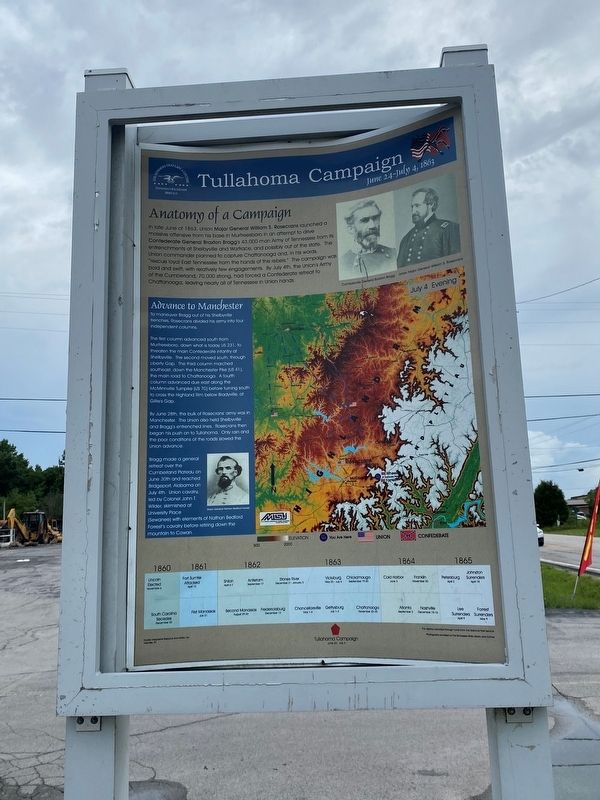
Anatomy of a Campaign
In late June of 1863, Union Major General William S. Rosecrans launched a massive offensive from his base in Murfreesboro in an attempt to drive Confederate General Braxton Bragg's 43,000-man Army of Tennessee from its entrenchments at Shelbyville and Wartrace, and possibly out of the state. The Union commander planned to capture Chattanooga and, in his words, "rescue loyal East Tennessee from the hands of the rebels.” The campaign was bold and swift, with relatively few engagements. By July 4th, the Union's Amy of the Cumberland,
Photographed by Darren Jefferson Clay, July 17, 2021
3. Tullahoma Campaign Marker
(captions)
Confederate General Braxton Bragg
Union Major General William S. Rosecrans
Advance to Manchester
To maneuver Bragg out of his Shelbyville trenches, Rosecrans divided his army into four independent columns.
The first column advanced south from Murfreesboro, down what is today US 231, to threaten the main Confederate infantry at Shelbyville. The second moved south, through Liberty Gap. The third column marched southeast, down the Manchester Pike (US 41), the main road to Chattanooga. A fourth column advanced due east along the McMinnville Turnpike (US 70) before turning south to cross the Highland Rim below Bradyville, at Gillie's Gap.
By June 28th, the bulk of Rosecrans' army was in Manchester. The Union also held Shelbyville and Bragg's entrenched lines. Rosecrans then began his push on to Tullahoma. Only rain and the poor conditions of the roads slowed the Union advance.
Bragg made a general retreat over the Cumberland Plateau on June 30th and reached Bridgeport, Alabama on July 4th. Union cavalry, led by Colonel John T. Wilder, skirmished at University Place (Sewanee) with elements of Nathan Bedford Forrest's cavalry before retiring down the mountain to Cowan.
(caption) Major General Nathan Bedford Forrest
Erected by Tennessee's Backroads Heritage.
Topics. This historical marker is listed in this topic list: War, US Civil. A significant historical year for this entry is 1863.
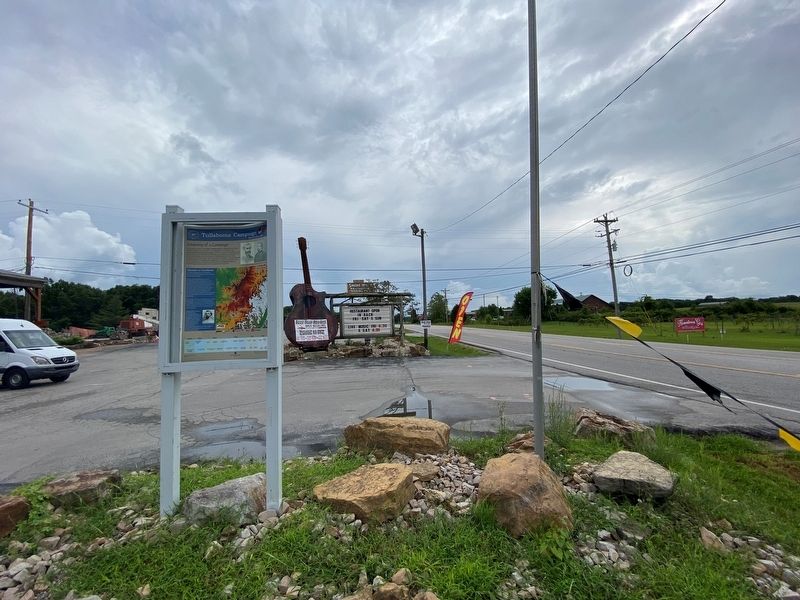
Location. Marker has been reported missing. It was located near 35° 14.16′ N, 85° 51.172′ W. Marker was in Monteagle, Tennessee, in Marion County. It was on West Main Street (Tennessee Route 56) 0.2 miles west of Indigo Lane, on the left when traveling west. Touch for map. Marker was at or near this postal address: 838 W Main St, Monteagle TN 37356, United States of America. Touch for directions.

Regionally, this marker was in the American South, specifically in the Upper South, in Appalachia, and specifically in Southern Appalachia. Globally, it was in North America, the Western Hemisphere, the Western World, and the Anglosphere. Historically, it found itself in what was once the territory of the Mississippian Culture, one of the Confederate States of America, and the Antebellum South.
Other nearby markers. At least 8 other markers are within 2 miles of this location, measured as the crow flies: Grundy County / Marion County (approx. 0.7 miles away); Struggling Through the Mountains (approx. 0.7 miles away); Monteagle Sunday School Assembly (approx. 0.9 miles away); a different marker also named Monteagle Sunday School Assembly (approx. 0.9 miles away); Welcome to Monteagle (approx. one mile away); The Hotel, the Eagle, and College Hijinks (approx. one mile away); The Amphitheater (approx. 1.1 miles away); The Dawn Redwood of Monteagle (approx. 1.2 miles away). Touch for a list and map of all markers in Monteagle.
Credits. This page was last revised on August 23, 2025. It was originally submitted on August 25, 2021, by Darren Jefferson Clay of Duluth, Georgia. This page has been viewed 554 times since then and 54 times this year. Last updated on August 21, 2025, by Edward Troxel of Creal Springs, Illinois. Photos: 1, 2, 3. submitted on August 25, 2021, by Darren Jefferson Clay of Duluth, Georgia. • Bernard Fisher was the editor who published this page.
