
Fort Hill in Boston in Suffolk County, Massachusetts — The American Northeast (New England)
Highland Park
Also known as: Fort Hill Park
| — | Formerly: Roxbury High Fort | — |

Photographed by Marc Belanger, April 13, 2008
1. Highland Park Marker
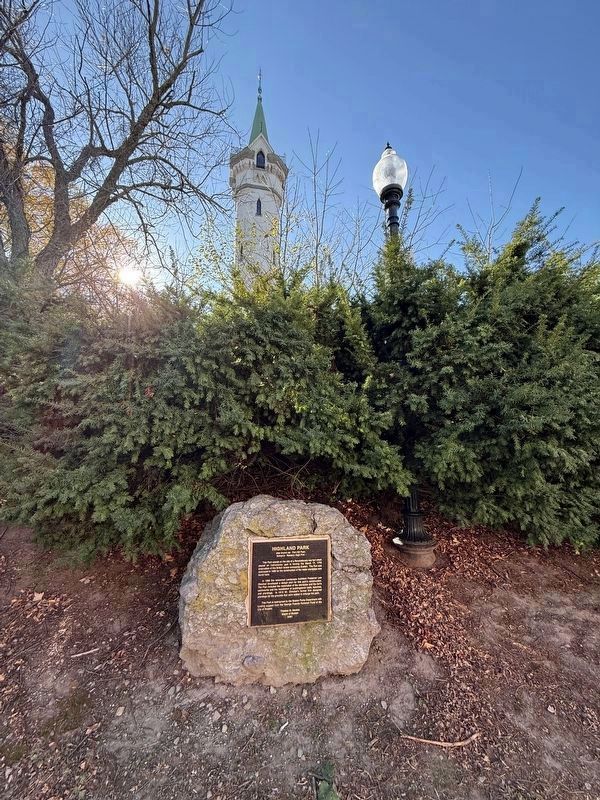
This Park stands on the site of a Revolutionary war fort which played an instrumental part in forcing the March 17, 1775 evacuation of the British forces occupying Boston. The Fort was destroyed in 1869 for the construction of the water standpipe now found here.
In 1895 the renowned Landscape Architect Fredrick Law Olmstead developed a design plan for this park's construction. The plan included the restoration of the standpipe and the fort's earthworks and the installation of pudding stone walls, benches and plantings. In 1912 Mr. Olmstead's former design firm designed planting for the grounds that were added to the enlarged park.
This Park is maintained by the Boston Parks Department with funding support from the George Francis Parkman Fund of the City of Boston.
Erected 2001 by City of Boston, Thomas M. Menino, Mayor.
Topics. This historical marker is listed in this topic list: Parks & Recreational Areas. A significant historical date for this entry is March 17, 1775.
Location. 42° 19.532′ N, 71° 5.663′ W. Marker is in Boston, Massachusetts, in Suffolk County. It is in Fort Hill. It is on Fort Avenue west of Fort Avenue Terrace, on the left when traveling west. Touch for map. Marker is at or near this postal address: 27 Fort Ave, Roxbury MA 02119, United States of America. Touch for directions.

Regionally, this marker is in Massachusetts’ Historic Boston. It is also in the American Northeast and in New England. Globally, it is in the North Atlantic Region, North America, the Western Hemisphere, the Western World, and the Anglosphere. Historically, it finds itself in what was once one of the original Thirteen Colonies.
Other nearby markers. At least
this page online
Related markers. Click here for a list of markers that are related to this marker.
Also see . . . Roxbury High Fort (Wikipedia). (Submitted on December 30, 2024, by Michael Herrick of Southbury, Connecticut.)
Additional commentary.
1. Clarification of the year of the evacuation of British forces from Boston
The plaque on the boulder contains an incorrect year. The evacuation of Boston took place in 1776, which can be confirmed via many available trusted history references. Note To Editor only visible by Contributor and editor
— Submitted December 21, 2025, by G.W.Bartlett of Hingham, Massachusetts.

Photographed by Marc Belanger, April 13, 2008
2. Highland Park Marker
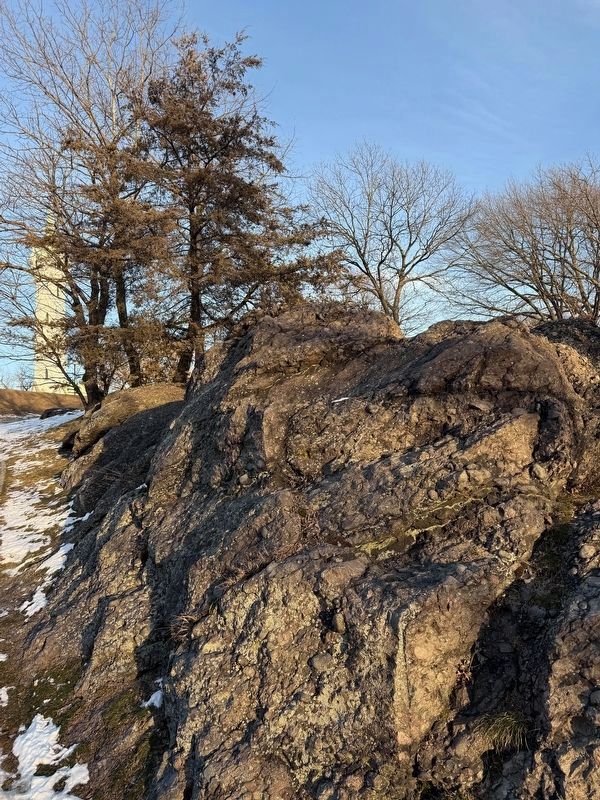
The boulder is Roxbury "Puddingstone".

Photographed by Marc Belanger, April 13, 2008
3. Cochituate Standpipe in Highland Park
1869
1869
Photographed by G.W.Bartlett, November 19, 2024
4. Highland Park Marker New Location
This marker has been relocated within park
Photographed by G.W.Bartlett, January 24, 2026
5. Roxbury “Puddingstone” formation atop Highland Park
Credits. This page was last revised on February 14, 2026. It was originally submitted on December 24, 2024, by Marc Belanger of Reno, Nevada. This page has been viewed 293 times since then and 57 times this year. Last updated on January 28, 2026, by G.W.Bartlett of Hingham, Massachusetts. Photos: 1, 2, 3. submitted on December 24, 2024, by Marc Belanger of Reno, Nevada. 4. submitted on August 20, 2025, by G.W.Bartlett of Hingham, Massachusetts. 5. submitted on January 28, 2026, by G.W.Bartlett of Hingham, Massachusetts. • Devry Becker Jones was the editor who published this page.
