San Giovanni in Firenze in Città Metropolitana di Firenze, Tuscany, Italy — Southern and Western Europe (Mediterranean)
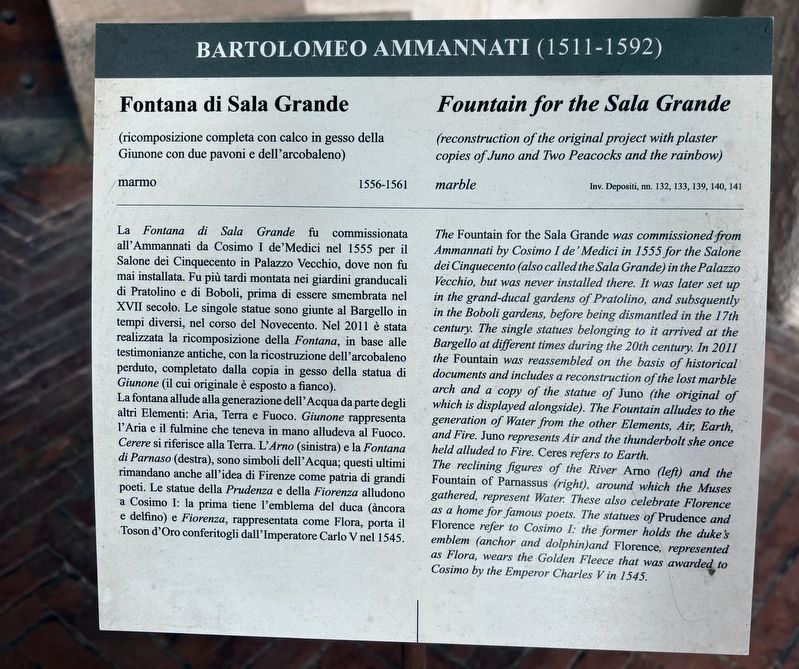
Fontana di Sala Grande
⎯⎯⎯
Fountain for the Sala Grande
Bartolomeo Ammannati (1511-1592)
Photographed by Sean P. Flynn, July 26, 2025
1. Fontana di Sala Grande / Fountain for the Sala Grande Marker
(ricomposizione completa con calco in gesso della Giunone con due pavoni e dell'arcobaleno)
marmo; 1556-1561
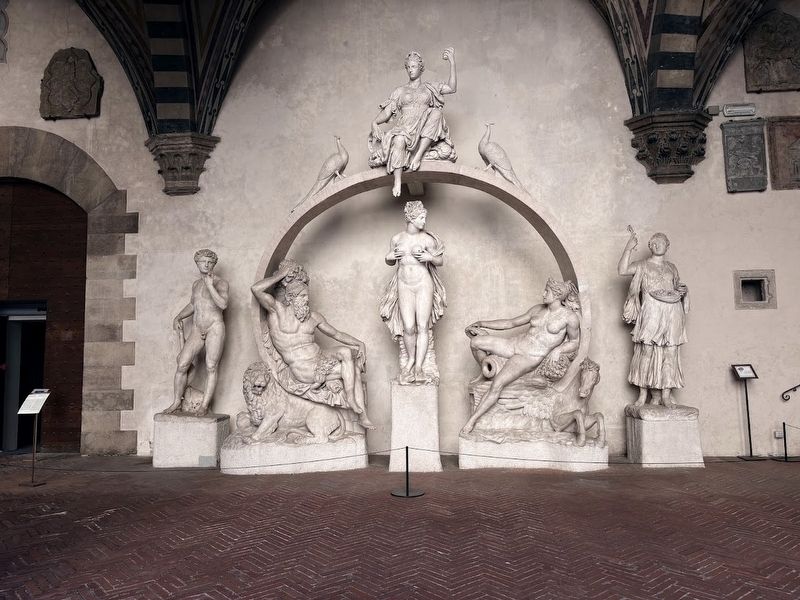
La Fontana di Sala Grande fu commissionata all'Ammannati da Cosimo I de' Medici nel 1555 per il Salone dei Cinquecento in Palazzo Vecchio, dove non fu mai installata. Fu più tardi montata nei giardini granducali di Pratolino e di Boboli, prima di essere smembrata nel XVII secolo. Le singole statue sono giunte al Bargello in tempi diversi, nel corso del Novecento. Nel 2011 è stata realizzata la ricomposizione della Fontana, in base alle testimonianze antiche, con la ricostruzione dell'arcobaleno perduto, completato dalla copia in gesso della statua di Giunone (il cui originale è esposto a fianco).
La fontana allude alla generazione dell'Acqua da parte degli altri Elementi: Aria, Terra e Fuoco. Giunone rappresenta l'Aria e il fulmine che teneva in mano alludeva al Fuoco. Cerere si riferisce alla Terra. L'Arno (sinistra) e la Fontana di Parnaso (destra), sono simboli dell'Acqua; questi ultimi rimandano anche all'idea di Firenze come patria di grandi poeti. Le statue della Prudenza e della Fiorenza alludono
this page online
(reconstruction of the original project with plaster copies of Juno and Two Peacocks and the rainbow)
marble
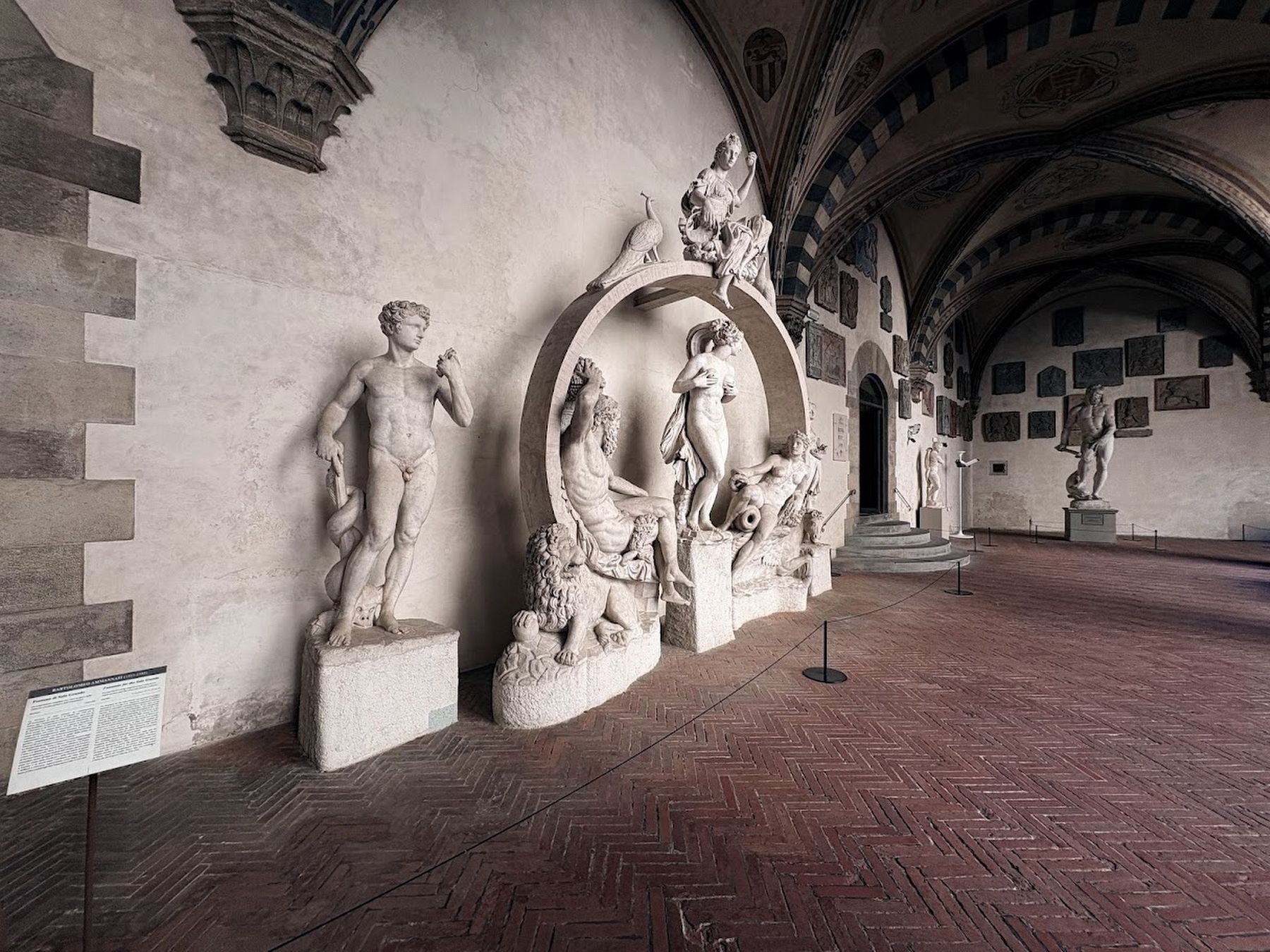
The Fountain for the Sala Grande was commissioned from Ammannati by Cosimo I de' Medici in 1555 for the Salone dei Cinquecento (also called the Sala Grande) in the Palazzo Vecchio, but was never installed there. It was later set up in the grand-ducal gardens of Pratolino, and subsquently in the Boboli gardens, before being dismantled in the 17th century. The single statues belonging to it arrived at the Bargello at different times during the 20th century. In 2011 the Fountain was reassembled on the basis of historical documents and includes a reconstruction of the lost marble arch and a copy of the statue of Juno (the original of which is displayed alongside). The Fountain alludes to the generation of Water from the other Elements, Air, Earth, and Fire. Juno represents Air and the thunderbolt she once held alluded to Fire. Ceres refers to Earth.
The reclining figures of the River Arno (left) and the Fountain of Parnassus (right), around which the Muses gathered, represent Water. These also celebrate Florence as a home for famous poets. The statues of Prudence and Florence refer to Cosimo I: the former holds the duke's emblem (anchor and dolphin)and Florence, represented as Flora, wears the Golden Fleece that was awarded to Cosimo by the Emperor Charles V in 1545.
Topics.
Photographed by Sean P. Flynn, July 26, 2025
2. Fontana di Sala Grande
Location. 43° 46.223′ N, 11° 15.504′ E. Marker is in Firenze, Toscana (Tuscany), in Città Metropolitana di Firenze. It is in San Giovanni. It can be reached from Via del Proconsolo near Via Ghibellina. The marker is inside the Bargello museum, accompanying the sculptures it references. Touch for map. Marker is at or near this postal address: Via del Proconsolo 4, Firenze, Toscana 50122, Italy. Touch for directions.

Regionally, it is in Europe, the European Union, the Schengen Area, a coastal Mediterranean country, and the Western World. Historically, it finds itself in what was once the Roman Empire and specifically also the Holy Roman Empire.
Other nearby markers. At least 8 other markers are within walking distance of this marker: L'incoronazione di Ferdinando I d'Aragona e Sei Musici (here, next to this marker); Il Museo / The Museum (a few steps from this marker); Il Pescatore / The Fisher Boy (a few steps from this marker); Il Palazzo / The Palazzo
Photographed by Sean P. Flynn, July 26, 2025
3. Fontana di Sala Grande
More about this marker. Sala Grande means "Big Room"; Salone dei Cinquecento translates to "The Hall of the Five Hundred."
Also see . . . Unsettled Sculptures: Mapping the Afterlife of Ammannati’s Juno Fountain. From Journal 18, a website devoted to 18th century art and culture
Excerpt: "Its iconography has inspired varied nuanced interpretations, but generally this artwork is understood as an allegory of the generation of water that emphasized Cosimo’s patronage of new aqueducts for Florence. Quarrying for the project began in 1555; Bartolomeo Ammannati (1511-1592) started work on it in 1556, probably completing it by 1563; and most of its parts remained in the Palazzo Vecchio until 1579, when their movement around Florence and its environs commenced, persisting for almost four centuries."(Submitted on August 21, 2025, by Sean P. Flynn of Oak Park, Illinois.)
Credits. This page was last revised on August 21, 2025. It was originally submitted on August 21, 2025, by Sean P. Flynn of Oak Park, Illinois. This page has been viewed 179 times since then and 89 times this year. Photos: 1, 2, 3. submitted on August 21, 2025, by Sean P. Flynn of Oak Park, Illinois.
