Chena in Fairbanks in Fairbanks North Star Borough, Alaska — Northwest (North America)
Caribou and Reindeer
A Key to Ancient and Modern Survival
Photographed by Thomas Smith, August 5, 2025
1. Caribou and Reindeer Marker
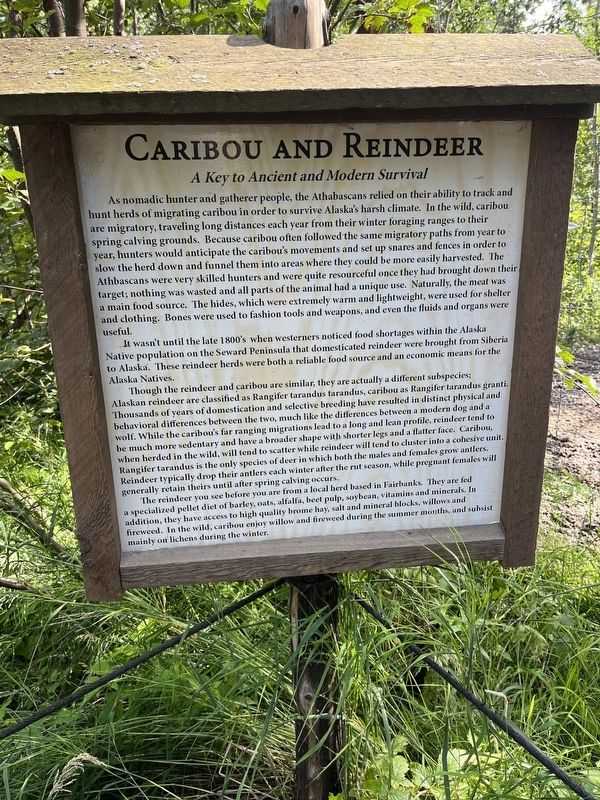
As nomadic hunter and gatherer people, the Athabascans relied on their ability to track and hunt herds of migrating caribou in order to survive Alaska's harsh climate. In the wild, caribou are migratory, traveling long distances each year from their winter foraging ranges to their spring calving grounds. Because caribou often followed the same migratory paths from year to year, hunters would anticipate the caribou's movements and set up snares and fences in order to slow the herd down and funnel them into areas where they could be more easily harvested. The were very skilled hunters and were quite resourceful once they had brought down their target; nothing was wasted and all parts of the animal had a unique use. Naturally, the meat was a main food source. The hides, which were extremely warm and lightweight, were used for shelter and clothing. Bones were used to fashion tools and weapons, and even the fluids and organs were useful.
It wasn't until the late 1800's when westerners noticed food shortages within the Alaska Native population on the Seward Peninsula that domesticated reindeer were brought from Siberia
this page online
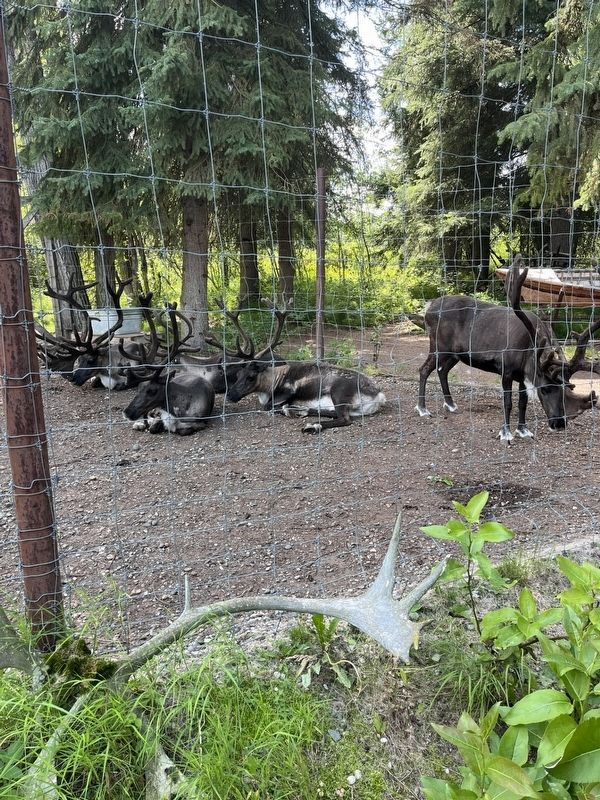
Though the reindeer and caribou are similar, they are actually a different subspecies; Alaskan reindeer are classified as Rangifer tarandus tarandus, caribou as Rangifer tarandus granti. Thousands of years of domestication and selective breeding have resulted in distinct physical and behavioral differences between the two, much like the differences between a modern dog and a wolf. While the caribou's far ranging migrations lead to a long and lean profile, reindeer tend to be much more sedentary and have a broader shape with shorter legs and a flatter face. Caribou, when herded in the wild, will tend to scatter while reindeer will tend to cluster into a cohesive unit. Rangifer tarandus is the only species of deer in which both the males and females grow antlers. Reindeer typically drop their antlers each winter after the rut season, while pregnant females will generally retain theirs until after spring calving occurs.
The reindeer you see before you are from a local herd based in Fairbanks. They are fed a specialized
Photographed by Thomas Smith, August 5, 2025
2. Reindeer
Topics. This historical marker is listed in these topic lists: Animals • Indigenous Peoples and Communities.
Location. 64° 48.019′ N, 147° 54.879′ W. Marker is in Fairbanks, Alaska, in Fairbanks North Star Borough. It is in Chena. It is on Tall Spruce Road 5 miles Chena Pump Road when traveling north. Chena Village Living Museum. Touch for map. Marker is at or near this postal address: 2633 Tall Spruce Road, Fairbanks AK 99709, United States of America. Touch for directions.

Regionally, this marker is in the Alaska Railroad Corridor, in the Athabascan Region, and in Interior Alaska. It is also on the American Pacific Coast. Globally, it is in North America, on the Pacific Rim, in the Western Hemisphere, in the Western World, and in the Anglosphere. Historically, it finds itself in what was once the Russian Empire.
Other nearby markers. At least 8 other markers are within walking distance of this marker: Pieper Super Cub (here, next to this marker); Susan Butcher: A Lifetime of Inspiration (a few steps from this marker); Post Office (within shouting distance of this marker); Steamboat Wood (within shouting distance of this marker); Smokehouse (within shouting distance of this marker); Fish Camp (within shouting distance of this marker); Locked to the End (within shouting distance of this marker); a different marker also named Locked to the End (within shouting distance of this marker).
Credits. This page was last revised on August 25, 2025. It was originally submitted on August 21, 2025, by Thomas Smith of Waterloo, Ill. This page has been viewed 111 times since then and 22 times this year. Photos: 1, 2. submitted on August 21, 2025, by Thomas Smith of Waterloo, Ill. • Andrew Ruppenstein was the editor who published this page.
