
Trinidad in Las Animas County, Colorado — The American Mountains (Southwest)
Corazón de Trinidad National Historic District
Photographed by Cosmos Mariner, July 10, 2025
1. Corazón de Trinidad National Historic District Marker
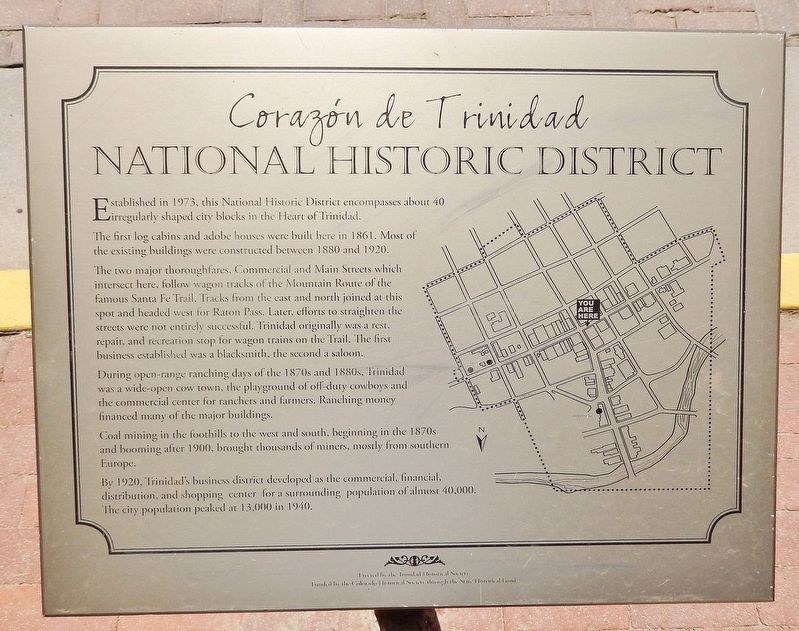
Established in 1973, this National Historic District encompasses about 40 irregularly shaped city blocks in the Heart of Trinidad.
The first log cabins and adobe houses were built here in 1861. Most of the existing buildings were constructed between 1880 and 1920.
The two major thoroughfares, Commercial and Main Streets which intersect here, follow wagon tracks of the Mountain Route of the famous Santa Fe Trail. Tracks from the east and north joined at this spot and headed west for Raton Pass. Later, efforts to straighten the streets were not entirely successful. Trinidad originally was a rest, repair, and recreation stop for wagon trains on the Trail. The first business established was a blacksmith, the second a saloon.
During open-range ranching days of the 1870s and 1880s, Trinidad was a wide-open cow town, the playground of off-duty cowboys and the commercial center for ranchers and farmers. Ranching money financed many of the major buildings.
Coal mining in the foothills to the west and south, beginning in the 1870s and booming after 1900, brought thousands of miners, mostly from southern Europe.
By 1920, Trinidad's
this page online
Erected by Trinidad Historical Society.
Topics and series. This historical marker is listed in these topic lists: Architecture • Immigration • Industry & Commerce • Settlements & Settlers. In addition, it is included in the National Register of Historic Places (NRHP), and the Santa Fe Trail series lists. A significant historical year for this entry is 1861.
Location. 37° 10.11′ N, 104° 30.354′ W. Marker is in Trinidad, Colorado, in Las Animas County. It is on West Main Street (Business Interstate 25) just west of North Commercial Street, on the left when traveling east. The marker stands on the sidewalk beside the former Columbian Hotel. Touch for map. Marker is at or near this postal address: 103 West Main Street, Trinidad CO 81082, United States of America. Touch for directions.

Regionally, this marker is in the American Mountain West, on the Great Plains, on the Southern Plains, and on the Santa Fe Trail Corridor. Globally,
Photographed by Cosmos Mariner, July 10, 2025
2. Corazón de Trinidad National Historic District Marker
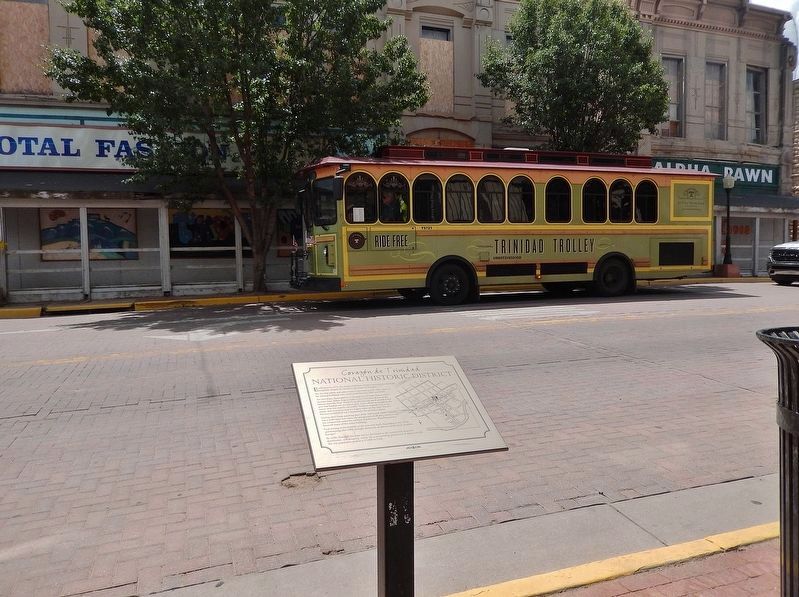
Looking south across Main Street. The former Trinidad Opera House, a contributing property in the historic district, is partially visible in the right background.
Other nearby markers. At least 8 other markers are within walking distance of this marker: The Santa Fe Trail (here, next to this marker); A Capital of Open Range Ranching (within shouting distance of this marker); The Aultman Studio (within shouting distance of this marker); Invasion by the United States Army (within shouting distance of this marker); Coal Miners' Memorial 1996 (within shouting distance of this marker); The Coal Miner's Canary (about 300 feet away, measured in a direct line); The Mountain Called Fisher's Peak (about 300 feet away); Trinidad Schools and the Sisters of Charity (about 300 feet away). Touch for a list and map of all markers in Trinidad.
Regarding Corazón de Trinidad National Historic District. National Register of Historic Places № 73000482.
From the National Register Nomination prepared by Willard D. Louden & Ronald Passarelli, Trinidad Historical Society, 11/10/1972:
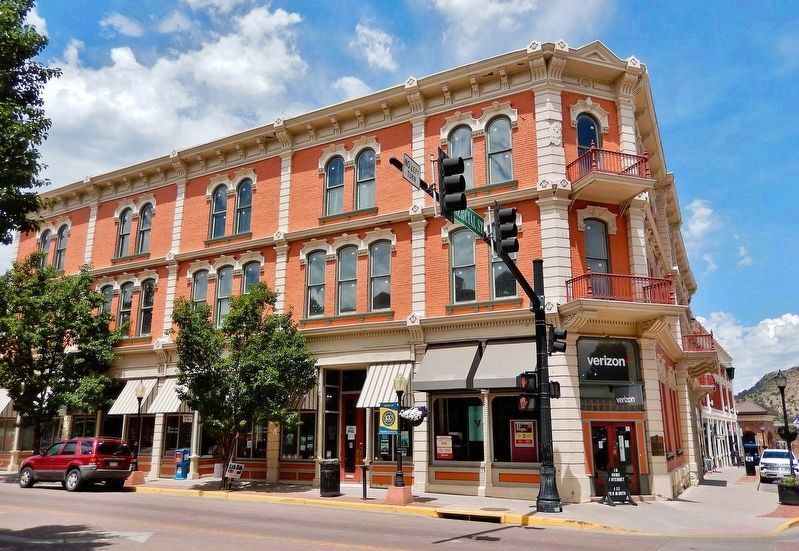
It may be saidthat Trinidad was born in March of 1861, when, at this site along the banks of the clear, mountain stream called the Purgatoire, the first cluster of adobe and/or log huts appeared. Trinidad acquired her name a few months later when a grid of streets was laid out to accommodate the growth of this little frontier, territorial town. Naturally, very few buildings or even parts of buildings from that territorial period remain, but the adobe brick and mud plaster Baca House is one such building.Photographed by Cosmos Mariner, July 10, 20253. Former Columbian Hotel, 101 West Main StreetContributing property, Corazón de Trinidad National Historic District. From the National Register Nomination: Its style is typical Western Victorian with many interesting details such as the decorative window lintels, cast iron trim and hammered-metal ceilings. John Conkie was the original owner as well as architect and builder of the hotel. The hotel contained nearly 100 sleeping rooms, a large lobby, a lavish saloon, a formal dining room, ornate ballroom, a barber shop and gambling rooms in the basement. Much of the charm and flavor of this flamboyant hotel remains. Many notable people have spent time in this hotel. Doc Holliday supposedly spent many hours in the gambling hall, President Hoover and his wife spent several days here, Will Rogers and Wiley Post stopped here enroute to Alaska where they were killed a short time later, and several movie celebrities such as Douglas Fairbanks and his wife Mary Pickford have spent nights here. Western silent movie star Tom Mix occupied room 214 his horse slept in room 212.
In 1876, the narrow-gauge Rio Grande Railroad reached the new town of El Moro about four miles down the Purgatoire, and the broad-gauge Atchison, Topeka and Santa Fe Railroad laid tracks into Trinidad in the late summer of 1878. Those were important commercial links, providing, among other things, shipping facilities for the then prospering cattle and sheep ranches of the region. The coming of the railroads also gave impetus to the coal-mining industry and the related production of coke. Within a few years Trinidad was surrounded by satellite coal camps — several of them with great rows of glowing coke ovens adjacent.
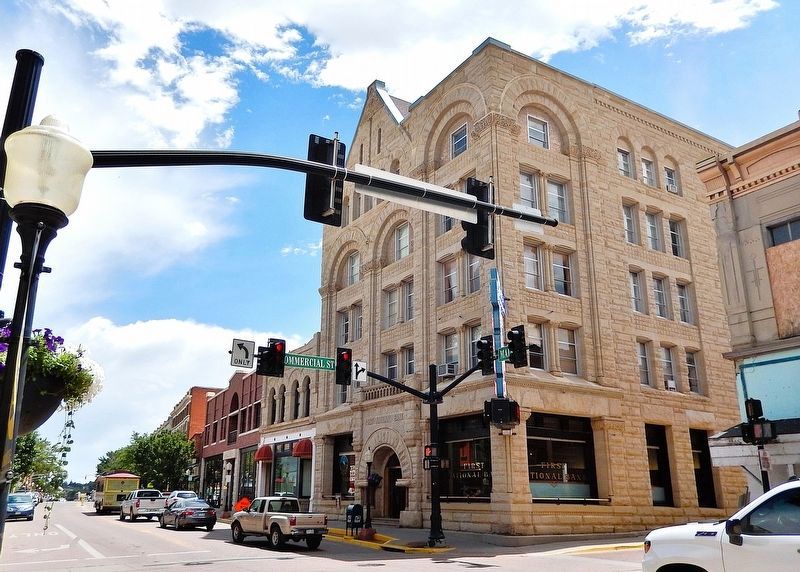
During the formative first twodecades of Trinidad's development the cultural traits deriving from Spain and Mexico were of prime importance in shaping the nature and character of the town. Increasing immigration from the eastern part of the country modified this, and Trinidad, like many southwestern towns, became a cultural amalgamation. The population of Las Animas County was ethnically diversified with the arrival of great numbers of men, women, and children from the countries of southern and eastern Europe. This great wave of people came primarily for the work offered by the coal mines and coke ovens.Photographed by Cosmos Mariner, July 10, 20254. First National Bank Building, 100 East Main StreetContributing property, Corazón de Trinidad National Historic District. From the National Register Nomination: The tallest edifice in the downtown area, the First National Bank Building, was erected in 1892. At this time it was owned by Aaron and Ed Rosenwold and the First National Bank. There is an attractive placement of Roman arches of different sizes on the front of this Victorian Romanesque stone building. The building stone was supplied by the quarries of James Radford and T. D. Mitchell. These two quarries often worked together in providing stone for building projects.
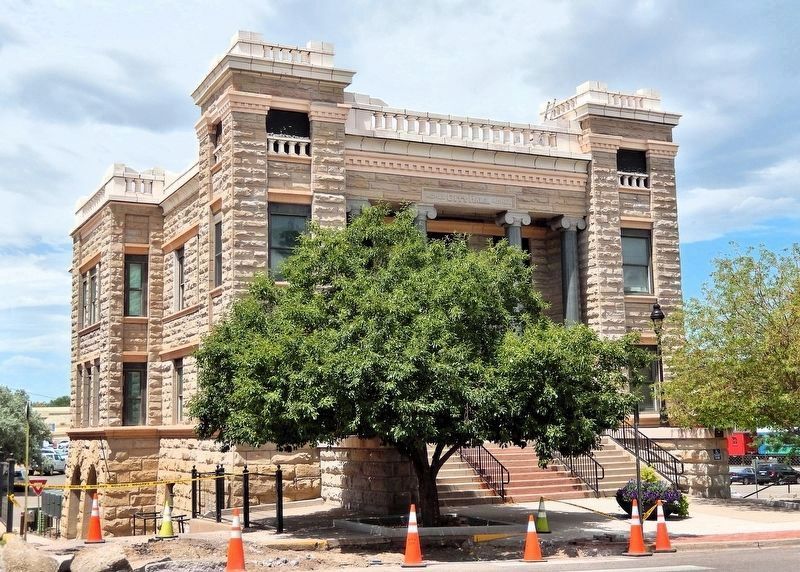
During the period from 1879 to 1900, Trinidad achieved much of her expansion and became the center of a large and diversified economic area in which railroading, coal mining, coke production, ranching and agriculture were all important factors. From those twenty years of growth Trinidad still has many lovely old homes and beautiful business structures of the late Victorian style. The expansion of Trinidad and of the neighboring camps continued after the turn of the century and so the town is also rich in architecture dating from the first two decades of the twentiethcentury.Photographed by Cosmos Mariner, July 10, 20255. City Hall, 135 North Animas StreetContributing property, Corazón de Trinidad National Historic District. From the National Register Nomination: According to the Chronicle-News, December 18, 1908, the book All About Las Animas County, written by Dr. Michael Beshoar in 1882, an 1888 copy of the City Directory, and copies of two daily papers were all to be placed in the cornerstone of the new two-story stone building on North Animas Street at the dedication on January 1, 1909. With a flourish of Victorian eclecticism, the architect designed towers from the late Italian Renaissance period, placed a French Renaissance balustrade atop the Hall, and fronted the building with Greek Ionic capitals on black granite columns on early Italian Renaissance The total effect gives a strong Romanesque feeling.
Partial economic paralysis set in with the 1930's. First the depression, and then basic industrial changes brought a rapid decline of the coal mining industry. As the coal camps disappeared, Trinidad settled into a time of greatly reduced prosperity. That condition probably, as much as anything, accounts for the survival in Trinidad of so many buildings ranging from the territorial days to the end of the prosperous 1920's.
Related markers. Click here for a list of markers that are related to this marker.
Also see . . . Corazón de Trinidad (Wikipedia).
Excerpt: The district is a 132 acre area roughly bounded by the Purgatoire River on the north and west, Walnut St. on the east, and 3rd, W. 1st and Animas Sts. on the south. A detailed survey of buildings, in text and historic plus then-current photos, appears in the 1970 manuscript “The Historic Buildings of Central Trinidad”, by Willard C. Louden, which concludes with an essay by Langdon Morris calling for appropriate historic preservation. The name of the district, meaning “The Heart of Trinidad”, was determined by a competition.(Submitted on August 23, 2025, by Cosmos Mariner of Cape Canaveral, Florida.)
Photographed by Cosmos Mariner, July 10, 2025
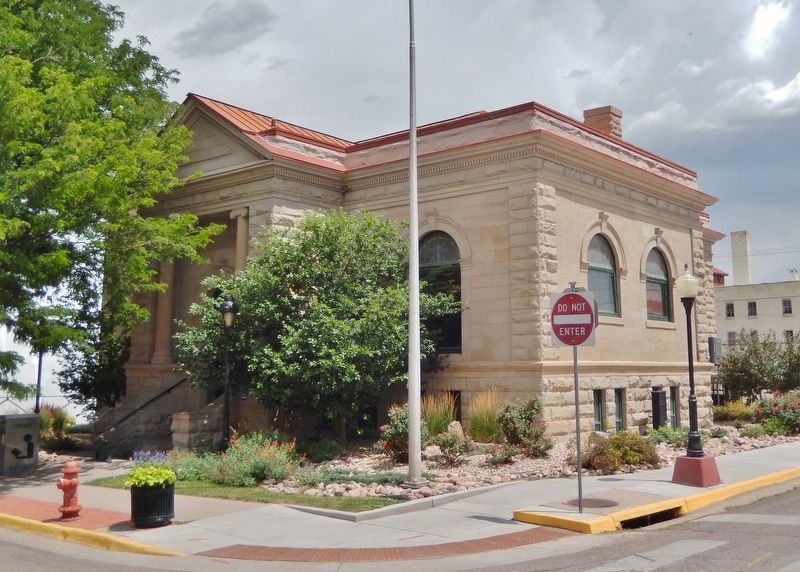
6. The Trinidad Public Library, 202 North Animas Street
Contributing property, Corazón de Trinidad National Historic District. From the National Register Nomination: This Carnegie Library stands almost unchanged since it was built in 1904. The structure is quite typical of Victorian architecture in the combining of a variety of styles in a single structure. For example, we see the capitals are Ionic, the base is Italian Renaissance, and the pediment is Roman. This style is one commonly used for libraries and public buildings at this time. The stone of which the library is built came from local quarries.
Credits. This page was last revised on August 23, 2025. It was originally submitted on August 22, 2025, by Cosmos Mariner of Cape Canaveral, Florida. This page has been viewed 197 times since then and 57 times this year. Photos: 1, 2, 3, 4, 5, 6. submitted on August 23, 2025, by Cosmos Mariner of Cape Canaveral, Florida.
