Decatur in Morgan County, Alabama — The American South (East South Central)
Dancy-Polk House (circa 1829)
“A Hard Nut To Crack”
| — | The Battle For Decatur | — |
Photographed by Tim Carr, February 20, 2010
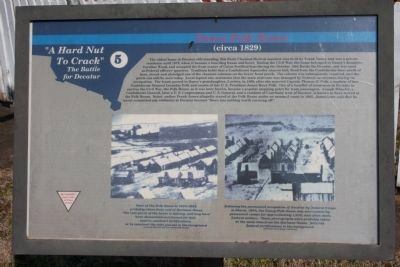
1. Dancy-Polk House (circa 1829) Marker
this page online
Erected by City of Decatur. (Marker Number 5.)
Topics and series. This historical marker is listed in this topic list: War, US Civil. In addition, it is included in the Former U.S. Presidents: #11 James K. Polk series list. A significant historical month for this entry is October 1864.
Location. 34° 36.877′ N, 86° 59.106′ W. Marker is in Decatur, Alabama, in Morgan County. It is at the intersection of Church Street Northwest and Railroad Street Northwest, on the left when traveling east on Church Street Northwest. Touch for map. Marker is in this post office area: Decatur AL 35602, United States of America. Touch for directions.

Regionally, this marker is in North Alabama. It is also in the American South, specifically in the Deep South, in Appalachia,
Photographed by Tim Carr, February 20, 2010
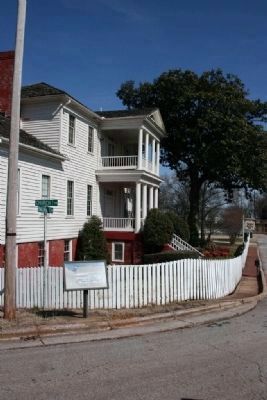
2. Tour Stop 5
Other nearby markers. At least 8 other markers are within walking distance of this marker: Parker-Hayes Boarding House and Tourist Home (a few steps from this marker); Daisy Nolan (about 400 feet away, measured in a direct line); “An Affair Most Important to Us” - The Federal Right, October 27-28, 1864 (about 400 feet away); Two Bridges Across The Tennessee River (about 400 feet away); Historic Downtown / Founders Park (about 500 feet away); Rising Sun Lodge No. 29 (about 500 feet away); Old State Bank Building (about 500 feet away); To Commemorate the Passage of The Olympic Torch (about 500 feet away). Touch for a list and map of all markers in Decatur.
Photographed by Tim Carr, February 20, 2010
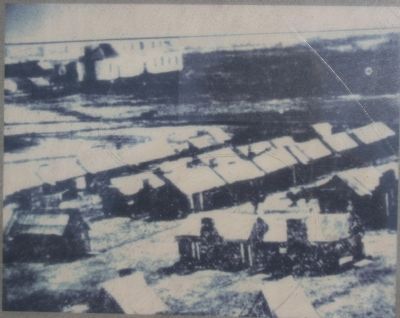
3. Lower Left Photo
Rear of the Polk House in 1864-1865 probably taken from roof of Burleson House. The rear porch of the house is missing, and may have been dismantled and burned for fuel, used to construct fortifications, or to construct the huts you see in the foreground. Photo on marker courtesy Jeff and Jan Lea, Dancy-Polk House.
Photographed by Tim Carr, February 20, 2010
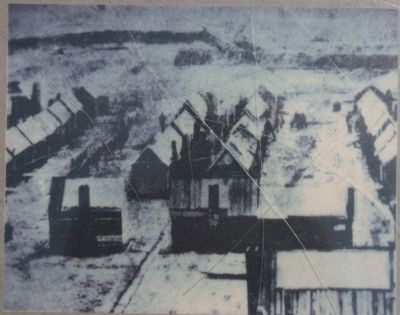
4. Lower Right Photo
Following the permanent occupation of Decatur by Federal troops in March, 1864, the Dancy-Polk House was surrounded by permanent camps for approximately 1,500, and often more, Federal soldiers. These photographs were probably taken at the same time from the Burleson House. Note the Federal fortifications in the background. Photo attributed to Jonathan Ford Baggs Collection.
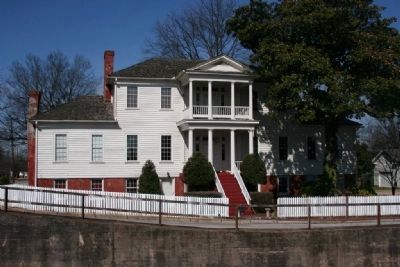
Photographed by Tim Carr, February 20, 2010
5. Dancy-Polk House
Credits. This page was last revised on June 16, 2016. It was originally submitted on March 6, 2010, by Timothy Carr of Birmingham, Alabama. This page has been viewed 4,281 times since then and 103 times this year. Photos: 1, 2, 3, 4, 5. submitted on March 6, 2010, by Timothy Carr of Birmingham, Alabama. • Craig Swain was the editor who published this page.
