
Downtown in Asheville in Buncombe County, North Carolina — The American South (South Atlantic)
Stephens - Lee H.S. Educates Legends and Heroes
1923-1965
| — | Black Cultural Heritage Trail | — |
Photographed by Mark Parker, March 4, 2025
1. Stephens - Lee H.S. Educates Legends and Heroes Marker
Click on image to zoom in to examine the photographs.
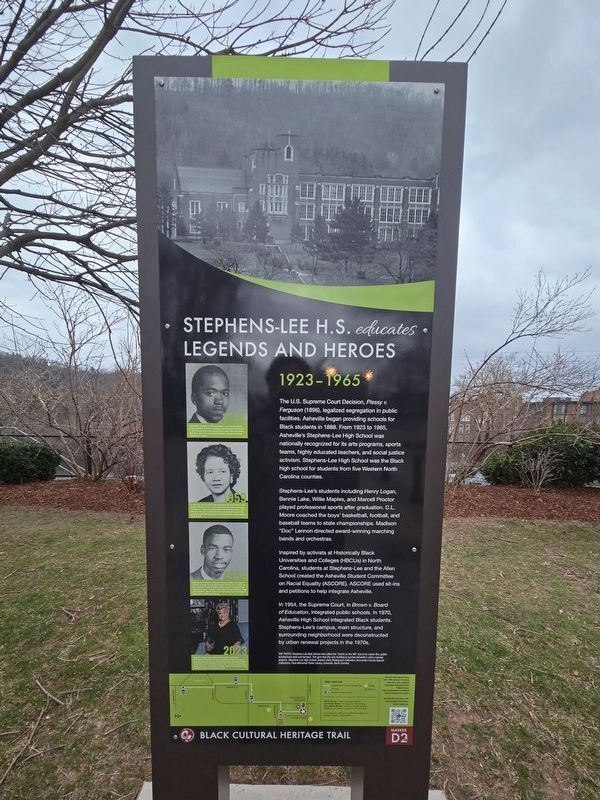
The U.S. Supreme Court Decision, Plessy v. Ferguson (1896), legalized segregation in public facilities. Asheville began providing schools for Black students in 1888. From 1923 to 1965, Asheville's Stephens-Lee High School was nationally recognized for its arts programs, sports teams, highly educated teachers, and social justice activism. Stephens-Lee High School was the Black high school for students from five Western North Carolina counties.
Stephens-Lee's students including Henry Logan, Bennie Lake, Willie Maples, and Marcell Proctor played professional sports after graduation. C.L. Moore coached the boys' basketball, football, and baseball teams to state championships. Madison "Doc" Lennon directed award-winning marching bands and orchestras.
Inspired by activists at Historically Black Universities and Colleges (HBCUs) in North Carolina, students at Stephens-Lee and the Allen School created the Asheville Student Committee on Racial Equality (ASCORE). ASCORE used sit-ins and petitions to help integrate Asheville.
In 1954, the Supreme Court, in Brown v. Board of Education, integrated public schools. In 1970,
this page online
Top Photo: Stephens-Lee High School was caled the "Castle an the Hill" due to is castle-like Gothic architectural style and location. The gym was the only building to survive Asheville's urban renewal projects. Stephens-Lee High School. Andrea Clark Photopraph Collection, Buncombe County Special Collections, Pack Memorial Public Library, Asheville, North Carolina
1935 Arthur Wilburn graduated in 1936 from Stephens-Lee as valedictorian with perfect attendance. He went on to graduate from the Tuskegee Flight School in 1944. uskegoe. Airmen were a group of Black military piliots who served in World War II. Buncombe County Special Collections, Pack Memorial Library, Asheville, North Carolina
1959 A native of the East End-Valley Street neighborhood, Ms. Elynora Martin Foster taught at Stephens-Lee for 31 years. She obtained two master's degrees and concluded her 37-year career at the integrated Ashevile High School in 1971. Ms. Eynora M. Foster The Bear
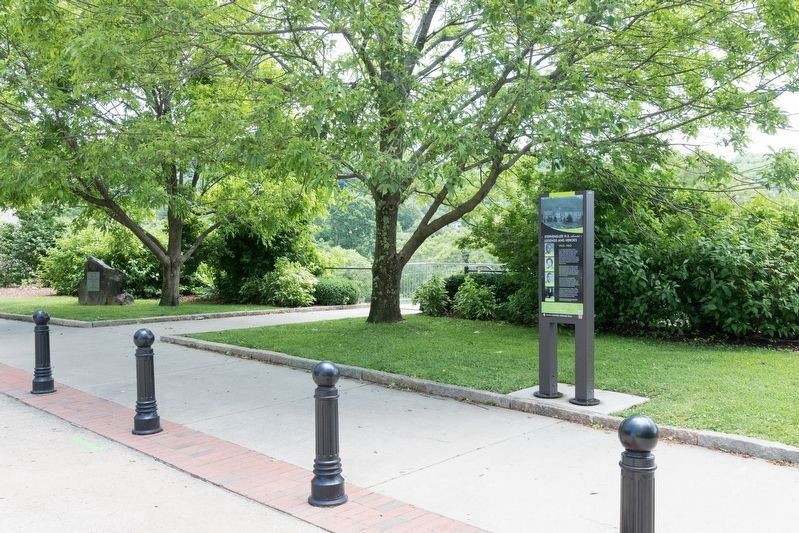
Photographed by J. J. Prats, May 17, 2025
2. Stephens - Lee H.S. Educates Legends and Heroes Marker
1959 Stephens-Lee alum James E. Ferguson II attended Columbia Law School at Columbia University. After graduating, he joined attorey Julius Chambers' law firm in Chariotte. The men fought for equality in education, employment, and voting tights. James E. Ferguson II Junior Portrait, The Bear (Stephens-Lee High School Yearbook), 1959, Buncombe Courity Spocial Collections, Pack Memarial Public Library, Asheville, North Carolina
2023 Stephens-Lee alum Oralene Graves Simmons was born in Mars Hill, North Carolina. When Mars Hills College (now University) rejected Simmons's application due to her race, she challenged that decision. The college relented and admitted her as its first Black student in 1961, She helped organize the Dr. Martin Luther King, Jr. Association of Asheville. Oralene Graves Simmons, 2023, Asheville NC, Photo courtesy of Reggie Tidwell (Marker Number D-2.)
Topics. This historical marker is listed in these topic lists: African Americans • Civil Rights • Education • War, World II. A significant historical year for this entry is 1923.
Location. 35° 35.714′ N, 82° 32.937′ W. Marker is in Asheville, North Carolina, in Buncombe County. It is in Downtown. It is on Court Plaza south of College Street, on the right when traveling south. Marker is at Pack Square Park near Asheville City Hall. Touch for map. Marker is at or near this postal address: 70 Court Plaza, Asheville NC 28801, United States of America. Touch for directions.

Regionally, this marker is in North Carolina’s Mountains. It is also in the American South, specifically in the Upper South, in Appalachia, and specifically in Southern Appalachia. Globally, it is in North America, the Western Hemisphere, the Western World, and the Anglosphere. Historically, it finds itself in what was once the original Cherokee Nation, the territory of the Mississippian Culture, one of the original Thirteen Colonies, one of the Confederate States of America, and the Antebellum South.
Other nearby markers. At least 8 other markers are within walking distance of this marker: Ashe Monument (here, next to this marker); In Remembrance of Col. Robert K. Morgan (within shouting distance of this marker); Shindig on the Green (about 300 feet away, measured in a direct line); Western North Carolina Veterans Memorial (about 300 feet away); Early Milestones in Buncombe County (about 300 feet away); Buncombe County Court House (about 300 feet away); Ellington's Dream (about 300 feet away); James Vester Miller (about 300 feet away). Touch for a list and map of all markers in Asheville.
Credits. This page was last revised on August 23, 2025. It was originally submitted on March 5, 2025, by Mark Parker of Hickory, North Carolina. This page has been viewed 222 times since then and 69 times this year. Last updated on August 23, 2025, by Mark Parker of Hickory, North Carolina. Photos: 1. submitted on March 5, 2025, by Mark Parker of Hickory, North Carolina. 2. submitted on June 1, 2025, by J. J. Prats of Powell, Ohio. • Bernard Fisher was the editor who published this page.
