
Downtown in Asheville in Buncombe County, North Carolina — The American South (South Atlantic)
The Asheville Black Cultural Heritage Trail
Asheville Elects Freedman Newton Shepard/Graduates of the Allen School

Photographed by Mark Parker, March 4, 2025
1. The Asheville Black Cultural Trail
(panel 1)
The Asheville Black Cultural Trail
Dignity, Humanity, and Agency
Did you know that Black people helped create this region's first non-Indigenous households? Did you know that Black people helped build Asheville and connected Asheville globally? Black entrepreneurs created thriving business districts. Black families cultivated close-knit neighborhoods. Black people from all backgrounds built resilient communities and fostered social change.
Explore the rich Black cultural heritage of Asheville throughout the three sections of this trail: Downtown, Southside, and the River Area.
Trail History:
In 2010, residents of Asheville's historically Black East End neighborhood proposed a trail to celebrate Black cultural heritage. River Front Development Group, a Black community development nonprofit founded in Asheville in 1996, committed to achieving this project. River Front Development Group focused on co-creating and sharing narratives of often overlooked Black Ashevillans. This trail celebrates the dignity, humanity, and agency of Black people. Community input on this project has been provided through
this page online
(panel 2)
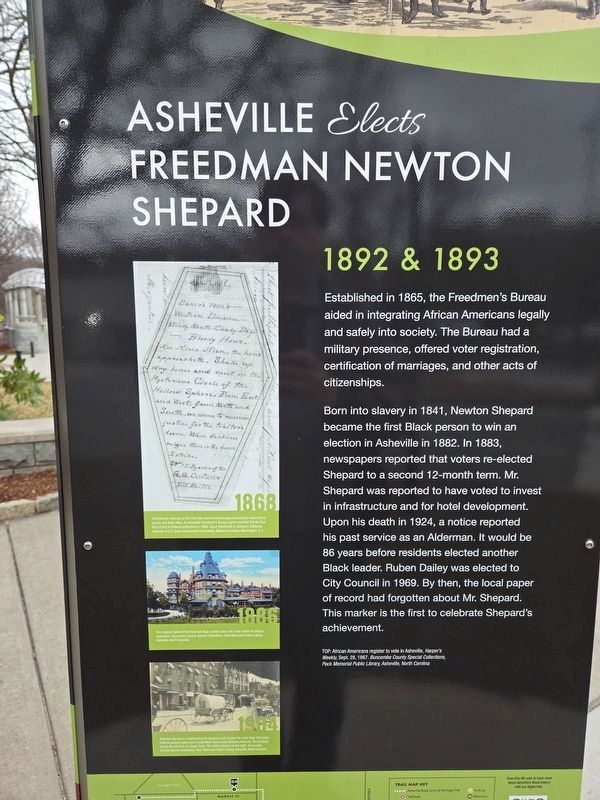
Asheville Elects Freedman Newton Shepard
1892 & 1893
Established in 1865, the Freedmen's Bureau aided in integrating African Americans legally and safely into society. The Bureau had a military presence, offered voter registration, certification of marriages, and other acts of citizenship.
Born into slavery in 1841, Newton Shepard became the first Black person to win an election in Asheville in 1882. In 1883, newspapers reported that voters re-elected Shepard to a second 12-month term. Mr. Shepard was reported to have voted to invest in infrastructure and for hotel development. Upon his death in 1924, a notice reported his past service as an Alderman. It would be 86 years before residents elected another Black leader. Ruben Dailey was elected to City Council in 1969. By then, the local paper of record had forgotten about Mr. Shepard. This marker is the first to celebrate Shepard's achievement.
TOP: African Americans register to vote in Asheville, Harper's Weekly, Sept. 28, 1867. Buncombe County Special Collections, Pack Memorial Public Library, Asheville,
Photographed by Mark Parker, March 4, 2025
2. Asheville Elects Freedman Newton Shepard Marker
(panel 3)
Graduates of the Allen School
Advancing Civil Rights, Arts, and Science
After the end of the Civil War, there was a national movement to create schools for Black students. The Allen School was founded in 1887 to offer basic education classes for girls, boys, and adults. The Allen School later became a girls boarding school.
The Allen School produced nationally and internationally recognized women including Nina Simone, singer, pianist, songwriter, and civil rights activist, and Dr. Christine Darden, one of the first Black female aerospace engineers for NASA. In 1961, teenage activists Oralene Simmons of Stephens-Lee High School and Viola Spells of the Allen School successfully petitioned to desegregate a public library. Many students in Asheville participated in further integration efforts around the city through the Asheville Student Committee on Racial Equality (ASCORE). The school closed in 1974.
TOP: A cooking cass at The Allen Industrial School, (ca. 1915-1930). Buncombe County Special Collections, Pack Memorial Public Library, Asheville, North Carolina
Erected by Asheville Black Cultural

Photographed by Mark Parker, March 4, 2025
3. Graduates of the Allen School
Topics. This historical marker is listed in these topic lists: African Americans • Civil Rights • Education.
Location. 35° 35.766′ N, 82° 32.956′ W. Marker is in Asheville, North Carolina, in Buncombe County. It is in Downtown. It is at the intersection of Court Plaza and College Street, on the left when traveling north on Court Plaza. Located in Pack Square Park near the Buncombe County Courthouse. Touch for map. Marker is at or near this postal address: 60 Court Plaza, Asheville NC 28801, United States of America. Touch for directions.

Regionally, this marker is in North Carolina’s Mountains. It is also in the American South, specifically in the Upper South, in Appalachia, and specifically in Southern Appalachia. Globally, it is in North America, the Western Hemisphere, the Western World, and the Anglosphere. Historically, it finds itself in what was once the original Cherokee Nation, the territory of the Mississippian Culture, one of the original Thirteen Colonies, one of the Confederate States of America,

Photographed by Mark Parker, March 4, 2025
4. The Asheville Black Cultural Trail Marker Buncombe County Courthouse in the background
Other nearby markers. At least 8 other markers are within walking distance of this marker: A different marker also named The Asheville Black Cultural Heritage Trail (here, next to this marker); Early Milestones in Buncombe County (a few steps from this marker); Western North Carolina Veterans Memorial (a few steps from this marker); Thomas Wolfe (within shouting distance of this marker); Confederate Armory (within shouting distance of this marker); Shindig on the Green (within shouting distance of this marker); Buncombe County Court House (within shouting distance of this marker); War with Spain (within shouting distance of this marker). Touch for a list and map of all markers in Asheville.
Credits. This page was last revised on August 23, 2025. It was originally submitted on March 5, 2025, by Mark Parker of Hickory, North Carolina. This page has been viewed 165 times since then and 16 times this year. Last updated on August 23, 2025, by Mark Parker of Hickory, North Carolina. Photos: 1, 2, 3, 4. submitted on March 5, 2025, by Mark Parker of Hickory, North Carolina. • Bernard Fisher was the editor who published this page.
