North Oaks in Ramsey County, Minnesota — The American Midwest (Upper Plains)
James J. Hill, the Empire Builder
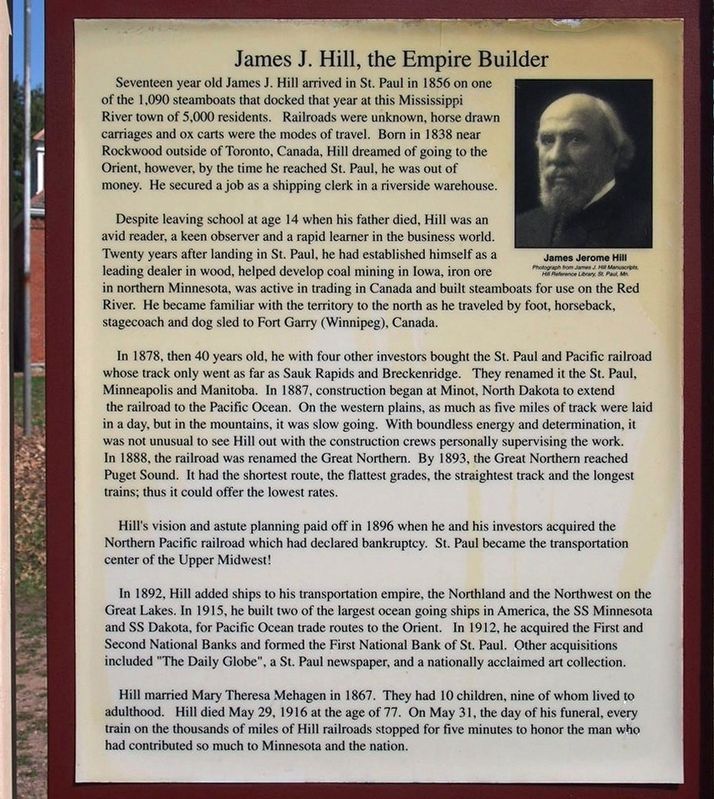
Photographed by McGhiever, May 14, 2013
1. James J. Hill, the Empire Builder Marker
Seventeen year old James J. Hill arrived in St. Paul in 1856 on one of the 1,090 steamboats that docked that year at this Mississippi River town of 5,000 residents. Railroads were unknown, horse drawn carriages and ox carts were the modes of travel. Born in 1838 near Rockwood outside of Toronto, Canada, Hill dreamed of going to the Orient, however, by the time he reached St. Paul, he was out of money. He secured a job as a shipping clerk in a riverside warehouse.
James Jerome Hill
Photograph from James J. Hill Manuscripts, Hill Reference Library, St. Paul, Mn.
Despite leaving school at age 14 when his father died, Hill was an avid reader, a keen observer and a rapid learner in the business world. Twenty years after landing in St. Paul, he had established himself as a leading dealer in wood, helped develop coal mining in Iowa, iron ore in northern Minnesota, was active in trading in Canada and built steamboats for use on the Red River. He became familiar with the territory to the north as he traveled by foot, horseback, stagecoach and dog sled to Fort Garry (Winnipeg), Canada.
In 1878, then 40 years old, he with
this page online
Hill's vision and astute planning paid off in 1896 when he and his investors acquired the Northern Pacific railroad which had declared bankruptcy. St. Paul became the transportation center of the Upper Midwest!
In 1892, Hill added ships to his transportation empire, the Northland and the Northwest on the Great Lakes. In 1915, he built two of the largest ocean going ships in America, the SS Minnesota and SS Dakota, for Pacific Ocean trade routes to the Orient. In 1912, he acquired the First and Second National Banks and formed the First National Bank of St. Paul. Other acquisitions included "The Daily Globe", a St. Paul newspaper, and a nationally acclaimed art collection.
Hill married Mary Theresa Mehagen in 1867. They had 10 children, nine of whom lived to adulthood. Hill died May 29, 1916 at the age of 77. On May 31, the day of his funeral, every train on the thousands of miles of Hill railroads stopped for five minutes to honor the man who had contributed so much to Minnesota and the nation.
Erected by Hill Farm Historical Society.
Topics. This historical marker is listed in these topic lists: Industry & Commerce • Railroads & Streetcars • Waterways & Vessels. A significant historical year for this entry is 1856.
Location. 45° 5.549′ N, 93° 6.554′ W. Marker is in North Oaks, Minnesota, in Ramsey County. It can be reached from the intersection of Hill Farm Circle and Red Barn Road. Touch for map. Marker is at or near this postal address: 35 Hill Farm Circle, Saint Paul MN 55127, United States of America. Touch for directions.

Regionally, this marker is in the Twin Cities Metropolitan Area. It is also in the American Midwest, in the Corn Belt, and in the Great River Road Region. Globally, it is in North America, the Western Hemisphere, the Western World, and the Anglosphere. Historically, it finds itself in what was once Rupert’s Land, the territory of the Mississippian Culture, and the Louisiana Purchase.
Other nearby markers. At least 8 other markers are within 5 miles of this marker, measured as the crow flies: James J. Hill's North Oaks Farm (here, next to this marker); Why is White Bear Township Shaped Like That? (approx. 2.8 miles away); The Landscape was Shaped by Natural Forces (approx. 2.8 miles away); Who Were the Area's First Inhabitants? (approx. 2.9 miles away); New Brighton World War I Memorial (approx. 4.6 miles away); Historic Lake Avenue (approx. 4.7 miles away); American Indian Mounds (approx. 4.8 miles away); The Original Townsite Plat of White Bear Lake (approx. 4.9 miles away).
More about this marker. North Oaks Farm is within a private community; non-residents may only access the site during official tours and events.
Credits. This page was last revised on August 24, 2025. It was originally submitted on August 24, 2025, by McGhiever of Minneapolis, Minnesota. This page has been viewed 98 times since then and 14 times this year. Photo 1. submitted on August 24, 2025, by McGhiever of Minneapolis, Minnesota.
