
Goderich in Huron County, Ontario — Central Canada (North America)
A Resting Place
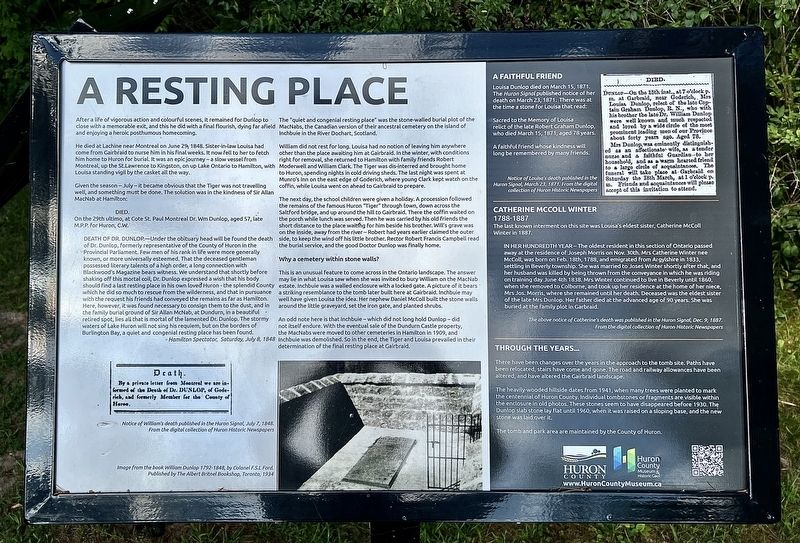
Photographed by Tim Boyd, August 22, 2025
1. A Resting Place Marker
After a life of vigorous action and colourful scenes, it remained for Dunlop to close with a memorable exit, and this he did with a final flourish, dying far afield and enjoying a heroic posthumous homecoming.
He died at Lachine near Montreal on June 29, 1848. Sister-in-law Louisa had come from Gairbraid to nurse him in his final weeks. It now fell to her to fetch him home to Huron for burial. It was an epic journey - a slow vessel from Montreal, up the St.Lawrence to Kingston, on up Lake Ontario to Hamilton, with Louisa standing vigil by the casket all the way.
Given the season - July - it became obvious that the Tiger was not travelling well, and something must be done. The solution was in the kindness of Sir Allan MacNab at Hamilton:
DIED.
On the 29th ultimo, at Cote St. Paul Montreal Dr. Wm Dunlop, aged 57, late M.P.P. for Huron, C.W.
DEATH OF DR. DUNLOP.-Under the obituary head will be found the death of Dr. Dunlop, formerly representative of the County of Huron in the Provincial Parliament. Few men of his rank in life were more generally known, or more universally esteemed. That the deceased gentleman possessed- Hamilton Spectator, Saturday, July 8, 1848literary talents of a high order, a long connection with Blackwood's Magazine bears witness. We understand that shortly before shaking off this mortal coil, Dr. Dunlop expressed a wish that his body should find a last resting place in his own loved Huron - the splendid County which he did so much to rescue from the wilderness, and that in pursuance with the request his friends had conveyed the remains as far as Hamilton. Here, however, it was found necessary to consign them to the dust, and in the family burial ground of Sir Allan McNab, at Dundurn, in a beautiful retired spot, lies all that is mortal of the lamented Dr. Dunlop. The stormy waters of Lake Huron will not sing his requiem, but on the borders of Burlington Bay, a quiet and congenial resting place has been found.
Click or scan to see
this page online
The "quiet and congenial resting place" was the stone-walled burial plot of the MacNabs, the Canadian version of their ancestral cemetery on the island of Inchbuie in the River Dochart, Scotland.
William did not rest for long. Louisa had no notion of leaving him anywhere other than the place awaiting him at Gairbraid.
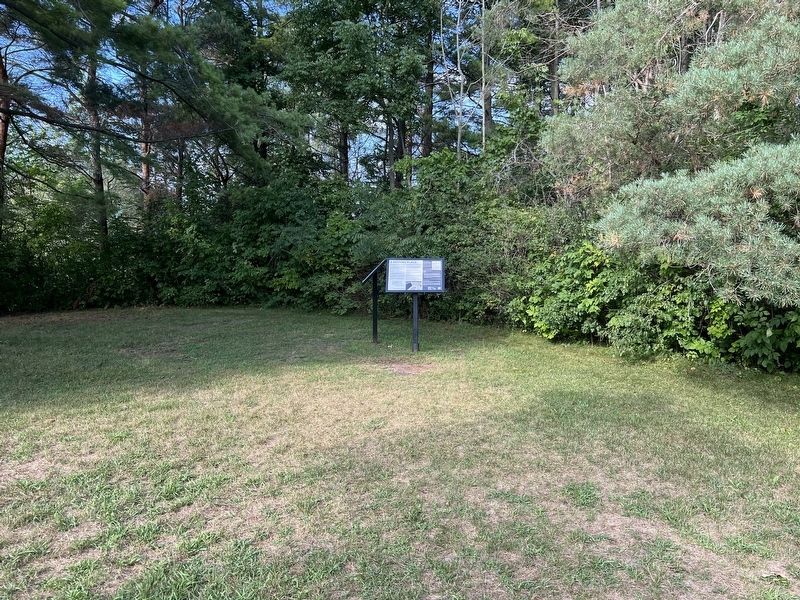
Photographed by Tim Boyd, August 22, 2025
2. A Resting Place Marker
Facing north, toward the rail trail
The next day, the school children were given a holiday. A procession followed the remains of the famous Huron "Tiger" through town, down across the Saltford bridge, and up around the hill to Gairbraid. There the coffin waited on the porch while lunch was served. Then he was carried by his old friends the short distance to the place waiting for him beside his brother. Will's grave was on the inside, away from the river - Robert had years earlier claimed the outer side, to keep the wind off his little brother. Rector Robert Francis Campbell read the burial service, and the good Doctor Dunlop was finally home.
Why a cemetery within stone walls?
This is an unusual feature to come across in the Ontario landscape. The answer may lie in what Louisa saw
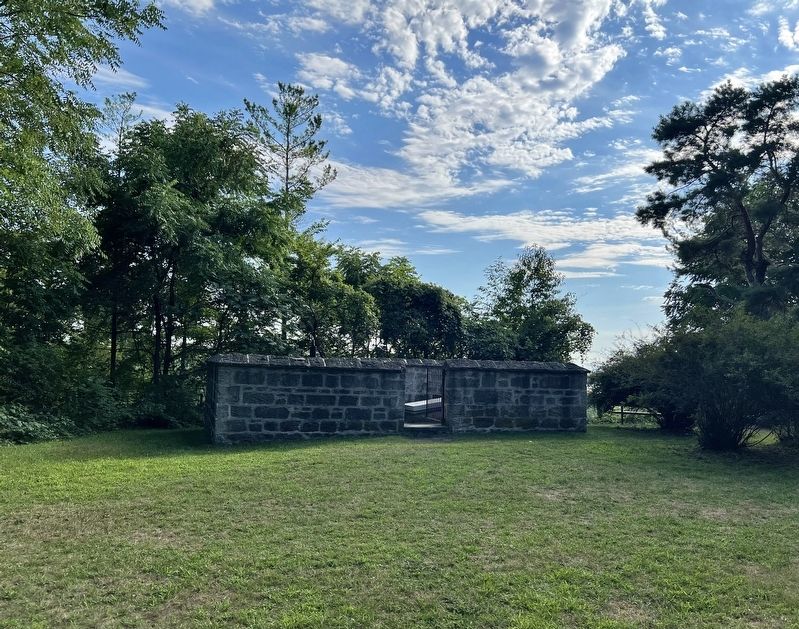
Photographed by Tim Boyd, August 22, 2025
3. The Dunlop enclosed tomb, 2025
An odd note here is that Inchbuie - which did not long hold Dunlop - did not itself endure. With the eventual sale of the Dundurn Castle property, the MacNabs were moved to other cemeteries in Hamilton in 1909, and Inchbuie was demolished. So in the end, the Tiger and Louisa prevailed in their determination of the final resting place at Gairbraid.
A Faithful Friend
Louisa Dunlop died on March 15, 1871. The Huron Signal published notice of her death on March 23, 1871. There was at the time a stone for Louisa that read:
Sacred to the Memory of Louisa relict of the late Robert Graham Dunlop, who died March 15, 1871, aged 78 years.
A faithful friend whose kindness will long be remembered by many friends.
Catherine McColl Winter
1788-1887
The last known interment on this
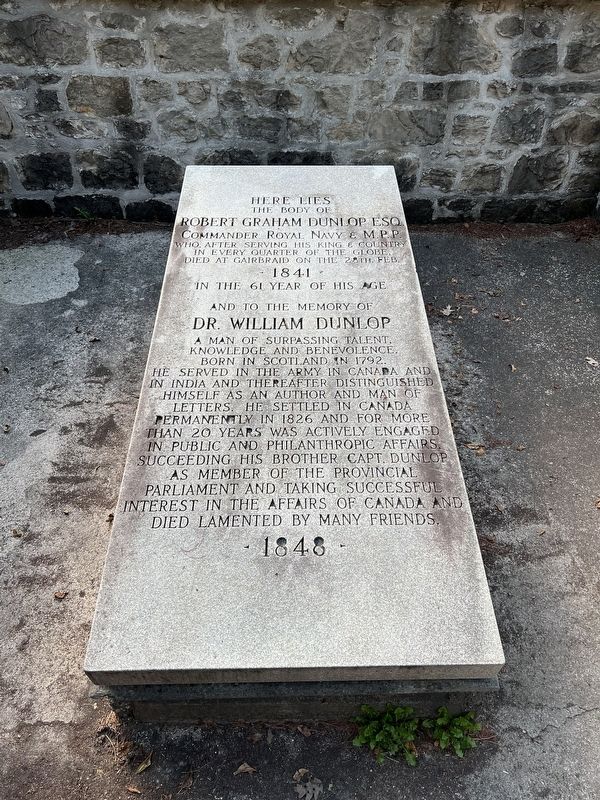
Photographed by Tim Boyd, August 22, 2025
4. William and Robert Dnlop’s marker stone
IN HER HUNDREDTH YEAR - The oldest resident in this section of Ontario passed away at the residence of Joseph Morris on Nov. 30th. Mrs Catherine Winter nee McColl, was born on Feb. 18th, 1788, and emigrated from Argylshire in 1833 settling in Beverly township. She was married to Joses Winter shortly after that and her husband was killed by being thrown from the conveyance in which he was riding on training day June 4th 1838. Mrs Winter continued to live in Beverly until 1860, when she removed to Colborne, and took up her residence at the home of her niece, Mrs Jos. Morris, where she remained until her death. Deceased was the eldest sister of the late Mrs Dunlop. Her father died at the advanced age of 90 years. She was buried at the family plot in Garbraid.The above notice of Catherine's death was published in the Huron Signal, Dec. 9, 1887. From the digital collection of Huron Historic Newspapers
Through the Years
There have been changes over the years in the approach to the tomb site. Paths have been relocated, stairs have come and gone. The road and railway allowances have been altered, and have altered the Gairbraid landscape.
The heavily-wooded hillside dates from 1941, when many trees were planted to mark the centennial of Huron County. Individual tombstones or fragments are visible within the enclosure in old photos. These stones seem to have disappeared before 1930. The Dunlop slab stone lay flat until 1960, when it was raised on a sloping base, and the new stone was laid over it.
The tomb and park area are maintained by the County of Huron.
Erected by Huron County.
Topics. This historical marker is listed in this topic list: Cemeteries & Burial Sites. A significant historical date for this entry is March 15, 1871.
Location. 43° 45.549′ N, 81° 42.076′ W. Marker is in Goderich, Ontario, in Huron County. It can be reached from River Ridge Crescent. The marker is accessible by foot from the Goderich to Auburn Rail Trail, approx. 350 metres east of the parking area at the end of River Ridge Crescent. Touch for map. Marker is at or near this postal address: 33981A River Ridge Crescent, Goderich ON N7A 3Y2, Canada. Touch for directions.

Regionally, this marker is in the Huron-Perth-Waterloo-Wellington Area and in Southwestern Ontario. It is also in Central Canada. Globally, it is in North America, on the Great Lakes, in the Western Hemisphere, in the Western World, and in the Anglosphere. Historically, it finds itself in what was once a British colony, the Viceroyalty of New France, the Haudenosaunee (Iroquois) Confederacy, and Rupert’s Land.
Other nearby markers. At least 8 other markers are within walking distance of this marker: The Tomb on Dunlop’s Hill (here, next to this marker); “Tiger” Dunlop 1792-1848 (within shouting distance of this marker); Gairbraid: the Dream & the Memory (within shouting distance of this marker); Days of the Canada Company (within shouting distance of this marker); Life and Times (within shouting distance of this marker); Sky Harbour (approx. 0.9 kilometers away); The British Commonwealth Air Training Plan (approx. 0.9 kilometers away); Huron County Gaol (approx. 1.2 kilometers away). Touch for a list and map of all markers in Goderich.
Credits. This page was last revised on September 8, 2025. It was originally submitted on August 24, 2025, by Tim Boyd of Hamilton, Ontario. This page has been viewed 65 times since then and 18 times this year. Photos: 1, 2, 3, 4. submitted on August 24, 2025, by Tim Boyd of Hamilton, Ontario. • Andrew Ruppenstein was the editor who published this page.
